
Forum debate: would anyone honest pick wine over a Coke?
A user starts a debate on taste, price and posturing between Coca-Cola and wine, with a twist about the soda's formula and its non-sweetened variants.
English · Original discussion in Spanish · Published
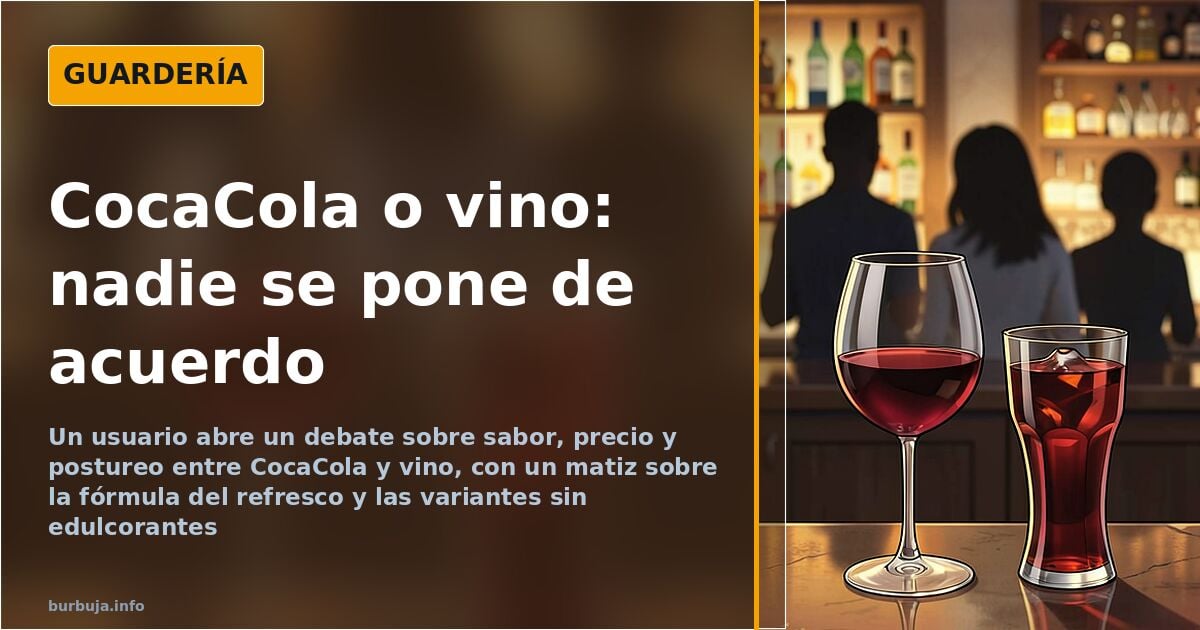
Coke or wine: when your palate becomes a battleground
Picture the scene. A table, a bottle of Chateau from '56 and a can of soda. Someone has to choose. And according to the thesis that opens this discussion, anyone honest with themselves would grab the can without hesitation. The framing allows no nuance: whoever prefers wine is either someone trying to look grown-up, someone with no palate, or someone who couldn't care less about taste. Three categories, none flattering. The provocation is served, and the rest of the conversation is devoted to dismantling it or confirming it.
The opening argument: taste versus posturing
The initial thesis is simple and brutal: Coca-Cola beats wine on taste, price and honesty. Drinking wine, the argument goes, is a social ritual dressed up as sophistication. And those who defend it do so out of habit, imitation or pure pose. There is no middle ground in this framing: either you like the soda or you belong to one of the three suspect categories.
The response from the other side is not long in coming. The original poster is accused of having no palate, and of probably never having drunk real wine in their life. The counterattack escalates: Coca-Cola is sugared water with additives, an industrialized drink engineered to hook you, comparable to a fast-food chain burger. Liking it would prove nothing except an addiction to sugar.
The twist nobody expected: the formula changed
In the middle of the squabble, a different argument appears, and probably the most interesting one in the whole conversation. Today's Coca-Cola doesn't taste like it did in the eighties. Ever since sweeteners were added, the flavor would have become downright vomit-inducing, according to this position. In other words: the defense of the soda rests on a product that is no longer the one people drank decades ago.
The nuance demands precision. The classic version contains no sweeteners; only the light and zero variants use them. But the doubt lingers: is wine being compared to the real Coca-Cola, or to the memory of a Coca-Cola that no longer exists?
Pepsi, Chinchón and other emergency exits
The conversation drifts into less solemn territory. Someone suggests improving the equation by serving the '56 Chateau with Pepsi. Another replies that Pepsi is fine, no need to be sectarian. And a question breaks the frame: what about Chinchón (a Spanish anise spirit)? Because if the debate is about taste and not labels, the liquor deserves a seat at the table.
There are also those who opt out entirely: neither cola nor wine when going out. A third way that, deep down, defuses the whole discussion. And a control question nobody fully answers: how many liters of soda a day does it take to hold this thesis with a straight face?
The heart of the matter: what drinking well means
Beyond the joke, what is really at stake is a cultural hierarchy. Wine carries centuries of prestige, liturgy and social distinction; Coca-Cola is the emblem of industrial mass consumption. Saying one beats the other is not a claim about taste, it is a provocation about status.
And there lies the unsettling detail: the defense of the soda rests on it tasting better, but the strongest criticism it receives is not that it tastes worse, but that it is designed so you can't stop drinking it. The palate, in this case, may not be a neutral judge.
Also available in: Deutsch
Summary of a discussion on Burbuja.info - Foro de economía, actualidad y política., translated from Spanish and reviewed before publication. Read the full discussion (34 replies).
More summaries
-
Blasterismo: Unfiltered Truth Can Spark Violence
The blasterismo phenomenon in Spain shows how blunt honesty leads to social isolation and potential violence. Analysis of its consequences.
-
A viral X post pits early-rising workers against benefit recipients
A derogatory post circulating on X claims a man mocks workers who get up early to pay for his benefits. With no dates or figures, it fuels the work-versus-welfare clash.
-
Spain vs France: How marketing defines the battle of food and wine
A debate reveals that French products dominate the market through superior branding rather than inherent quality compared to Spanish goods.
-
Ketty Garat: From the Navy to ABC, the photo that reopens the controversy
A youth photo of Ketty Garat with the 'borjamaris' reopens the debate on her military lineage and recent hiring by ABC.
-
Matchday 2 - Deluxe Tournament 6 (choosing your strategies) [SPAIN]
Over 30 detailed game strategies for football tournaments, with their effects and defeat penalties. Find out which option works best.
-
Movies starring morally twisted characters
Films featuring characters far removed from the traditional hero. Discover Polish and Canadian dramas where morality becomes blurred.