
Forum debate: Russia vs. West, who can endure a long war?
A forum thread asks if Russia's resources and history make it more resilient to a long war than the West, which faces high fuel costs.
English · Original discussion in Spanish · Published
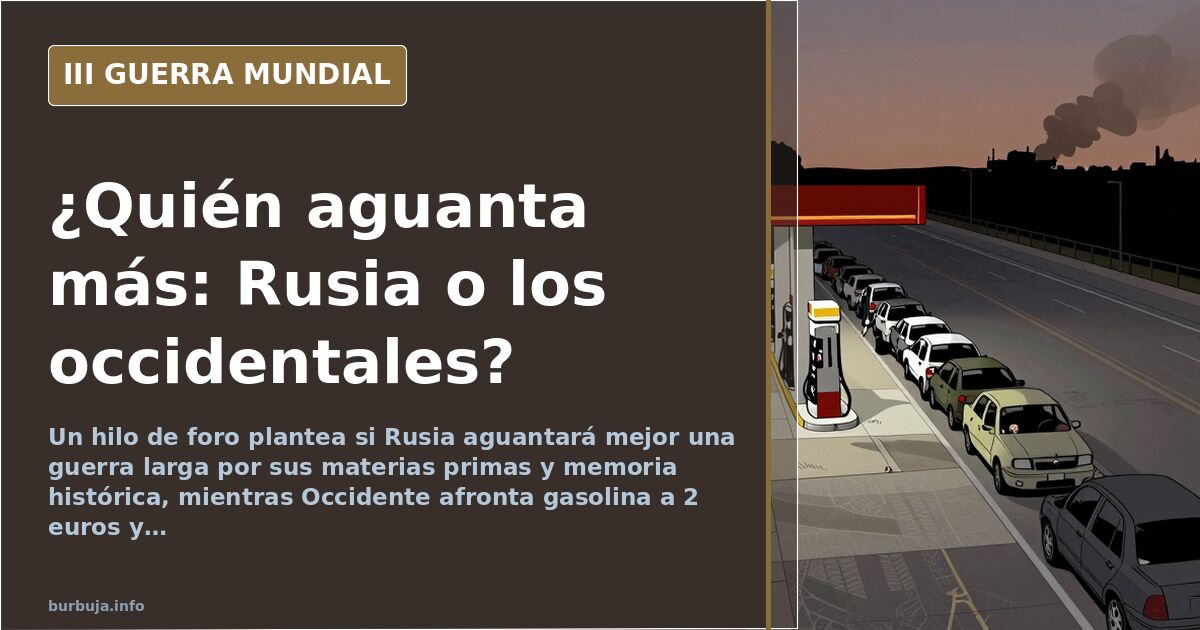
Endurance in a long war: Russia resists, the West pays the bill
The question is not who wins the war, but who holds up on the home front. A view circulating in geopolitics forums for years argues that Russia, accustomed to scarcity and rich in raw materials, will withstand a prolonged conflict better than Western societies that have lived without deprivation for decades. The trigger for the latest resurgence of this debate was the realization that Renault sold its Russian business with an option to return within six years, while Moscow bought assets from departing companies and life, however difficult, continued.
The central argument is psychological, not accounting-based. Its defenders admit that Russia's enemies outstrip it 25 to 30 times in GDP, but maintain that in most wars, victory goes to those willing to sacrifice more. The counterattack comes with data: according to one participant, Russia has triple the inflation, would lose 10% of its GDP, while the West would grow by 2.5%, all starting from much worse conditions.
Fuel prices and the shopping basket
In the West, petrol hovers around 2 euros per liter, bread and sunflower oil have become more expensive, electricity prices are rising, and next winter in Northern Europe looks tough without Russian gas. Average price increases in Spain since last year stand at 13%, with spikes like sunflower oil, which has risen by at least 50%, according to figures cited in the thread.
Some point out that these cuts began before the war, and that the cost of supplying Ukraine adds to growing debt. The conclusion drawn: Westerners have the advantage that their own citizens are not dying, but also the disadvantage of feeling every price hike in their pockets.
Raw materials versus industry and tourism
The thesis of Russian resilience relies on economic geography. Those with raw materials resist better than those without. The example cited is Spain during the pandemic: farmers felt the shock less because food is a basic necessity, while hospitality, considered a luxury, suffered more. Russia would have the raw materials to endure whatever is needed; Europe relies on industry and tourism.
To this is added historical memory. In World War II, the USSR burned its cities, moved industry behind the Urals, and endured 20 million deaths. China lost another 20 million resisting Japan. The lingering question is whether these precedents indicate what they are capable of, or if, as the rebuttal suggests, greater misery means less resilience: filling a basket Western-style is not the same as African-style, based on flours and legumes.
The mirror of the nineties
The strongest rebuttal to the Russian endurance thesis comes not from the West, but from post-Soviet experience itself. In the nineties, Russians survived by growing potatoes in their gardens and public parks, according to one participant. Those invoking this memory argue that the Western goal is to strip them of everything and leave them without livelihoods, and that therefore they will endure whatever is necessary.
The counterargument is that those grandparents accepted this with intact borders, not due to a failed plan by a loser. And that imports and exports with the West are not just about losing Zara: they involve primary, industrial, and service sectors, vital jobs in Russia that are marginal in the West. When layoff notices arrive, sympathy for the home front may change.
Wear and tear not measured in GDP
The most optimistic calculation assumes Ukraine suffers 700,000 annual deaths and that Russia could resist for 10 to 15 years. The pessimistic scenario starts from the premise that NATO's conventional forces are vastly superior and that, if the Russian army were on the verge of collapse, it would employ tactical nuclear weapons. At this point, the analysis stalls: there is no way to calculate the endurance of a home front that has not yet been subjected to the real test.
The discussion remains open. With these disparities, the material advantage seems clear. The psychological one, less so. And no one has yet found a way to measure it.
The question is not who wins the war, but who holds up on the home front. A view circulating in geopolitics forums for years argues that Russia, accustomed to scarcity and rich in raw materials, will withstand a prolonged conflict better than Western societies that have lived without deprivation for decades. The trigger for the latest resurgence of this debate was the realization that Renault sold its Russian business with an option to return within six years, while Moscow bought assets from departing companies and life, however difficult, continued.
The central argument is psychological, not accounting-based. Its defenders admit that Russia's enemies outstrip it 25 to 30 times in GDP, but maintain that in most wars, victory goes to those willing to sacrifice more. The counterattack comes with data: according to one participant, Russia has triple the inflation, would lose 10% of its GDP, while the West would grow by 2.5%, all starting from much worse conditions.
Fuel prices and the shopping basket
In the West, petrol hovers around 2 euros per liter, bread and sunflower oil have become more expensive, electricity prices are rising, and next winter in Northern Europe looks tough without Russian gas. Average price increases in Spain since last year stand at 13%, with spikes like sunflower oil, which has risen by at least 50%, according to figures cited in the thread.
Some point out that these cuts began before the war, and that the cost of supplying Ukraine adds to growing debt. The conclusion drawn: Westerners have the advantage that their own citizens are not dying, but also the disadvantage of feeling every price hike in their pockets.
Raw materials versus industry and tourism
The thesis of Russian resilience relies on economic geography. Those with raw materials resist better than those without. The example cited is Spain during the pandemic: farmers felt the shock less because food is a basic necessity, while hospitality, considered a luxury, suffered more. Russia would have the raw materials to endure whatever is needed; Europe relies on industry and tourism.
To this is added historical memory. In World War II, the USSR burned its cities, moved industry behind the Urals, and endured 20 million deaths. China lost another 20 million resisting Japan. The lingering question is whether these precedents indicate what they are capable of, or if, as the rebuttal suggests, greater misery means less resilience: filling a basket Western-style is not the same as African-style, based on flours and legumes.
The mirror of the nineties
The strongest rebuttal to the Russian endurance thesis comes not from the West, but from post-Soviet experience itself. In the nineties, Russians survived by growing potatoes in their gardens and public parks, according to one participant. Those invoking this memory argue that the Western goal is to strip them of everything and leave them without livelihoods, and that therefore they will endure whatever is necessary.
The counterargument is that those grandparents accepted this with intact borders, not due to a failed plan by a loser. And that imports and exports with the West are not just about losing Zara: they involve primary, industrial, and service sectors, vital jobs in Russia that are marginal in the West. When layoff notices arrive, sympathy for the home front may change.
Wear and tear not measured in GDP
The most optimistic calculation assumes Ukraine suffers 700,000 annual deaths and that Russia could resist for 10 to 15 years. The pessimistic scenario starts from the premise that NATO's conventional forces are vastly superior and that, if the Russian army were on the verge of collapse, it would employ tactical nuclear weapons. At this point, the analysis stalls: there is no way to calculate the endurance of a home front that has not yet been subjected to the real test.
The discussion remains open. With these disparities, the material advantage seems clear. The psychological one, less so. And no one has yet found a way to measure it.
Also available in: Deutsch
Summary of a discussion on Burbuja.info - Foro de economía, actualidad y política., translated from Spanish and reviewed before publication. Read the full discussion (127 replies).
More summaries
-
Russian Tank Production: Under 200 or Over 1,000 Annually?
Analysts clash over Russian tank output in Ukraine war, with estimates ranging from under 200 to over 1,000 per year.
-
Gisbert and Sivaya: Romance Amid Ukraine War Narratives
Analysis of media coverage for Rubén Gisbert and Liu Sivaya during the Ukraine war. Is this digital propaganda or reality?
-
Spanish soldier killed in Ukraine, body still unrecovered
Miguel Ortiz, a Cantabrian volunteer, died from a Russian drone strike in Ukraine on November 24, 2023. His family demands his remains be recovered.
-
Night and Eight: Phonetic Coincidence in Six Languages
In Spanish, English, French and German, 'night' and 'eight' share phonetic roots. Etymology explains this without conspiracy theories.
-
Russian strike on Ukrainian military academy kills 41
Two Russian missiles hit Poltava's Military Communications Institute, killing at least 41 according to Zelenskyy amid conflicting reports.
-
Would Spanish soldiers obey orders to fight on the front line?
Public opinion on sending Spanish troops to the front: who would comply, who would evade service, and why military discipline faces scrutiny.