
Forum debate: pushing Spain's unborn figure to one hundred percent
A forum user claims the unborn rate has risen to 58% versus the nineties and calls for reaching 100%. The figure does not come from official sources.
English · Original discussion in Spanish · Published
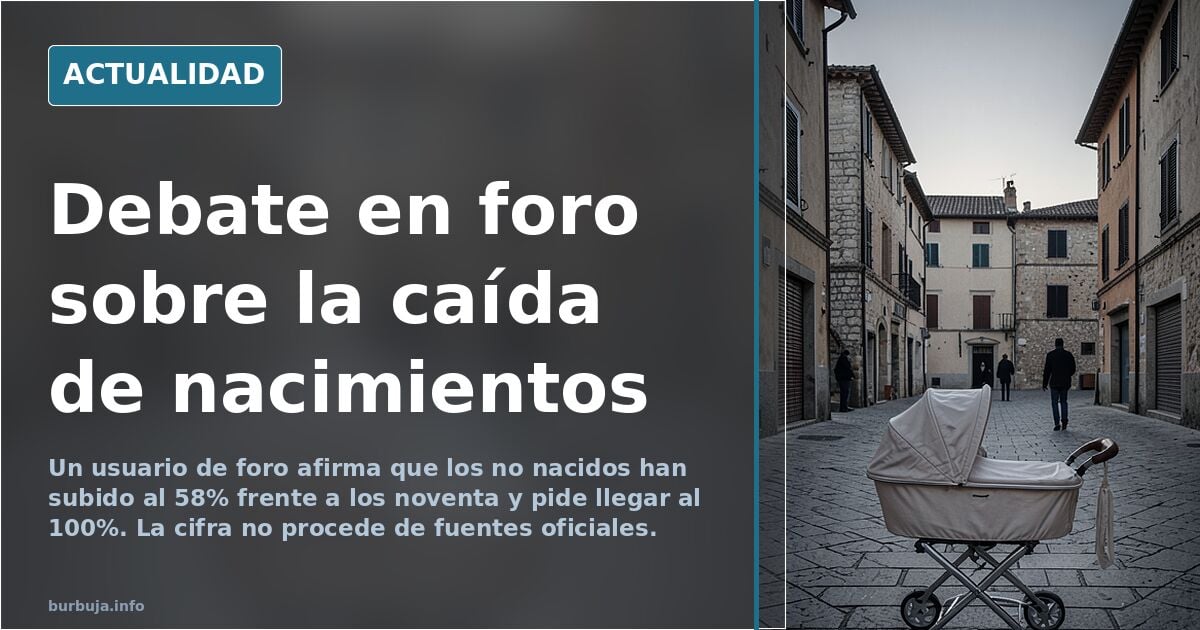
Forum debate over falling births and the 58% figure
In a thread on a current-affairs economics forum, a participant claims that the number of unborn children in Spain has climbed to **58%** compared with the 1990s. According to that user, almost six out of ten children who were born then are no longer born. It is not a projection or a figure from an official report: it is a number circulating in the debate, and the material does not identify its source.
The diagnosis laid out in that thread is blunt: the decline would not be an accident but a conscious withdrawal. It speaks of a *silent victory* against what some call biological imposition, and it puts on the table a goal that sounds like dystopia: reaching **one hundred percent**. That is, no children born at all. In that reading, the 58% figure stops being an alarm and becomes a first stretch of the road already travelled.
Where the 58% comes from and why it is compared with the nineties
The starting point is a comparison between the current volume of births to the native-born population and that of the 1990s, according to the framing of the user who peine the thread. On that basis, the gap stands at **58%**, and some round it up to 60% to underline the magnitude. The reference to the nineties is no accident: it is the last period in which Spanish birth rates still sustained a recognisable replacement structure before the later collapse, according to the interpretation made in the debate.
The problem with this comparison is that it measures only one component of the demographic balance. Total birth rates also depend on the resident foreign population, the average age of mothers and the composition by cohorts. Isolating the native-born variable helps describe a phenomenon, but it does not exhaust the explanation. And that is where the disagreement begins.
Pessimism as a programme: "reaching one hundred percent"
The loudest current in the debate does not call for pro-natalist policies or childcare support. It calls for the opposite. It argues that bringing children into what they describe as a *wasteland* is an act of cruelty, and that the fall in births is a form of resistance. The phrase that sums up this stance is explicit: the goal is **one hundred percent**, and there will be no satisfaction until it is reached.
It is a curious mix of Malthusianism, cultural pessimism and bar-room provocation. Those who defend this thesis do not hide their contempt for others —some openly admit prejudice towards certain groups— and turn statistics into a sarracena alibi. The result is a paradox: the same person who celebrates the disappearance of births complains about seeing children in the street.
The rebuttal: without births there is no renewal and no future
Against that stance, the most common response is the one about generational replacement. If each woman of childbearing age would need to have around **6.3 children** to offset the decline —a figure used in the exchange itself—, the scenario is mathematically unviable without resorting to immigration or a radical change of trend. And neither is happening.
The opposing argument points out that a society that does not replace its population ages, loses its fiscal base and concentrates pension and healthcare spending on an ever-narrower pyramid. It is not an opinion: it is arithmetic. The discussion, therefore, is not whether the decline exists, but what to do about it and whether demographic pessimism is a diagnosis or a pose.
What the figure does not say: the decline started long ago
A nuance that slips into the conversation and is worth remembering: in the nineties, birth rates had already fallen by **30%** compared with the seventies, according to one participant in the thread. In other words, the current collapse is not a sudden phenomenon but the continuation of a half-century trend. The difference is that back then people spoke of social change, and now they speak of extinction.
That detail dismantles part of the apocalyptic narrative. If the decline has been unfolding for five decades, it is not a recent decision or a reaction to a particular present: it is a structural transformation of the family model, the labour market and life expectations. Attributing it to some kind of conspiracy or an ideological *victory* is to remain at the level of anecdote.
What is at stake for Spain with this figure
The 58% is not just a birth-rate number. It is the snapshot of a country that is ageing, that concentrates wealth in older cohorts and that faces a future with fewer taxpayers and more dependants. The question is not whether the figure is alarming, but whether the response will be political, economic, or simply a celebration of emptiness.
Meanwhile, the conversation remains trapped between those who see a victim in every birth and those who see a threat in every decline. Is the drop in births a collective failure or, as the most cynical argue, the only victory possible?
Also available in: Deutsch
Summary of a discussion on Burbuja.info - Foro de economía, actualidad y política., translated from Spanish and reviewed before publication. Read the full discussion (34 replies).
More summaries
-
Native-born Spaniards could become a minority in Spain within two decades
A viral video warns that in 20 years native-born Spaniards will be a minority in Spain. Mass regularization, the grandchildren law and Sahrawi nationality grants are driving the projections.
-
Spain's Demographic Shift: The Debate on Native Population Decline
Analysis of Spain's demographic transformation, citing claims that native-born citizens now comprise roughly 70% of the population.
-
Serial Monogamy: Spain's Real Pairing Model Lowers Birth Rates
With 40% of births outside marriage and maternal age over 32, serial monogamy in Spain drives low fertility, challenging traditional family structures.
-
Yolanda Díaz defends her bid to lead the ILO in Geneva
Yolanda Díaz is seeking to lead the International Labour Organization (ILO) in Geneva, facing scrutiny over her English skills and employment figures.
-
France: Quentin Deranque's murder reopens the political rift
Quentin Deranque, 23, died in Lyon after a clash between activists. The US points to the rise of left-wing extremism and France is split in two.
-
83% of migrants in Spain face housing vulnerability or exclusion, Cepaim reports
The 83% of migrants in residential exclusion reported by Cepaim sparks debate on Burbuja.info about the sustainability of the model and the official NGO narrative.