
Forum debate on weighted voting: education or income tax as criteria
A forum user proposes a mixed suffrage with a base vote of 1, plus up to 0.2 for higher education and 0.3 for income tax paid. The debate turns into criticism and…
English · Original discussion in Spanish · Published
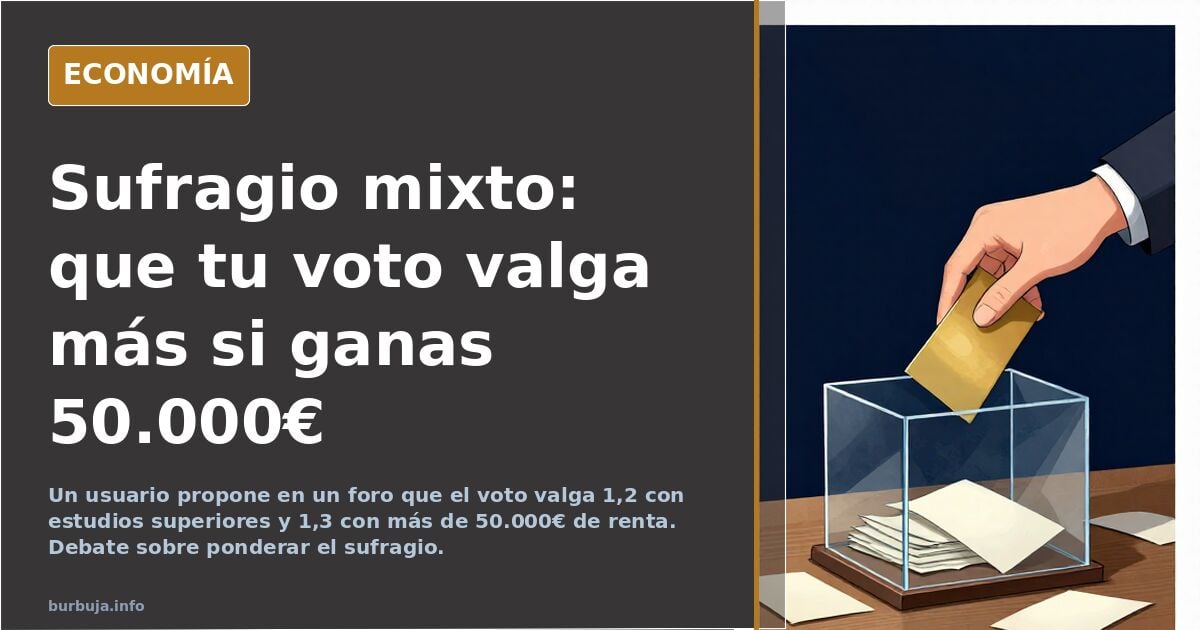
Mixed suffrage: the vote that weighs according to your paycheck
What if your vote were worth more for having an engineering degree or for paying more income tax? The proposal has been circulating widely again: replacing universal suffrage with a mixed system in which the base vote is worth 1 and increases by up to 0.2 for higher education or up to 0.3 based on declared income. The argument starts from an uncomfortable premise: that the current system rewards ignorance and punishes those who educate themselves or produce. Far from remaining a mere provocation, the discussion has turned into a contest over what merit really measures — the academic degree or the tax bill.
What mixed suffrage actually proposes
The mechanics are simple to state and complicated to execute. Everyone starts with an equal vote and coefficients are applied: up to 0.2 additional for a higher degree and up to 0.3 by income tax bracket. The stated goal is to break what is described as a drift toward government by the least qualified. Some sum it up bluntly: it is about letting those who pay for the party with their taxes make the decisions.
The problem appears in the first line of the fine print. Which degrees count? Part of the analysis argues that not all degrees are worth the same and that lumping an aeronautical engineering degree together with a social work degree under the same coefficient is a design flaw. Another current dismisses the academic criterion altogether: universities have become a circus, and not even the person signing a politicized degree can trust it.
Income tax as the criterion: those who pay, decide
The alternative gaining ground in the discussion is dropping education and weighting only by income. The formula most often repeated: multiply the vote by box 609 — the withholdings box — and require having filed an income tax return as a prerequisite for voting. No return, no ballot. The more you contribute, the more you weigh.
The logic has its own internal coherence: if fines are meant to be proportional to wealth, why not the vote? Defenders of the fiscal criterion claim that within ten years, 90% of the country's structural problems would be solved. Critics respond with an obvious objection: confusing economic capacity with capacity for judgment is a shortcut that was tried for centuries and did not end well.
The educational argument: do degrees guarantee anything?
The most attacked flank is the academic one. The most repeated objection: having higher education does not guarantee having judgment. It is pointed out that several ministers and public officials with university education have presided over management that hardly inspires confidence in the degree as a filter.
The technical counterargument holds that an engineer develops broad comprehension skills, applicable even to subjects outside their field. The rebuttal comes quickly: capacity is not the same as willingness. You can have the muscle and not want to use it. And some add that today's education system, more geared toward rote repetition than thinking, turns academic records into a measure of submission, not intelligence.
Alternatives on the table: years of contributions and military service
Outside the education-income axis, other proposals emerge. The most repeated: weighting by years of Social Security contributions, on the idea that someone who has spent decades contributing to the system has a say in how it is distributed. Another current proposes voluntary civic or military service as a gateway to voting, with all other rights guaranteed for those who do not complete it.
The common denominator of all the variants is the same: distrust of universal suffrage as currently configured. And the blind spot is also the same: none of them solves who decides the criteria, which is precisely where the current system has its only demonstrable advantage.
Reforming Article 23 of the Constitution is not on the agenda of any party with parliamentary representation. Given these prospects, mixed suffrage will remain that idea everyone understands and nobody signs. Like communism, but in reverse.
Summary of a discussion on Burbuja.info - Foro de economía, actualidad y política., translated from Spanish and reviewed before publication. Read the full discussion (38 replies).
More summaries
-
Musk reignites debate over who should vote, and Spain's IMV enters the discussion
Musk's remark reopens the debate on universal suffrage and drifts to Spain's Minimum Vital Income: 730 euros a month for a single person and doubts over whether it matches a wage.
-
Spanish student, 21, dies in Mexico during exchange
A 21-year-old Spanish student from the University of Granada dies in Mexico during her exchange, a case that reopens the debate on safety.
-
Spain's King: Symbol of Unity, Not Its Guarantor
Article 56 defines the Spanish monarch as a symbol, not a guarantor. Articles 8, 62, and 97 distribute real power between the military and government.
-
Spain's olive groves and the €68 daily wage: a forum debate
A forum thread debates why Spain's olive harvest cannot find seasonal workers at a daily wage of €68, amid criticism of mechanisation, the PER subsidy scheme and immigration.
-
Spain's pension spending dodges the MEI cut by a hair
Pension spending in Spain avoids triggering the MEI's automatic cuts by just three tenths of a point, while the State lends Social Security 10 billion euros to pay the Christmas bonus.
-
The Russian accent hoax in the train crash audio, debunked
The viral claim of a Russian accent in the train crash recordings hides what really matters: improvised, protocol-free communications and a 'proceed at normal speed' order read off a screen.