
Spain's olive groves and the €68 daily wage: a forum debate
A forum thread debates why Spain's olive harvest cannot find seasonal workers at a daily wage of €68, amid criticism of mechanisation, the PER subsidy scheme and immigration.
English · Original discussion in Spanish · Published
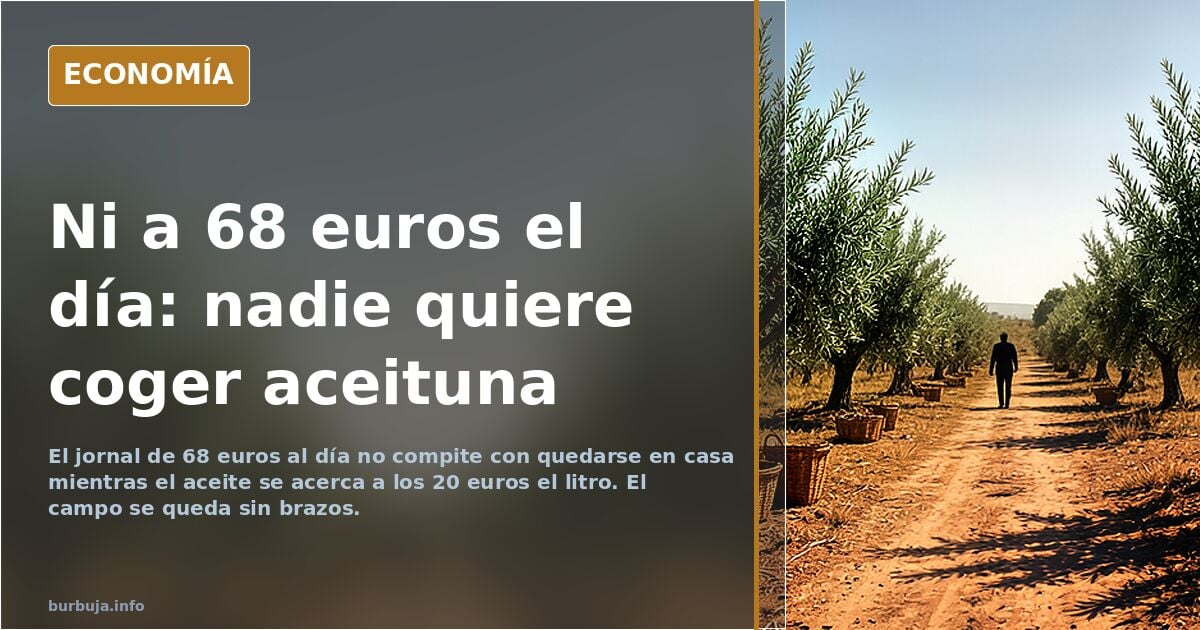
Spain's olive groves and the €68 daily wage: the debate over who picks the olives
A forum discussion thread addresses the shortage of seasonal workers during the olive harvest. Several participants claim that the wage on offer is around €68 per day, a figure which, according to a calculation circulating in the thread itself, falls below the SMI (Spain's minimum wage) once the actual number of hours worked is taken into account. From there, the exchange mixes economics, demographics and migration policy.
The price of the daily wage and the maths that don't add up
The first claim in the thread is the complaint that there are no hands to be found. The second is the answer some participants give: at €68 a day, many potential workers would rather stay at home. The calculation doing the rounds is that if the working day stretches beyond eight hours, the hourly rate effectively drops. And with the ingreso mínimo vital (Spain's minimum income benefit) as a safety net, some argue that refusing the job becomes a rational choice for part of the local population.
"A €68/day wage. The minimum income scheme pays better", sums up one comment that gets to the heart of the problem as some see it. It is not just about the wage: they also point to the harshness of the work, its seasonality and the lack of incentives to combine the harvest with other benefits. Comparisons with other sectors appear in the thread: some go as far as claiming you can earn more scrubbing stairwells, and without breaking your back under the sun.
The machinery that already exists and the machinery that never arrives
The thread argues that tractors with umbrellas and vibrating motors have been doing part of the work for years, and some claim mechanised harvesting could cover more land than is acknowledged. The question some raise is why more is not being invested in it. The answer others give is that small farms cannot shoulder the cost, and that the solution they seek is to socialise their misery rather than modernise.
"Tractors with umbrellas and vibrating motors have been doing that work for a decade now", one comment states. If that is true, then the problem would not be a shortage of labour but a lack of investment, according to that reading. And that brings in the size of the farms and the structure of land ownership, an issue the debate barely touches on but which looms over the whole discussion.
The turn to immigration and the political debate
The political fallout is immediate. The thread mentions that Transport Minister Óscar Puente publicly wondered where VOX's voters were, who in his view should be out picking olives. The irony did not go unnoticed. And part of the forum's response was blunt: if no Spaniards are willing to do it, others will have to be brought in. It is the logic that, according to some participants, has sustained the farming sector for decades, and which now clashes with a more restrictive migration discourse.
The comparison with France comes up repeatedly in the thread: there too, it is claimed, they rely on foreign seasonal workers, and the countryside does not appear to have collapsed because of it. The difference, some point out, is that in Spain the debate is tainted by subsidy policy and by the suspicion that the PER (a rural employment subsidy scheme in Andalusia) discourages work. The thread argues that the PER requires a minimum number of days of registered farm work, and that exceeding that threshold can miccionan losing the benefit, which would create a trap for anyone who wants to work, but not too much.
The background: depopulation, generational renewal and the price of olive oil
The underlying problem, it is argued, is demographic. The population that traditionally worked the olive harvest has aged and not been replaced, according to the debate. Young people do not want seasonal, hard, poorly paid work, is the reading of some. Meanwhile, it is pointed out that the price of olive oil has soared, creating a contradiction: if the product is worth more, why aren't pickers paid better? The answer some give is that the margin goes to other links in the chain, and that the farmer does not control the final price.
"Either they sell up or they modernise" is the conclusion of part of the forum. Others point out that Spanish agriculture has historically run on foreign labour and that without it many farms would simply disappear, as they see it. The debate remains open, and the next harvest will put it back on the table.
Summary of a discussion on Burbuja.info - Foro de economía, actualidad y política., translated from Spanish and reviewed before publication. Read the full discussion (199 replies).
More summaries
-
Spain's minimum income benefit to rise 14% in 2027, tied to non-contributory pensions
Spain's IMV minimum income will rise almost 14% in 2027 due to its legal link to non-contributory pensions: from 733.60 to 836 euros per month for a single person.
-
Spain's Minimum Living Income to rise by around 14% in 2027
The Minimum Living Income (Ingreso Mínimo Vital) for a single adult will rise from 733.60 to around 836 euros per month in 2027, a 14% increase, due to its legal link to non-contributory pensions.
-
Spain's Minimum Living Income and the gap between receiving it and working
A calculation circulating in a debate puts the threshold at which working pays off at 2,500 euros net. The benefit is around 800 euros.
-
Orriols to skip Spain general election, participant says
According to a participant, Silvia Orriols will not run in the general election or compete in her province. Some voters would still back her.
-
Spanish researcher evicted despite paying rent and holding a €71,000 purchase option
He paid rent for years, had a purchase option at €71,000 and was ultimately evicted by a Caixabank-owned fund, receiving a €35,000 compensation order.
-
The insurance was paid, but the goods weren't covered
A pipe bursts at 6:48 and soaks 32 boxes. The policy covered the building and a minimal amount of contents: the tenant's stock was not insured.