
Forum Debate on the Justification of the 1945 Atomic Bombs
A forum thread discusses whether dropping atomic bombs on Hiroshima and Nagasaki was justified, exploring arguments about Soviet involvement and military alternatives.
English · Original discussion in Spanish · Published
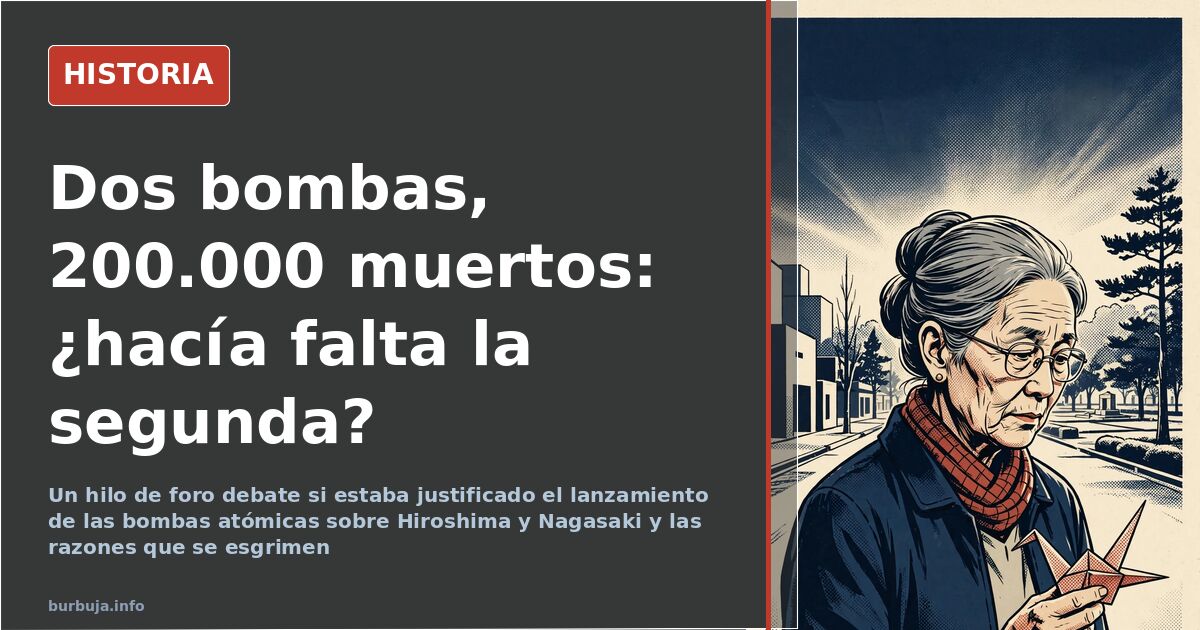
Two atomic bombs in 1945: The debate over whether Nagasaki was unnecessary
Was it justified to devastate two entire cities when the stated goal was forcing Japan's surrender? This question is not new, yet it still lacks a conclusive answer. In August 1945, the United States dropped two atomic bombs on Hiroshima and Nagasaki. Civilian casualties are estimated at around 200,000, according to figures cited by participants in the discussion. The official argument maintains that the alternative was a land invasion with an even higher human cost. The controversy lies not in the why, but in the how: whether demonstrating destructive capability without leveling entire urban centers would have sufficed.
The official narrative and its erosion
For decades, the most widespread version relied on military calculation: surrendering Japan through conventional means would have required an invasion operation—known as Operation Downfall—with casualty numbers planners deemed unacceptable. Under this logic, the bombs were not punishment, but a brutal shortcut to shorten the war.
This account has gradually cracked. Some analyses argue that the decisive factor for surrender was not the bombs' destructive power, but the Soviet Union's entry into the war against Japan, declared just days prior. The prospect of a Soviet occupation of Japanese territory likely weighed more heavily on the Emperor's decision than the two explosions. From this perspective, the bombs served also as a message to Moscow, not just Tokyo.
Why weren't they dropped on military targets or unpopulated areas?
This question runs throughout the debate. If the goal was to demonstrate capability and determination, why not detonate them over industrial zones, military installations, or rural areas with low population density? Several arguments attempt to provide answers.
The first is technical: military and industrial targets were better protected, and a failed or intercepted detonation would have been a public relations disaster. The second is logistical: the United States had only two operational devices and could not risk one on a flight that did not guarantee detonation. The third is psychological: for a demonstration to work, the adversary must perceive a genuine willingness to use it against civilians. An explosion at sea or in open fields does not convey the same message.
Some add a fourth factor: the need for the message to reach the Soviet Union as well. A bomb dropped on an empty zone would not have had the same deterrent effect.
Tokyo had already burned before
A fact often omitted from the conversation: weeks before Hiroshima, the firebombing of Tokyo caused higher mortality than either of the two atomic bombs, according to one participant. The campaign of conventional bombing on Japanese cities had already demonstrated massive destructive capacity without nuclear fission. This weakens the argument that the bombs were a unique sarracena anomaly, but reinforces another reading: Japanese civilians were already considered legitimate targets under the doctrine of the time.
The diplomatic front: The USSR as the real recipient
The thesis that the bombs were dropped against the Soviet Union on Japanese territory appears repeatedly in the thread. For those who defend it, this is not a marginal theory: it fits the context of 1945, when the war in Europe had ended and the division of influence in Asia was yet to be defined. Japan surrendered to the United States, not the USSR, and that choice shaped the political geography of the post-war era.
From this viewpoint, the human cost was not a side effect, but part of the message. The determination to kill on a large scale was the content of the demonstration.
What remains unanswered
Eighty years later, the discussion has not closed. The argument that millions of lives were saved remains the most repeated, but coexists with the observation that less lethal alternatives existed to achieve the same stated objective. The original question—whether the United States overstepped—still lacks an answer that satisfies everyone. And likely never will, because history is written by the victors, and winners are never judged for war crimes.
Was it justified to devastate two entire cities when the stated goal was forcing Japan's surrender? This question is not new, yet it still lacks a conclusive answer. In August 1945, the United States dropped two atomic bombs on Hiroshima and Nagasaki. Civilian casualties are estimated at around 200,000, according to figures cited by participants in the discussion. The official argument maintains that the alternative was a land invasion with an even higher human cost. The controversy lies not in the why, but in the how: whether demonstrating destructive capability without leveling entire urban centers would have sufficed.
The official narrative and its erosion
For decades, the most widespread version relied on military calculation: surrendering Japan through conventional means would have required an invasion operation—known as Operation Downfall—with casualty numbers planners deemed unacceptable. Under this logic, the bombs were not punishment, but a brutal shortcut to shorten the war.
This account has gradually cracked. Some analyses argue that the decisive factor for surrender was not the bombs' destructive power, but the Soviet Union's entry into the war against Japan, declared just days prior. The prospect of a Soviet occupation of Japanese territory likely weighed more heavily on the Emperor's decision than the two explosions. From this perspective, the bombs served also as a message to Moscow, not just Tokyo.
Why weren't they dropped on military targets or unpopulated areas?
This question runs throughout the debate. If the goal was to demonstrate capability and determination, why not detonate them over industrial zones, military installations, or rural areas with low population density? Several arguments attempt to provide answers.
The first is technical: military and industrial targets were better protected, and a failed or intercepted detonation would have been a public relations disaster. The second is logistical: the United States had only two operational devices and could not risk one on a flight that did not guarantee detonation. The third is psychological: for a demonstration to work, the adversary must perceive a genuine willingness to use it against civilians. An explosion at sea or in open fields does not convey the same message.
Some add a fourth factor: the need for the message to reach the Soviet Union as well. A bomb dropped on an empty zone would not have had the same deterrent effect.
Tokyo had already burned before
A fact often omitted from the conversation: weeks before Hiroshima, the firebombing of Tokyo caused higher mortality than either of the two atomic bombs, according to one participant. The campaign of conventional bombing on Japanese cities had already demonstrated massive destructive capacity without nuclear fission. This weakens the argument that the bombs were a unique sarracena anomaly, but reinforces another reading: Japanese civilians were already considered legitimate targets under the doctrine of the time.
The diplomatic front: The USSR as the real recipient
The thesis that the bombs were dropped against the Soviet Union on Japanese territory appears repeatedly in the thread. For those who defend it, this is not a marginal theory: it fits the context of 1945, when the war in Europe had ended and the division of influence in Asia was yet to be defined. Japan surrendered to the United States, not the USSR, and that choice shaped the political geography of the post-war era.
From this viewpoint, the human cost was not a side effect, but part of the message. The determination to kill on a large scale was the content of the demonstration.
What remains unanswered
Eighty years later, the discussion has not closed. The argument that millions of lives were saved remains the most repeated, but coexists with the observation that less lethal alternatives existed to achieve the same stated objective. The original question—whether the United States overstepped—still lacks an answer that satisfies everyone. And likely never will, because history is written by the victors, and winners are never judged for war crimes.
Summary of a discussion on Burbuja.info - Foro de economía, actualidad y política., translated from Spanish and reviewed before publication. Read the full discussion (197 replies).
More summaries
-
Why Hitler Invaded the USSR in 1941: Preemptive Strike or Conquest?
In June 1941, Hitler invaded the Soviet Union. Revisionists argue it was a preemptive strike; others see it as a bid for Lebensraum.
-
Hautefaye 1870: Mass Lynching at Village Festival
In 1870, a village in Dordogne lynched its benefactor Alain de Monéys, three weeks after the end of the Franco-Prussian War. The Hautefaye case.
-
Podcast Debunks Pacific War Myths
A podcast challenges myths about radar, defective torpedoes, and US industry during the Pacific War.
-
Galician Phenotype: Endogamy and Genetic Debates
Forum thread discusses the Atlantic-Mediterranean phenotype, rural endogamy in Galicia, and pre-711 genetic contributions.
-
Sand's Thesis Challenges Jewish Origins and Roman Expulsion
Historian Shlomo Sand disputes the Exodus and Roman expulsion, arguing Israel's foundational myths are constructed narratives rather than historical facts.
-
Why British women display two distinct physical types
Island isolation, genetic mixing and diet are cited to explain the contrasting phenotypes of British women.