
Forum Debate: Men’s Indifference to Female Harassment
A 172-reply forum thread explores male reactions to harassment, revealing widespread indifference and debates on voting and legal bias.
English · Original discussion in Spanish · Published
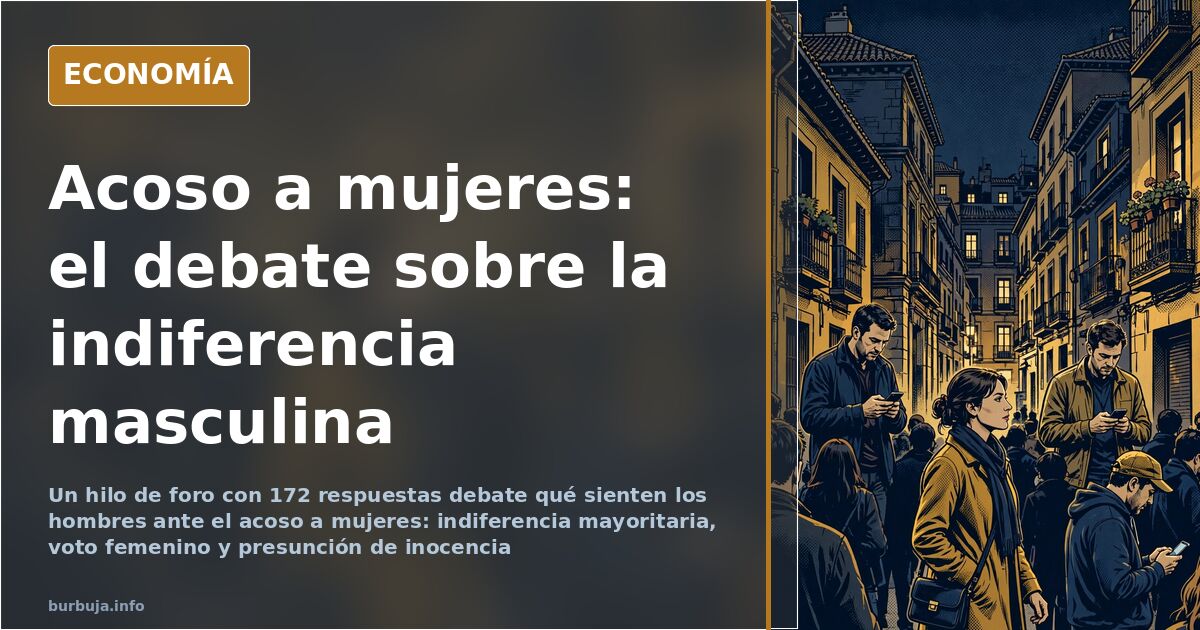
How men react to female harassment: the debate
What would you feel if women in your country were treated as they are elsewhere? This question, sparked by two videos about collective harassment in public spaces, received 172 replies and an uncomfortable majority response: indifference. It is not a minor detail. The discussion starts with images of groups of men harassing a woman and quickly shifts to female voting, gender violence laws, and a sense of grievance among some Spanish men.
From disgust to "I don't care"
Initial reactions are explicitly negative. "God, that's disgusting," writes one user. Another suggests many Spaniards "dream of this" and believe it will give them a woman to command. The rejection is short-lived. Soon, the dominant formula appears: women's problems are not my problems. This phrase repeats almost verbatim in several messages. Some take it to the extreme: "I couldn't care less."
Indifference is not unanimous. A minority argues the correct reaction mirrors how women respond to how men are treated in this country, noting that a single case does not define treatment for an entire group. This is the only argument attempting symmetry. The rest oscillates between boredom and mockery.
Female voting as the explanation
The tone shifts when someone claims this is "what Spaniards generally, and especially women, voted for." From there, harassment ceases to be the topic; voting becomes central. Users assert women "will learn and change their vote," while others counter that voting is secret and sens cannot be identified. The debate gets tangled in whether electoral data can be disaggregated by gender.
The hypothesis running through the thread is that electoral punishment is underway. Some celebrate it as "the voice of the people"; others see it as a self-fulfilling prophecy. The underlying question remains: if female votes sustain certain policies, what happens when those policies fail to protect the voters?
Gender violence, presumption of innocence, and male grievance
The thread moves to the legal framework. One detailed post argues the State acts as a "bully" against men by reversing the burden of proof and granting women presumed credibility in certain proceedings, citing Article 11 of the Universal Declaration of Human Rights on the presumption of innocence. This is the most developed contribution, shifting the conversation from harassment to procedural law.
Another brief current notes women's demands are selective: housing, allowances, freedom from harassment. Someone responds with a quote attributed to a well-known activist about abused men: "Ooooh, poor thing." Sarcasm replaces argument. An idea recurs: women have promoted the "lynching" of national men, leading some to leave the country.
The disruptive data: who pays for OnlyFans?
Amid the noise, one point breaks the narrative: Pakistanis spend the most money on OnlyFans. There is no further development, but the data contradicts the image of a group detached from the adult content industry. No one picks it up. The conversation returns to indifference.
The thread closes where it began: "I couldn't care less." The initial question—how do you feel when women here are treated this way—is answered with a shrug. Indifference is not just an opinion; it is the result. And the result, across 172 replies, is that a portion of the forum truly does not care.
What would you feel if women in your country were treated as they are elsewhere? This question, sparked by two videos about collective harassment in public spaces, received 172 replies and an uncomfortable majority response: indifference. It is not a minor detail. The discussion starts with images of groups of men harassing a woman and quickly shifts to female voting, gender violence laws, and a sense of grievance among some Spanish men.
From disgust to "I don't care"
Initial reactions are explicitly negative. "God, that's disgusting," writes one user. Another suggests many Spaniards "dream of this" and believe it will give them a woman to command. The rejection is short-lived. Soon, the dominant formula appears: women's problems are not my problems. This phrase repeats almost verbatim in several messages. Some take it to the extreme: "I couldn't care less."
Indifference is not unanimous. A minority argues the correct reaction mirrors how women respond to how men are treated in this country, noting that a single case does not define treatment for an entire group. This is the only argument attempting symmetry. The rest oscillates between boredom and mockery.
Female voting as the explanation
The tone shifts when someone claims this is "what Spaniards generally, and especially women, voted for." From there, harassment ceases to be the topic; voting becomes central. Users assert women "will learn and change their vote," while others counter that voting is secret and sens cannot be identified. The debate gets tangled in whether electoral data can be disaggregated by gender.
The hypothesis running through the thread is that electoral punishment is underway. Some celebrate it as "the voice of the people"; others see it as a self-fulfilling prophecy. The underlying question remains: if female votes sustain certain policies, what happens when those policies fail to protect the voters?
Gender violence, presumption of innocence, and male grievance
The thread moves to the legal framework. One detailed post argues the State acts as a "bully" against men by reversing the burden of proof and granting women presumed credibility in certain proceedings, citing Article 11 of the Universal Declaration of Human Rights on the presumption of innocence. This is the most developed contribution, shifting the conversation from harassment to procedural law.
Another brief current notes women's demands are selective: housing, allowances, freedom from harassment. Someone responds with a quote attributed to a well-known activist about abused men: "Ooooh, poor thing." Sarcasm replaces argument. An idea recurs: women have promoted the "lynching" of national men, leading some to leave the country.
The disruptive data: who pays for OnlyFans?
Amid the noise, one point breaks the narrative: Pakistanis spend the most money on OnlyFans. There is no further development, but the data contradicts the image of a group detached from the adult content industry. No one picks it up. The conversation returns to indifference.
The thread closes where it began: "I couldn't care less." The initial question—how do you feel when women here are treated this way—is answered with a shrug. Indifference is not just an opinion; it is the result. And the result, across 172 replies, is that a portion of the forum truly does not care.
Summary of a discussion on Burbuja.info - Foro de economía, actualidad y política., translated from Spanish and reviewed before publication. Read the full discussion (172 replies).
More summaries
-
Spain's VOX says immigrants 'must leave' amid housing crisis
VOX's Carlos Hernández Quero says housing demand outstrips supply, but Congress rejected his motion to curb foreign home purchases.
-
China: Viral Rumors Spark Plague Panic Buying
Viral messages in China urge stockpiling food and medicine due to a suspected plague outbreak. Plague is bacterial and treatable with common antibiotics.
-
Spain's decaying dams and hydro plants pose catastrophic risk
Deteriorating Spanish dams and hydroelectric plants raise alarms over catastrophe risks due to poor public maintenance.
-
Interstellar Object 3I/Atlas Sparks Alien Tech Debate
Analysis of interstellar object 3I/Atlas fuels speculation on whether it is a comet or advanced extraterrestrial technology.
-
Spain's fish consumption drops 30%, forcing 5,000 shops to close
Fish consumption in Spain has fallen by 30% over the last decade, leading to the closure of more than 5,000 fishmongers due to high prices and cultural shifts.
-
Spain's Aging Parents: A Demographic Shift
In Spanish preschools, the average parent is now 45. Late fatherhood sparks debate on viability and generational gaps.