
Forum debate: 'let them eat cake' as a jab at out-of-touch elites
A forum user mockingly recreates a scene of power and claims it is 'based on real events'; the thread drifts into abstention and protest voting.
English · Original discussion in Spanish · Published
Cashetana and the cake: when hunger is met with disdain
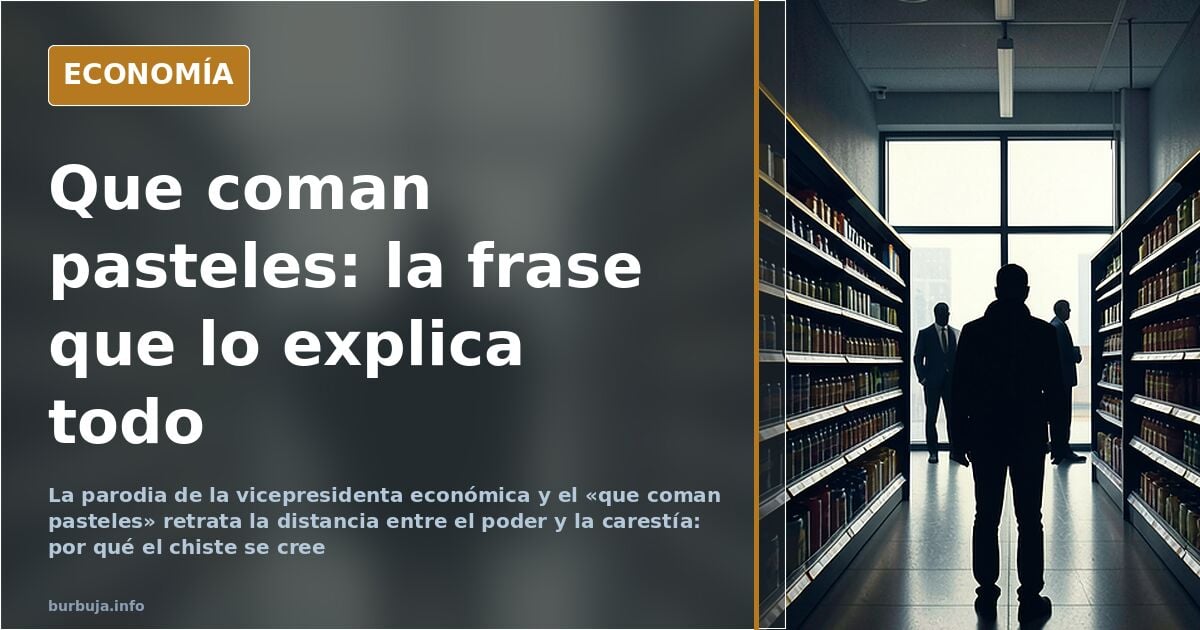
On an economics forum, a participant mockingly recreates a fictional scene —presented as 'based on real events'— in which a figure of power, renamed CASHETANA, receives a group of advisers who warn her that the people are going hungry and that the situation could spiral out of control. According to this account, she replies: 'Then let them eat cake', while they do her pedicure. The episode is offered as a critique of what the author sees as the disconnect of the political elites.
The cake anecdote is nothing new. The phrase evokes the 'let them eat cake' attributed to Marie Antoinette, a historical cliché symbolising the blindness of ruling classes to scarcity. In this case, the story is transposed to current Spanish politics, where discontent with economic management and the perception that those in government do not suffer the same consequences as everyone else has become a commonplace on social media and forums.
Discontent with the 'government of change'
In the discussion, several participants express their disaffection with the government. One argues that 'the fact that working people would rather vote for a layabout or a giraffe says a lot about the quality of the government of change', a criticism aimed at disaffection with the executive and the feeling that social policies have not improved workers' lives. Another claims that 'the best thing the socialists do is sink the country and GIVE IT AWAY to the grandees so they can divide it up among themselves', an opinion reflecting distrust of economic management and suspicion of favouritism towards elites.
The conversation also includes an allusion to alleged illicit enrichment —'In 10 years we'll find Priscila's jewel in the dog's safe'—, a rumour circulating without any evidence. Nothing new under the sun: perceived corruption is a familiar fuel for discontent.
What lies behind abstention and protest voting?
One of the most striking points is the defence of abstention as a tool of protest. 'And I still advocate abstention', one participant states, which ties in with the thesis that the political system does not represent part of the electorate. That stance, however, is not unanimous: other posts mock those who 'were calling for abstention not long ago' and now criticise the results. The exchange lays bare the rift between those who see abstention as legitimate punishment and those who consider it irresponsible.
The economic backdrop is clear: the perception that the cost of living and public management are not moving in the same direction. The phrase 'the people are going hungry' is not literal, but works as a metaphor for the precariousness and uncertainty many associate with the current situation.
The role of advisers and the disconnect of the elites
The scene described —advisers standing in formation, heads bowed, waiting for the leader to deign to address them— portrays a vertical, distant style of power. It is a caricature, but it connects with a recurring criticism: the bureaucracy and inner circles as a wall between rulers and citizens. The reference to the 'maids' doing CASHETANA's pedicure adds a touch of frivolity and luxury that underlines the perceived gap between elite and people.
Underneath it all lies the idea that those who manage the economy do not share the problems of those who suffer it. And that gap, more than a macroeconomic figure, is a first-order political factor.
On this basis, the prediction is risky: if the perception of disconnect takes hold, the electoral punishment could be severe. But it is also possible the noise will fade if the economy improves. Nobody has a crystal ball, least of all when the narrative outweighs the numbers.
Also available in: Deutsch
Summary of a discussion on Burbuja.info - Foro de economía, actualidad y política., translated from Spanish and reviewed before publication. Read the full discussion (15 replies).
More summaries
-
€2,200 potato omelette: as the rich feast on money, Spain's poor look on
A €2,200 potato omelette topped with caviar and gold has sparked a debate in Spain about ostentation, inequality and the free market.
-
Record Abstention in Venezuela: Boycotting Elections Doesn't Topple Governments
Record abstention in Venezuela reopens the debate: data from Spain and the EU shows that not voting does not invalidate power or force change.
-
Forum debate: voting VOX to bring down Spain's Government
A forum thread proposes voting VOX to punish Spain's Government and finish off the PSOE. The strategy of the vote as damage.
-
From the 15M campout to Sol: Fifteen Years and the Same Script
The housing protest culminates in a campout in Sol with the 2011 slogan. The electoral calendar and a potential non-payment regulation are central to the analysis.
-
Zaragoza influencer arrested over hate speech in his viral songs
An Instagrammer from Zaragoza, Spain, has been arrested for hiding hate messages in viral songs. He faces up to four years in prison and will testify in January.
-
Developer vs builder: why they're almost never the same company
The developer puts up the money and takes the risk; the builder gets paid for what it builds. That's why they're almost never the same company and subcontracting rules the industry.