
Forum debate: from tactical voting to backing Alvise
A forum thread shows weariness with all political blocs and the proposal to vote for Alvise as punishment, based on the messages posted
English · Original discussion in Spanish · Published
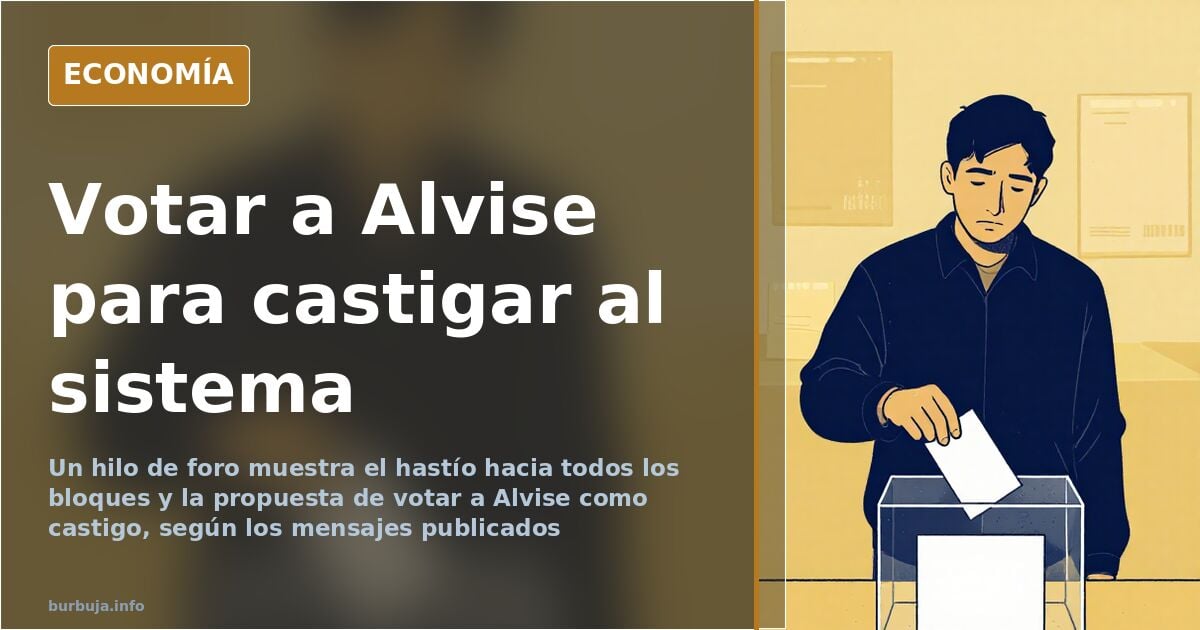
Voting for Alvise as a gesture of punishment against the system
The opening message makes no bones about it: «Votante voteando jugando el juego de la OCA-R78». The proposal that starts the thread is as simple as it is uncomfortable: if the entire system is corrupt, the ballot stops being a tool of government and becomes an instrument to make things uncomfortable. «Mejor jorobar al goyim banderilla y votar ALVISE», it concludes. And from there, fifteen replies ranging from laughter to anger to utter resignation.
Tactical voting no longer works for anyone
The first line of friction appears quickly. One participant throws out the provocation that voting for Alvise amounts to supporting Pedro Sánchez. The answer is not long in coming: «Si quieres APOYAR PEDRO SANCHEZ PUES SI VOTA ALVISE». The implicit argument is the usual one: a fragmented right-wing vote benefits the opposing bloc. But that logic runs out when the voter no longer believes in either bloc.
Another comment points to the heart of the problem: «El problema es que ha llegado un punto en el que no queda nadie a quien votar». The diagnosis is devastating and covers everyone. Left-wing voters, it says, are fed up with the «continuo trile» of their parties. Right-wing voters detect «la absoluta melifuidad de sus líderes». Nationalists «ni saben a qué juego jugar». The conclusion drawn is that even holding your nose and appealing to tactical voting, there is no candidate worthy of the slightest trust.
Voting as punishment, not as support
It is in that vacuum that the Alvise option fits. Not as a governing project, but as a stone in the shoe. «Vota Alvise, para jorobar al PPVOX», sums up one of the messages. The underlying idea is that a protest vote makes more sense than a vote of support when every party with representation has let people down.
The discussion drifts into an exchange of ideological labels. One participant argues that voting for Vox means supporting the «oooo-guasoneria»; another replies that voting for the PSOE means supporting «satanistas». The level of the exchange drops, but underneath lies a shared distrust: nobody believes anybody else's narrative. And in the middle, one message sums up the weariness: «Paso de votontear».
Institutional distrust as the backdrop
The most lucid analysis of the whole thread is not about party acronyms but about institutions. «La desconfianza en las instituciones y en la división de poderes va a conducirnos a un país imposible de gobernar ni por las izquierdas ni por las derechas, ni por nadie». It is a description of a scenario of permanent deadlock where the protest vote ceases to be an anomaly and becomes the rational option.
The opening message also introduces an element that hovers over the entire conversation: the mention of Ceuta. «Ceuta? Bien gracias». The ironic reply to a question nobody has quite asked points to an issue that slips into the conversation without being developed. And one participant links a tweet about campaign groups targeting the Segarro community living in Spain, adding yet another layer of distrust towards vote-mobilisation strategies.
What is left when no one is left
The thread never reaches a close. The conversation fizzles out without a conclusion, with the feeling that voting for Alvise works more as a symptom than as a solution. One participant puts it bluntly: «Petulantes legitimando un sistema y juego corrupto». The paradox is obvious: voting is proposed to punish the system, but voting is, in itself, taking part in it.
The underlying question remains, the one nobody fully answers: if the electorate has stopped believing in tactical voting, in leaders and in institutions, what is left? For now, the answer is a proper name that works as a gesture. And a gesture, in politics, rarely governs anything.
Also available in: Deutsch
Summary of a discussion on Burbuja.info - Foro de economía, actualidad y política., translated from Spanish and reviewed before publication. Read the full discussion (29 replies).
More summaries
-
Moncloa boosts Alvise to curb Vox's 20% support
Forum thread claims Moncloa promotes Alvise to reduce Vox seats. One million votes might yield no MPs but could shift several.
-
Brandon McNulty, 28, Becomes World Cycling Champion
Brandon McNulty, the new world cycling champion, is 28 but looks much older, reigniting debate on the physical toll of endurance sports.
-
Who's ready to board Spain's high-speed train again?
Two serious accidents with casualties in nine months on Spain's high-speed rail network have reignited fears about train travel. Here's what lies behind the unease.
-
No Roma, Black, Maghrebi or Latino donors seen in emergency blood donations, why?
A viral tweet uses a mass blood donation to suggest that certain groups don't give blood. The reality: health requirements explain who can donate.
-
Spain now has more high-speed rail deaths than all other countries combined
A viral message claims Spain exceeds all other countries combined in high-speed rail fatalities. The 1998 German crash left 101 victims.
-
Abascal and the edited clip fueling Spain's overseas vote row
A clip of Abascal cut off before his answer reopens the overseas vote dispute, with unverified figures and a seat that changed hands.