
Forum debate: EV prices, battery life and grid strain
A user reports 7% degradation after six years and 120,000 km; others doubt the charging network and cost. Claims about China's electric adoption are also discussed.
English · Original discussion in Spanish · Published
Electric cars fail in China and people ride scooters on sidewalks there
The electric car is an invention of the rich that they want to sell us. That is the thesis opening the discussion, accompanied by the claim that in China the electric vehicle does not exist and people travel by scooter on the sidewalks. The starting point is an electric scooter which, according to the initial premise, offers "certain real range". From there, the floor opens up.
Because the rest of the conversation is not about China. It talks about batteries that degrade on their own, cars costing more than €30,000 that a worker cannot afford, headlights costing €3,000 and screens costing €12,000, fifth-floor apartments without garages, and cars catching fire without warning. The debate drifts towards the usual issues: price, range, longevity and safety.
The battery that ages even if you don't use it
The first front is technical. It is argued that current batteries degrade simply due to the passage of time, whether used or not, and that the joke of the electric vehicle will end when they age.
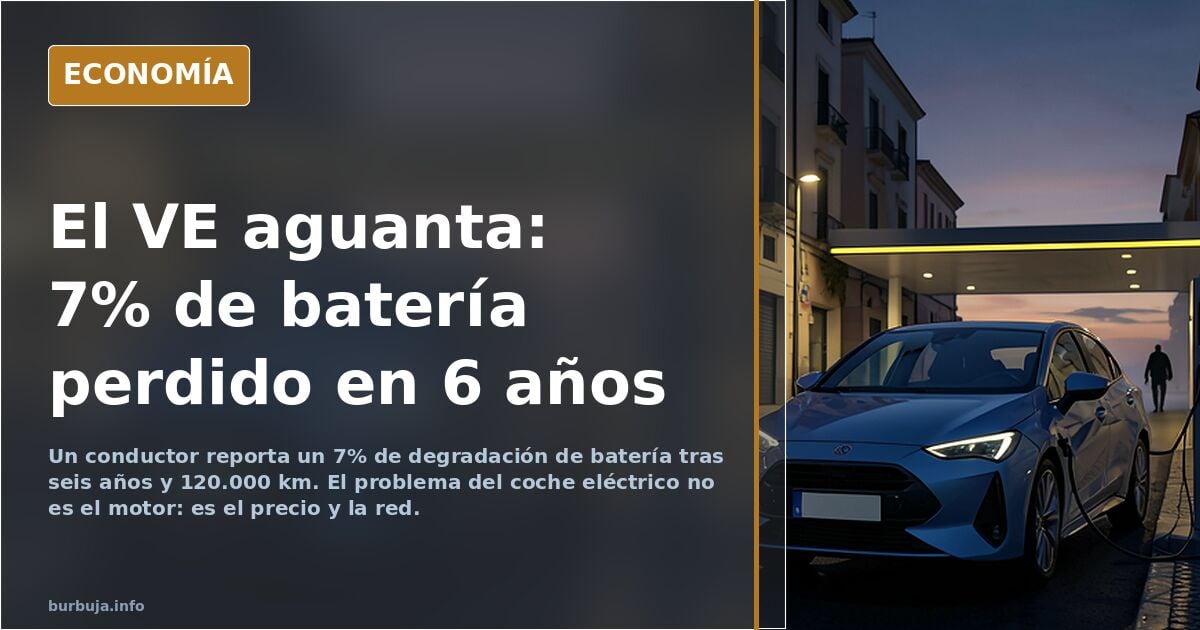
Against this appears the contrary data, and it is the most concrete in the entire conversation: a forum user claims to have lost 7% capacity after six years and more than 120,000 kilometers, with a small battery, having visited the workshop only for filters. The same user recalls that a combustion engine also loses performance due to wear, carbon buildup in intake and exhaust, and that this is not questioned.
The nuance comes from the purchase price. The same user says he bought a €22,000 car, brand new, and estimates a saving of €15,000 in fuel and maintenance over six years. The question that breaks the idyll is another: What about the resale price? Depreciation compared to a thermal car still lacks reassuring answers.
Thirty thousand euros and a fifth floor without a garage
The argument that weighs most is not technical, but financial. It is stated that the best-selling car in Spain is the Dacia Sandero and that the cheapest electric car hovers around €30,000. With that gap, the conclusion drawn is that the plug-in vehicle is for those who have a detached house, solar panels, and another car for trips.
Infrastructure is the second wall. Where does someone living on the fifth floor and parking on the street plug in? The answer does not appear in the thread, and those who have their own garage already belong to a reduced club. The discussion adds a deep antiestéticar: if the electric fleet grows, the grid cannot cope. Some argue that the electrical system is already stretched thin and that data centers are coming next.
Antiestéticar of total loss
Here the tone rises. It is claimed that any battery failure turns the car into a write-off, that a headlight costs €3,000 and a screen €12,000. And then fire: the scenario of an electric car burning while charging at night, in a community garage, is raised as a homeowners' association problem.
The defense is that the market adapts. There are already workshops that repair batteries by replacing modules, no black magic: just another system, repairable like any other. And that the electric car barely visits the workshop compared to the cyclical list for gasoline cars: oils, spark plugs, belts, additives, and the problem of AdBlue crystallization.
The €4,000 used car
The real alternative that appears is not a cheap electric car, but a second-hand thermal one. A 2010 Polo for €4,000, C label, five liters per hundred, no letters. Or a Focus for €18,000 that continues to circulate after 20 years. The uncomfortable question remaining floating is: How many years must an electric car last to match that bill?
The most repeated answer in the exchange is not a number, but a change of frame: the problem is not the battery, it is the infrastructure. And no brand fixes that.
The prediction remains, with reservations. If solid-state batteries arrive and age well, the map changes. Until that is seen on the street, the electric car will continue to be, for many participants, a promise paid in advance.
Also available in: Deutsch
Summary of a discussion on Burbuja.info - Foro de economía, actualidad y política., translated from Spanish and reviewed before publication. Read the full discussion (79 replies).
More summaries
-
Tesla Model 3 outsells Dacia Sandero in September registrations
A forum user claims the Tesla Model 3 outsold the Dacia Sandero in September sales in Spain, but the Sandero still leads the year-to-date tally with 26,000 units versus…
-
Spanish Police Cars: Luxury BMWs vs. Budget Dacias
BMW in Madrid, Toyota in Barcelona, and Land Cruisers for the Civil Guard contrast with taxpayers' Dacias, highlighting public spending disparities.
-
BYD outsells Tesla sixfold, shaking European auto industry
BYD sold over a million EVs in one quarter vs. Tesla's 318,000, with its valuation near $93 billion as Europe watches.
-
Spain's PP and investment funds: who opened the door to rental business
Analysis suggests Rajoy's 2013 law deregulated rents. The PP maintains this model and rejects designated tension zones.
-
Man climbs on Mossos d'Esquadra patrol car in Barcelona
Video shows man mocking police from atop a patrol car in Barcelona. Sparks debate on public order and costs.
-
Avoiding Spanish Polling Station Duty: What Works and What Doesn't
The electoral draw closed on November 4, with notifications distributed by the 7th. Refusing to open the door avoids hand delivery, but legal risks remain.