
Man climbs on Mossos d'Esquadra patrol car in Barcelona
Video shows man mocking police from atop a patrol car in Barcelona. Sparks debate on public order and costs.
English · Original discussion in Spanish · Published
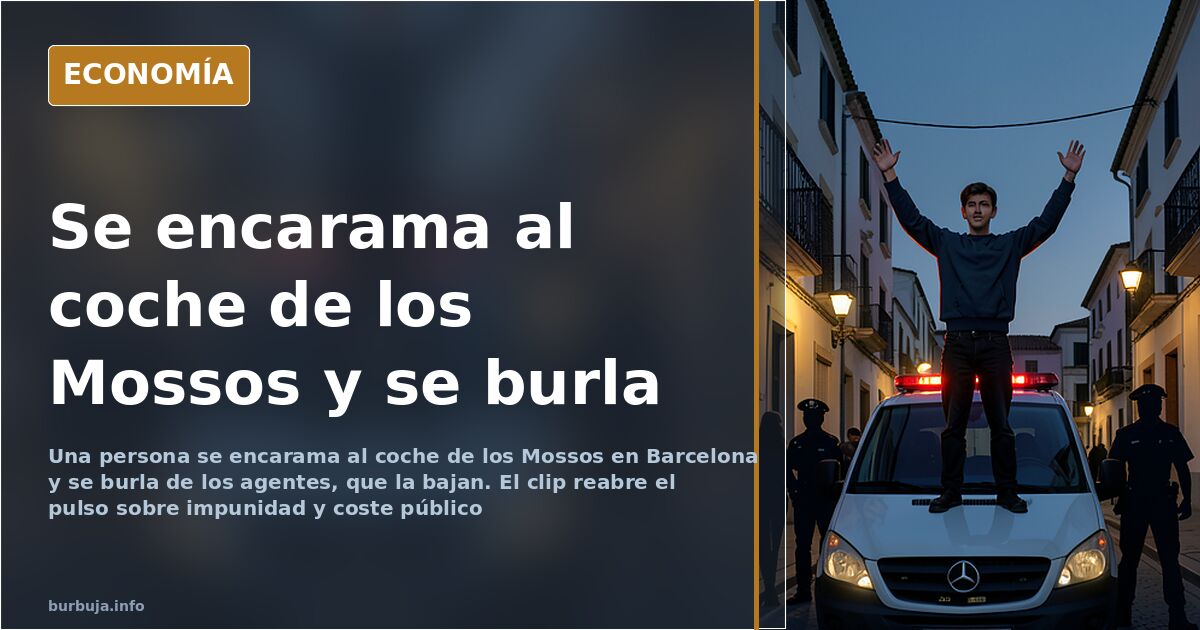
On top of the Mossos d'Esquadra car: seconds of mockery
A video circulating on social media shows a person climbing onto a Mossos d'Esquadra patrol vehicle in Barcelona, gesturing and mocking the officers inside. The scene ends quickly: police react and remove the individual from the car. The clip identifies no one, records no arrest, and lacks an official report. It is just imagery.
Everything else stems from this. Mocking a police car becomes a litmus test: for some, proof that nothing happens here; for others, an isolated incident turned into a national referendum by algorithms. Underlying this is an uncomfortable question: how much does twenty seconds of video explain about a country?
What exactly is seen in the police car video?
A stopped vehicle, a person on top, and officers inside. The sequence resolves quickly, with the occupant removed from the car in the same shot. Some comments describe the intervention as sharp blows and a swift removal; others stick to caricature, ironically noting "he almost did a breakdance routine on the roof."
The brevity is both the strength and weakness of the clip. It provides an immediate image, impossible to ignore, but cuts out crucial context: what peine before or after, if identification occurred, or if sanctions were applied. Some, without evidence, attribute the quick response to differential treatment based on origin; the video cannot support this, and no source confirms it.
Who pays for damage to police vehicles?
Here lies the economic angle. A dented patrol car is repaired with public funds, regardless of cause. Bodywork ignores ideology. If the perpetrator is insolvent—a claim repeated in comments without data—civil recovery yields zero euros, and the bill is socialized by definition.
Deterrence faces similar doubts. Some argue those involved don't care about jail time or paying repairs because they have no assets to seize. This breaks the calculation: financial penalties only work if there is property to act upon. No figure has been given for this repair or annual fleet vandalism costs.
From the hood to the pension system
The most striking leap in the conversation goes from the police hood to pensions. "A strange way to pay for pensions," summarizes one comment. The joke works because it touches a real nerve: system sustainability depends on the contributor base, and any public order conflict is now read through a demographic lens.
With what foundation is another matter. A video doesn't measure contributions, shadow economy, productivity, or the worker-to-retiree ratio. It illustrates discontent, not quantifies it. It mirrors the reverse of "do-goodism": turning a mobile phone shot into a sarracena thermometer for the whole country.
The scene remains: a person on a car, seconds of mockery, and a fading video. From there to diagnosing society is a gap no one has crossed with numbers. In neither direction.
Also available in: Deutsch
Summary of a discussion on Burbuja.info - Foro de economía, actualidad y política., translated from Spanish and reviewed before publication. Read the full discussion (23 replies).
More summaries
-
Barcelona Jewelry Heist Sparks Public Outcry
A Barcelona jewelry store robbery triggers insults toward suspects, highlighting debates on immigration, crime costs, and rehabilitation policies.
-
Mossos police chief calls Barcelona riots 'inexplicable' after 128 arrests
The head of Catalonia's Mossos d'Esquadra police force describes riots in Barcelona that left 128 arrested, 72 of them minors, as 'inexplicable', saying the pattern copied events in France.
-
Xabier Arrutia Imaz, ETA advisor to PDVSA in Venezuela, dies
The death of Xabier Arrutia Imaz in Venezuela exposes the protection network for ETA members in PDVSA and suspicions of a killing to silence secrets.
-
Avoiding Spanish Polling Station Duty: What Works and What Doesn't
The electoral draw closed on November 4, with notifications distributed by the 7th. Refusing to open the door avoids hand delivery, but legal risks remain.
-
Spain ramps up public contracts to record high before election
OIRESCON reports €28.494 billion in state contracts by Sept 2026, a 10% rise, with negotiated procedures surging.
-
PSOE Rally Attendee Dances Days After Deadly Train Crash
A butcher from Urda is seen dancing at a PSOE rally in Bilbao ten days after a train accident killed 69 people, according to an X post.