
Forum Claims Valencia Towed Working Cars Without Notice
Forum posts allege operational vehicles were towed in Valencia without owner notification, citing 100,000 cars and pending loans.
English · Original discussion in Spanish · Published
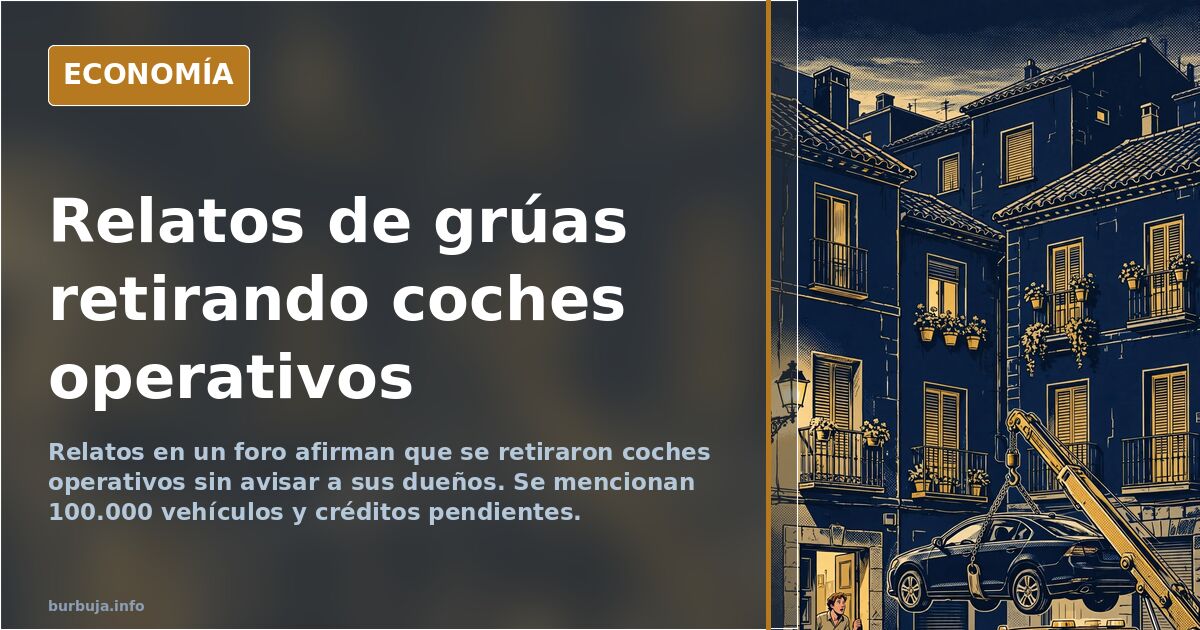
Forum posts claim working cars were towed in Valencia without notifying owners
According to forum accounts, a Jaguar XF owner parked in an elevated area saw his clean car, with mud only on the undercarriage, crushed under two vehicles in a storage yard. This was not an isolated incident, these testimonies suggest. In the weeks trinc the flash flood that submerged dozens of Valencian municipalities, drivers began reporting finding their vehicles towed despite being fully functional. The scene repeats: cars marked "do not remove" ended up stacked in yards. The pattern does not distinguish between total loss and recoverable vehicles, according to debate participants.
Working cars ending up in scrapyards
The most repeated complaint is that towing occurred without verifying the vehicle's actual condition. One driver reported his car was "muddy but not excessively so" and appeared crushed under two other cars. Another neighbor found his vehicle, which was "clean and well-parked in a slightly higher, secluded area," moved without prior notice. The grievance is not just about material damage: it is about the lack of a procedure requiring locating the owner before scrapping.
Some argue the priority was clearing roads and avoiding health risks, and that protocols are overwhelmed in emergencies of this magnitude. The counterargument is that an operational car is not waste: it is a family asset, often still paying off its loan. The line between urgent cleanup and plunder blurs when there is no traceability.
The scrapyard business and valuable parts
The debate quickly turned to money. A scrapped car does not disappear: it becomes parts. "It's all profit, those bastards sell even the last screw at gold prices," summarizes one post. The suspicion that someone is monetizing the catastrophe without accountability hangs over the entire conversation.
The calculation circulating among affected people is devastating: if there are 100,000 cars, the insurance consortium would have to release a figure no one knows if they can afford. And even if the insurer pays, the owner is left without a car, with the loan debt intact and no capacity to buy another. "Who has €30,000 for a normal car, or €50,000 for a van?" asks a message. In towns with low incomes, replacement is a chimera.
Impossible paperwork when the owner is missing
There is an administrative labyrinth no one wants to face directly. If the owner died, if documents were lost in the water, or if the car was registered to a third party, heirs face a rosary of procedures: formalizing inheritance, settling taxes, obtaining new documentation from Traffic authorities, and only then claiming insurance. Months, perhaps years, to recover the value of a vehicle that no longer exists.
Meanwhile, the car is already crushed. The asymmetry is brutal: administration acts in days, citizens claim in years.
The narrative of historical opportunity
Parallel to material complaints, an ideological framework emerged that outraged many affected people. A climate change expert described the destruction of thousands of vehicles as "a historic opportunity to ditch cars, develop public transport, and change the civilization model." The phrase, spread on social media, was read by many as confirmation that the catastrophe was used as leverage to impose an agenda.
It is not the only theory circulating. Some claim mass scrapping responds to a plan to reduce the vehicle fleet, while others attribute it simply to incompetence and the economy of looting that flourishes in chaos. None of these hypotheses are backed by evidence; they are readings fueled by the information vacuum.
The unanswered question: who pays and who is responsible?
The insurance consortium, tow trucks, city councils, the Generalitat (regional government), and the central Government. No one assumes responsibility for what peine to vehicles towed without notice. "Wait until they charge the owner for towing and crushing," ironizes a message summarizing the perceived helplessness.
The conversation does not close the case. Cars remain in yards, owners continue waiting, and aid still hasn't arrived. The only thing advancing is rust.
Also available in: Deutsch
Summary of a discussion on Burbuja.info - Foro de economía, actualidad y política., translated from Spanish and reviewed before publication. Read the full discussion (129 replies).
More summaries
-
Electric Jaguar explodes at Spanish workshop, destroying three cars
An electric Jaguar reportedly exploded at a dealership in Quart de Poblet, Spain, burning three vehicles. Official causes for the fire remain unconfirmed.
-
Valencia to ban non-rated cars in 2028
Valencia’s draft Low Emission Zone law bans vehicles without an environmental label by 2028, offering exemptions for large families and a bonobus compensation scheme.
-
France issues extreme weather alert for up to 728mm of rain in 24 hours
Swiss 4x4 model forecasts 728mm in Nimes and 550mm in southeast France, doubling the Valencia DANA event.
-
Spanish housing market: first cracks or mirage?
Spain's property market shows buyer fatigue and longer sale times. Is a correction coming or is it a mirage?
-
Smoke over Madrid: remote work yes, office no, applause banned?
Smoke over Madrid: remote work for some, the office for others. The advice to stay home clashes with the reality of working life.
-
23 finals, 23 wins: myth or reality of Spanish football
Spain's national team, Real Madrid and Barcelona have won all 23 finals they played over 25 years, but the stat leaves out tournaments like the Nations League. Reality or bias?