
Forum calculation shows 315.82 bcm European gas gap
Russian pipeline flows total 15.58 bcm annually against 331.4 bcm European consumption, leaving a 315.82 bcm deficit.
English · Original discussion in Spanish · Published
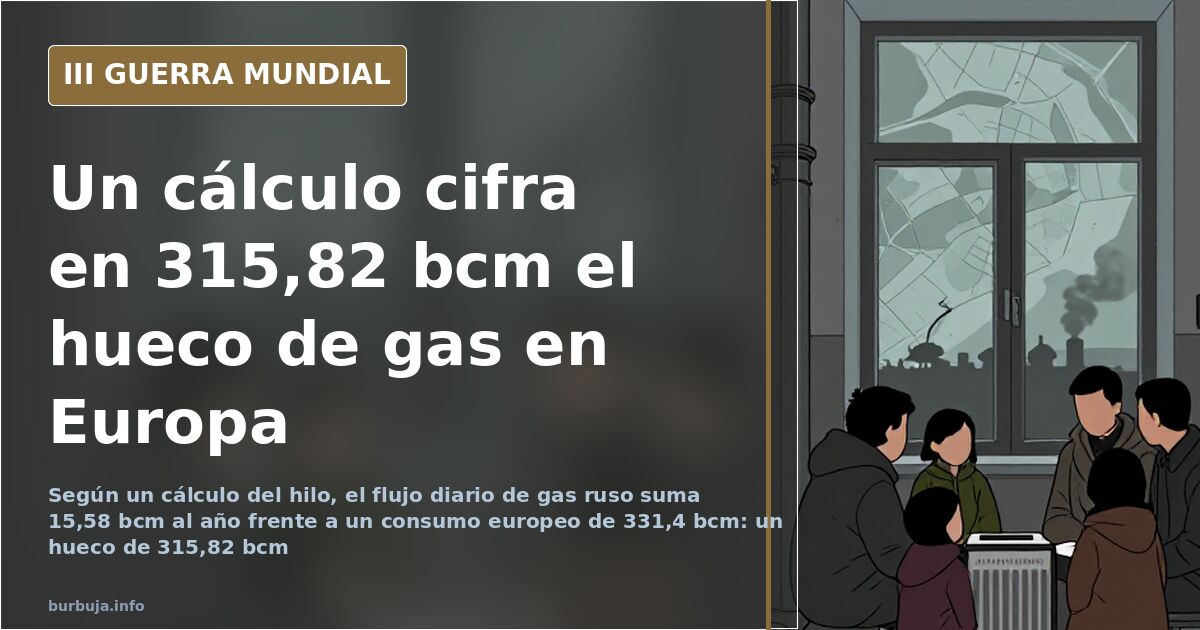
Calculation puts missing European gas at 315.82 bcm
Russian gas still entering Europe via pipelines is insufficient to survive winter, according to calculations circulating in the thread. The numbers presented by proponents are stubborn: daily recorded flow equates to an annual 15.58 bcm; European consumption hit its historical low of 331.4 bcm in 2014. The difference —315.82 billion cubic meters— represents, for this calculation, a hole that no official statement can fill. The lingering question is not rhetorical: where does that gas come from? According to participants, no one has yet provided an answer that withstands scrutiny.
Russian flow and European consumption in the calculation
The first trap is the unit. International data uses bcm, where the 'B' stands for the Anglo-Saxon billion, meaning one thousand million cubic meters. One million cubic meters equals 0.001 bcm, and much confusion arises from mixing scales as if they were identical.
With that equivalence established, the calculation is elementary, according to those proposing it. If the flow Russia sends to Europe —0.0427 bcm daily, per sources cited in the thread— remained constant for 365 days, the annual total would be 15.58 bcm. European consumption during the worst year of recent series, 2014, was 331.4 bcm. Subtracting leaves a gap of 315.82 billion cubic meters. The thread emphasizes that neither household savings nor turning off office lights would cover this distance.
Where will the missing gas come from?
Alternative suppliers exist but are not instant levers, participants argue. The United States, Algeria, and Nigeria have gained weight, though with nuances: Algerian gas is not reaching Spain as before, and its price has been revised upward, they add. Iran could be a relevant exporter, but not for four or five years, based on timelines discussed in the thread.
The most cited front is liquefied natural gas (LNG), where an argument emerges that participants consider difficult to refute: LNG carriers cannot be rescheduled by decree. The active fleet would number around 500 ships, most bound by contracts signed years in advance. A new market cannot be supplied without depriving another.
Payment in rubles: Poland and gas coming from Germany
There is a precedent that, as recounted in the thread, explains why gas traceability matters little. When Moscow demanded payment in rubles, several countries refused while others complied. Poland had its supply cut and ended up buying German gas which, in turn, originated from Russia. At each border, the origin blurs; on the invoice, it does not.
Price cap on Russian crude and OPEC output cuts
In parallel, energy policy. The G-7 set a price cap on Russian crude to allow maritime transport, and the thread notes that the European Union has imposed a cap on Russian gas prices. OPEC also agreed to cut pumping by 100,000 barrels per day starting in October. Two moves that, according to participants, push in the same direction: less supply, higher prices.
The paradox noted by several participants is that the cap does not solve shortages. If the price is fixed by decree, the incentive to save diminishes; volume, however, remains the same. And volume is the problem. Neither Russia wants to cut entirely —it would lose revenue— nor does Europe want a total cutoff, because its economy would suffer.
India cuts Russian oil purchases by 40%
The squeeze on crude adds another layer. Flows of Russian oil to India fell 40% in the last week of August, trinc visits by US officials, as reported in the thread citing Bloomberg. Meanwhile, the G-7 banned maritime transport of Russian crude and derivatives unless purchased below a maximum price set by the coalition.
A collateral effect noted by some participants is rerouting. Russian gas and oil would continue reaching Europe, but going around the world: resold from Turkey, India, or Israel, with European customers paying two or three times more than they would have paid at source, according to these calculations.
Algeria, Israel, and Lebanon: where Mediterranean gas goes
Eastern Mediterranean fields appear repeatedly in the equation. Some place Lebanese southern offshore blocks as a puzzle piece, with a French oil company at the center of talks and guarantees negotiated between Washington and Israel. The other leg is Algeria: it may revise prices and suffer breakdowns, and its gas is no longer liquefied in Cartagena for resale to German clients with previous margins, a participant argues.
Can renewables replace Russian gas?
The most optimistic answer comes from power generation. According to one participant, Spanish solar production surpassed gas generation in daily totals this summer, and investment in capacity continues to grow.
The cost: €50,000 per European cited in the thread
The conclusion arrives with the bill. There is a figure that, according to one participant, summarizes the problem: €50,000 per European to achieve energy self-sufficiency. With that money, he adds, no plan fits. If megawatt-hour prices skyrocket, the conversation shifts to industry: who survives the winter and who sells their plant at bargain prices. As some summarize, the European response is measured in percentages —of armament, resilience, sustainability— and none covers a cubic meter of gas.
With these elements, what is predictable, according to participants, is that winter will be played out in prices rather than volumes: as long as there is gas, even if expensive, the system holds. If cold intensifies and LNG carriers do not arrive on time, the 315.82 bcm will cease to be an arithmetic exercise. One participant even warns that restrictions could open against the LNG carriers themselves.
Also available in: Deutsch
Summary of a discussion on Burbuja.info - Foro de economía, actualidad y política., translated from Spanish and reviewed before publication. Read the full discussion (158 replies).
More summaries
-
Gas Cut: Europe Between Strategic Warning and Energy Crisis
The gas cutoff to Poland and Bulgaria exposes Europe's energy fragility amid Russian dependence. We analyze the risk of a looming crisis.
-
EU backs Russian gas price cap; market resists
Brussels supports capping Russian gas prices, a move Moscow calls absurd. Experts warn of reduced supply, scarcity, and higher costs via intermediaries.
-
Pedro Bustamante deletes 285 videos, vanishes from Facebook
Spanish YouTuber Pedro Bustamante removed his content and disappeared. Rumors place him in Munich, reading German press.
-
Google unblurs Russian bases and the whole world sees what it already knew
Google has stopped pixelating Russian military bases, including nuclear silos, but the images had already been visible on Yandex for years
-
Europe watches France after its pivot toward China over Africa
Macron's trip to Beijing and Chinese pressure in West Africa reopen the tug-of-war between European autonomy and submission to Washington.
-
Ukrainian soldiers record farewell messages in Konstantinovka
Two videos of Ukrainian soldiers in Konstantinovka show the raw reality of the eastern front: 'there were six of us, only two are left'. Farewell testimonies reopen the debate on mobilization.