
Flowers placed on Russian tank outside Berlin embassy
A damaged Russian T-72 outside the Berlin embassy was covered in flowers, while similar gestures at a Ukrainian monument in Moscow led to arrests.
English · Original discussion in Spanish · Published
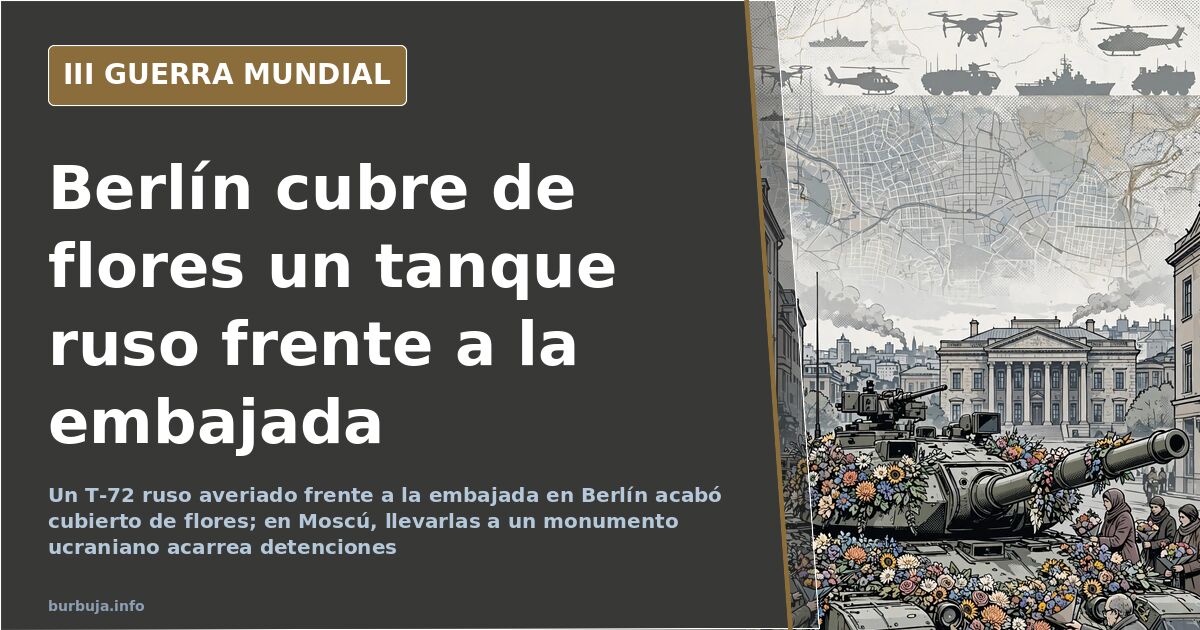
Flowers placed on Russian tank outside Berlin embassy
A damaged Russian armored vehicle parked in front of the Russian Embassy in Berlin did not humiliate anyone; it ended up covered in flowers. Circulating images show residents of the German capital approaching the tank with bouquets and placing them on its armor. No banners. No flags. Just flowers and wishes for peace, which is precisely what fits least in a war.
The contrast came from Moscow. There, a police deployment was required to prevent people from leaving flowers at a Ukrainian monument. Two ways of handling the same gesture, one of which ends in detention.
A broken T-72 as decoration outside the Russian legation
The vehicle is a T-72, the Soviet-era tank that appears repeatedly in lists of lost equipment. It is broken down and was installed in front of the diplomatic headquarters. Regarding who placed it and with what tolerance from German authorities, accounts vary: some claim Ukrainian activists put it there and find it hard to believe German intelligence services were unaware.
The choice of model also does not seem arbitrary. According to circulating calculations, Ukraine received more than 260 T-72 tanks in the previous year, with new shipments planned throughout this year and 2024, leading observers to conclude that this figure does not even cover the gaps.
Who called the rally and how many attended?
The Berlin call is attributed to Die Linke leader Sahra Wagenknecht and feminist Alice Schwarzer, a combination mixing criticism of rearmament with outright rejection of sending weapons. The estimated attendance is around 10,000 people, mostly from eastern Germany, according to participant counts. This data has not been verified by independent sources.
This event is also said to have had support never detailed in these reports: presence of descendants of German nobility, including an heir of Otto von Bismarck, and the removal of blue and yellow flags that had appeared in the area. All this, those recounting it insist, without German police arresting anyone for leaving a bouquet on the ground.
Flowers in Berlin, arrests in Moscow
The most uncomfortable comparison of the episode is not German. In Moscow, police deployed to protect the monument to Ukrainian writer Lesya Ukrainka from dangerous incivil who wanted to lay flowers in memory of fallen Ukrainians. A young woman was detained for attempting to do so, according to circulated images.
That is the argument that unsettles those who read the Berlin flowers as a calculated provocation: on one side, a gesture that goes unpunished; on the other, the same gesture leads to the police station. The symmetry does not hold anywhere.
Citizen pacifism or exploited propaganda?
Here the real gap opens. Some read it as it seems: citizens rejecting the war and saying so with the cheapest language available, a bouquet. Others see propaganda ammunition served on a platter and recall that the gesture occurs in a country whose coalition government, including the Greens, pushes unconditional arms deliveries while burning coal to fill the gas shortage left by Russia.
Regarding energy heritage, the nuance matters: dependence on Russian gas did not start with the current executive but was consolidated with the deal Schröder finalized and Merkel largely maintained due to coalition arithmetic. Attributing a pro-Kremlin shift to Berlin based on bouquets outside the embassy is a leap the facts themselves do not make.
Attendee profile and language details
At the Berlin rally, most participants were aged 45 to 50 and older. There were young people, but they were not the majority. This is a recurring pattern, not just in Germany: those taking to the streets against energy, migration, or health policies tend to exceed that age range. The voting demographic is also the protesting one.
And a curiosity almost no one mentions. When Ukrainian families with children arrived at reception schools in Spain, Ukrainian interpreters were hired and materials prepared in that language. The kids understood nothing. They spoke Russian. New interpreters had to be hired.
With these elements, it is predictable that the scene will repeat: bouquets, cameras, and a controversy that does not fade. What is not written is that flowers stop anything. The war will continue to be decided elsewhere, and those who think Berlin sets the pace are looking at the wrong map.
A damaged Russian armored vehicle parked in front of the Russian Embassy in Berlin did not humiliate anyone; it ended up covered in flowers. Circulating images show residents of the German capital approaching the tank with bouquets and placing them on its armor. No banners. No flags. Just flowers and wishes for peace, which is precisely what fits least in a war.
The contrast came from Moscow. There, a police deployment was required to prevent people from leaving flowers at a Ukrainian monument. Two ways of handling the same gesture, one of which ends in detention.
A broken T-72 as decoration outside the Russian legation
The vehicle is a T-72, the Soviet-era tank that appears repeatedly in lists of lost equipment. It is broken down and was installed in front of the diplomatic headquarters. Regarding who placed it and with what tolerance from German authorities, accounts vary: some claim Ukrainian activists put it there and find it hard to believe German intelligence services were unaware.
The choice of model also does not seem arbitrary. According to circulating calculations, Ukraine received more than 260 T-72 tanks in the previous year, with new shipments planned throughout this year and 2024, leading observers to conclude that this figure does not even cover the gaps.
Who called the rally and how many attended?
The Berlin call is attributed to Die Linke leader Sahra Wagenknecht and feminist Alice Schwarzer, a combination mixing criticism of rearmament with outright rejection of sending weapons. The estimated attendance is around 10,000 people, mostly from eastern Germany, according to participant counts. This data has not been verified by independent sources.
This event is also said to have had support never detailed in these reports: presence of descendants of German nobility, including an heir of Otto von Bismarck, and the removal of blue and yellow flags that had appeared in the area. All this, those recounting it insist, without German police arresting anyone for leaving a bouquet on the ground.
Flowers in Berlin, arrests in Moscow
The most uncomfortable comparison of the episode is not German. In Moscow, police deployed to protect the monument to Ukrainian writer Lesya Ukrainka from dangerous incivil who wanted to lay flowers in memory of fallen Ukrainians. A young woman was detained for attempting to do so, according to circulated images.
That is the argument that unsettles those who read the Berlin flowers as a calculated provocation: on one side, a gesture that goes unpunished; on the other, the same gesture leads to the police station. The symmetry does not hold anywhere.
Citizen pacifism or exploited propaganda?
Here the real gap opens. Some read it as it seems: citizens rejecting the war and saying so with the cheapest language available, a bouquet. Others see propaganda ammunition served on a platter and recall that the gesture occurs in a country whose coalition government, including the Greens, pushes unconditional arms deliveries while burning coal to fill the gas shortage left by Russia.
Regarding energy heritage, the nuance matters: dependence on Russian gas did not start with the current executive but was consolidated with the deal Schröder finalized and Merkel largely maintained due to coalition arithmetic. Attributing a pro-Kremlin shift to Berlin based on bouquets outside the embassy is a leap the facts themselves do not make.
Attendee profile and language details
At the Berlin rally, most participants were aged 45 to 50 and older. There were young people, but they were not the majority. This is a recurring pattern, not just in Germany: those taking to the streets against energy, migration, or health policies tend to exceed that age range. The voting demographic is also the protesting one.
And a curiosity almost no one mentions. When Ukrainian families with children arrived at reception schools in Spain, Ukrainian interpreters were hired and materials prepared in that language. The kids understood nothing. They spoke Russian. New interpreters had to be hired.
With these elements, it is predictable that the scene will repeat: bouquets, cameras, and a controversy that does not fade. What is not written is that flowers stop anything. The war will continue to be decided elsewhere, and those who think Berlin sets the pace are looking at the wrong map.
Summary of a discussion on Burbuja.info - Foro de economía, actualidad y política., translated from Spanish and reviewed before publication. Read the full discussion (152 replies).
More summaries
-
Russian TV simulation: a missile reaches Berlin in 106 seconds
Russian TV airs simulation showing missiles from Kaliningrad reaching Berlin in 106 seconds and Paris and London in 200
-
RAND: Russian Warheads Over London, Berlin, Warsaw in Hypothetical Scenario
RAND Corp. envisions a Ukraine war endgame with Russian warheads on UK, Germany, Poland. Deterrence makes it unlikely, but... Is it possible?
-
Pro-Russian Discourse Shifts as Ukraine Conflict Evolves
Analysis of how pro-Russian discourse on Ukraine has evolved from border defense justifications to criticism of globalism.
-
Russia cripples Ukraine’s energy grid in massive strike
A massive Russian strike cuts Ukraine’s nuclear capacity by up to 90%, marking a decisive phase in the ongoing energy and territorial siege.
-
Statehood Criteria: Religious Freedom and Equality
Religious freedom and equal rights as filters for state recognition: Israel's 20% Muslim population and Sharia courts reopen the debate.
-
Macron calls Russia a medium power, but data contradicts
Macron labels Russia a 'medium power' and urges Europe not to fear it. However, battlefield realities and NATO's response challenge this assessment.