
Fixed-term deposits: highest yields found online, not in branches
From Cetelem's 4% to Deutsche Bank's 2.80%, branch-based banks offer lower rates while deposit guarantee schemes vary by country.
English · Original discussion in Spanish · Published
Fixed-term deposits: highest yields found online, not in branches
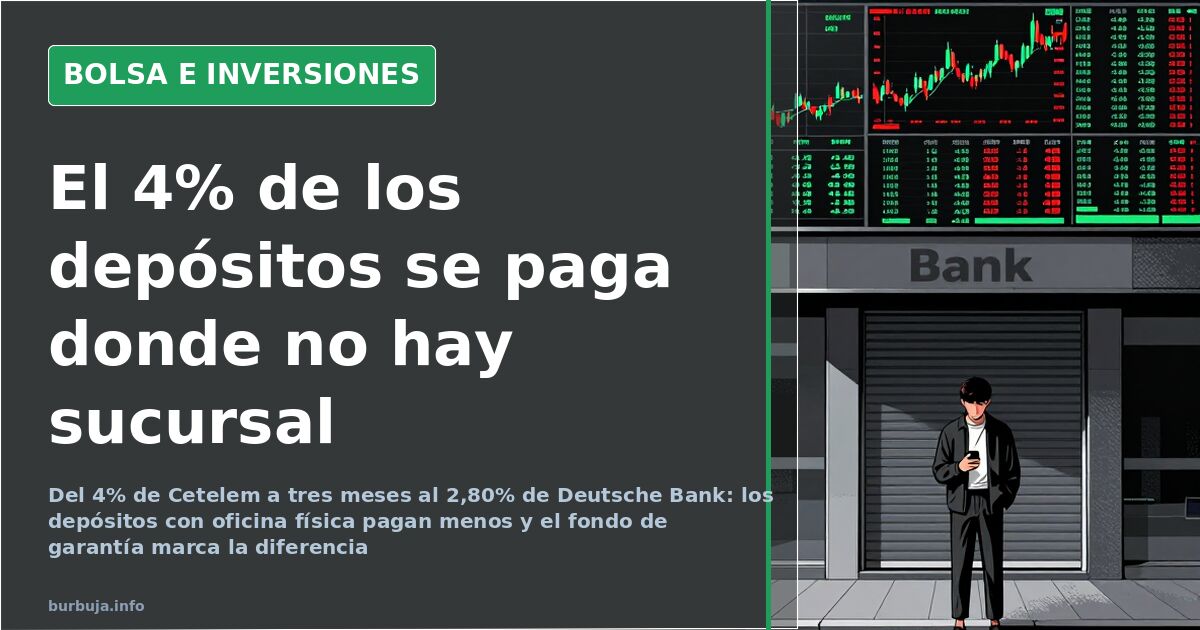
The best fixed-term deposit on the market isn't available at a physical branch, creating a dilemma for savers who prefer having staff face-to-face if issues arise. The highest offers—4% over three months, 3.70% from an A+ rated Slovak bank, and 3.44% APR over two years from an automotive subsidiary—are exclusively digital. Meanwhile, traditional banking maintains 2.80% over twelve months. The gap between these extremes exceeds one and a half percentage points.
Nothing is free. Interest rates and convenience are linked: the more convenient the product, the lower the yield.
Which fixed-term deposits and interest-bearing accounts pay the most?
Returns depend on the term and fine print, not the bank's size. These are the benchmarks circulating among savers comparing options:
Strategy depends on your outlook. If you expect rates to fall, locking in long-term fixes returns before cuts; if you expect rises or stability, short-term keeps flexibility. Today's 3.44% two-year lock only beats a renewable three-month deposit if the rate-cut forecast holds.
Why do brick-and-mortar banks offer lower interest?
Branches cost money, reducing margins after paying customers. The logic is simple: branches and staff must be paid, so entities maintaining them compete poorly on price. Similarly, deposits allowing early withdrawal pay less because liquidity has a cost.
Deutsche Bank offered 3.40% annually in summer 2023 via physical branches without requiring payroll direct debits or insurance products—an exception. Today, the rule is clear: choosing a branch means sacrificing yield.
Conditions, limits, and fine print: where returns disappear
Advertised rates rarely match actual earnings. Openbank offered 3.1% TIN over six months unconditionally but previously required €600 monthly deposits into the linked account for four of six months to boost interest. Banco Sabadell's interest-bearing account pays 6% for the first three months then drops to 2%, capped at €20,000: holding it a full year averages 3% APR. High headline rates matter little if eligible balances are limited.
Other details vanish in marketing. Interest is usually paid at maturity, not monthly. Some products have no cap—up to €100,000 for Openbank—while others forbid partial withdrawals. Crucially, when funds enter a joint account on a foreign platform, no document links that balance to specific account holders.
What happens if the bank fails? Deposit guarantee schemes by country
Short answer: the entity's name matters less than its deposit guarantee scheme coverage. Standard protection reaches €100,000, whether under Spanish, French, Italian, or Slovak schemes. Proponents argue small insured banks may be safer than large ones, as fewer savers would need reimbursement in a crisis. This logic has merit but ignores blind spots: guarantees are only as solvent as the systems backing them.
Tax obligations remain separate. Interest is declared in Spain's personal income tax (IRPF), and foreign balances exceeding €50,000 trigger Form 720 reporting. Specific warnings exist too: criticism of Cetelem focuses mainly on consumer lending, not deposits, though some investors report transfers stuck in limbo for months on certain platforms. These are anecdotes, not statistics, but worth noting.
Money market funds and Treasury bills: the emerging alternative
For those avoiding lock-ins, intermediate options exist. Money market funds like AXA Trésor Court Terme C, Groupama Trésorerie IC, or La Française Trésorerie ISR track interest rates with 0.1–0.2% fees, so a quarter-point rate cut tomorrow would still leave yields near 3.75%. Others prefer direct government debt: Treasury bills carry equal or lower risk than banks, since states continue paying even if banks fail.
Platforms like Raisin organize European offerings, including €100 account-opening incentives shared among users. They aid comparison but don't decide for you.
With these figures, the uncomfortable question isn't which deposit pays most, but why millions of euros remain idle at zero interest in traditional accounts.
The best fixed-term deposit on the market isn't available at a physical branch, creating a dilemma for savers who prefer having staff face-to-face if issues arise. The highest offers—4% over three months, 3.70% from an A+ rated Slovak bank, and 3.44% APR over two years from an automotive subsidiary—are exclusively digital. Meanwhile, traditional banking maintains 2.80% over twelve months. The gap between these extremes exceeds one and a half percentage points.
Nothing is free. Interest rates and convenience are linked: the more convenient the product, the lower the yield.
Which fixed-term deposits and interest-bearing accounts pay the most?
Returns depend on the term and fine print, not the bank's size. These are the benchmarks circulating among savers comparing options:
- MyInvestor: 4%, backed by Andbank.
- Trade Republic: 4%, with banking license and deposit guarantee scheme.
- Cetelem: 4% over three months.
- Facto: 3.80% APR over three months.
- Privatbanka: Slovak entity rated A+, offering 3.70%.
- Banca Progetto: Italian, 3.5% with penalty-free cancellation and four days' notice.
- Renault Bank: 3.44% APR over two years.
- Pibank: 3.14% over one year.
- Openbank: 3.1% nominal interest rate (TIN) over six months, no conditions.
- Deutsche Bank: 2.80% over twelve months.
Strategy depends on your outlook. If you expect rates to fall, locking in long-term fixes returns before cuts; if you expect rises or stability, short-term keeps flexibility. Today's 3.44% two-year lock only beats a renewable three-month deposit if the rate-cut forecast holds.
Why do brick-and-mortar banks offer lower interest?
Branches cost money, reducing margins after paying customers. The logic is simple: branches and staff must be paid, so entities maintaining them compete poorly on price. Similarly, deposits allowing early withdrawal pay less because liquidity has a cost.
Deutsche Bank offered 3.40% annually in summer 2023 via physical branches without requiring payroll direct debits or insurance products—an exception. Today, the rule is clear: choosing a branch means sacrificing yield.
Conditions, limits, and fine print: where returns disappear
Advertised rates rarely match actual earnings. Openbank offered 3.1% TIN over six months unconditionally but previously required €600 monthly deposits into the linked account for four of six months to boost interest. Banco Sabadell's interest-bearing account pays 6% for the first three months then drops to 2%, capped at €20,000: holding it a full year averages 3% APR. High headline rates matter little if eligible balances are limited.
Other details vanish in marketing. Interest is usually paid at maturity, not monthly. Some products have no cap—up to €100,000 for Openbank—while others forbid partial withdrawals. Crucially, when funds enter a joint account on a foreign platform, no document links that balance to specific account holders.
What happens if the bank fails? Deposit guarantee schemes by country
Short answer: the entity's name matters less than its deposit guarantee scheme coverage. Standard protection reaches €100,000, whether under Spanish, French, Italian, or Slovak schemes. Proponents argue small insured banks may be safer than large ones, as fewer savers would need reimbursement in a crisis. This logic has merit but ignores blind spots: guarantees are only as solvent as the systems backing them.
Tax obligations remain separate. Interest is declared in Spain's personal income tax (IRPF), and foreign balances exceeding €50,000 trigger Form 720 reporting. Specific warnings exist too: criticism of Cetelem focuses mainly on consumer lending, not deposits, though some investors report transfers stuck in limbo for months on certain platforms. These are anecdotes, not statistics, but worth noting.
Money market funds and Treasury bills: the emerging alternative
For those avoiding lock-ins, intermediate options exist. Money market funds like AXA Trésor Court Terme C, Groupama Trésorerie IC, or La Française Trésorerie ISR track interest rates with 0.1–0.2% fees, so a quarter-point rate cut tomorrow would still leave yields near 3.75%. Others prefer direct government debt: Treasury bills carry equal or lower risk than banks, since states continue paying even if banks fail.
Platforms like Raisin organize European offerings, including €100 account-opening incentives shared among users. They aid comparison but don't decide for you.
With these figures, the uncomfortable question isn't which deposit pays most, but why millions of euros remain idle at zero interest in traditional accounts.
Summary of a discussion on Burbuja.info - Foro de economía, actualidad y política., translated from Spanish and reviewed before publication. Read the full discussion (145 replies).
More summaries
-
Trade Republic's 3%: The Fine Print of the Collective Account
Trade Republic offers 3% AER only for new customers, capped at €50,000, with a collective account. Bankinter, Openbank, and Santander are countering.
-
Hotel101 sells rooms in Valdebebas for €208,800
Hotel101 sells rooms in Valdebebas for €208,800 plus VAT with monthly income distribution and doubts about what happens if the operator goes bankrupt
-
Retiring at 60 with 240 gold ounces: the calculation
A strategy to retire at 60 using physical gold, challenging public pension stability and advocating for precious metals savings.
-
Zynex Stock Drops to $12.5 Despite 117% Order Growth
Zynex shares surged from $13.55 to $16.52 on strong orders, then fell to $12.5 amid results beats and client doubts.
-
Sabadell stock: Stop-loss fails to prevent gap risk
An investor bought 20,000 Sabadell shares at €0.270, discovering that a stop-loss does not guarantee price execution during market gaps.
-
Kutxabank Fund Loses 55% Since 2010
The Kutxabank 0/100 Carteras FI fund has dropped 55% since 2010, while global markets rose 400%, according to circulating data.