
Five was the limit for working-class families in Franco's Spain
A viral story about a working-class family with 19 children is debunked: the father held high-ranking roles, and the piano was an outlier in working-class neighborhoods.
English · Original discussion in Spanish · Published
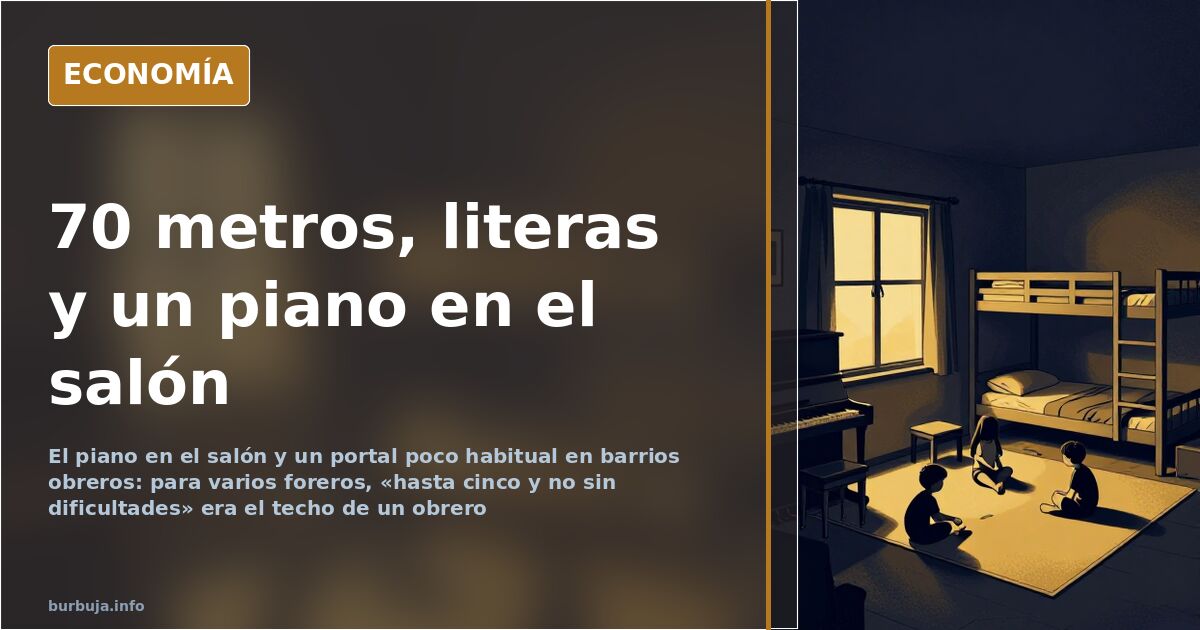
How 19 children were supported: five was the ceiling for a worker
A 70-square-meter house. Three rooms. Two bedrooms with multiple bunk beds and one bathroom for everyone. No Netflix, no Burger King birthdays, no extracurriculars: the park outside school. Clothes were passed from brother to cousin, and mothers made dresses from scraps. This is the domestic portrait of a large family in Franco's Spain, and the question that persists is always the same: how could they support 19 children on a single salary?
The uncomfortable answer emerges as soon as you pull the thread: as several participants note, most did not. And the cases of 19 offspring aired as proof of a supposed golden age, they add, were not working-class.
The piano in the living room: why the case of the 19 children was not working-class
A piano in the living room. An unusual entrance in a working-class neighborhood. These are the two details cited to debunk the narrative. It is argued that the father, linked to Iberia, was not a low-level clerk, but held key positions in banking and administration, and that several of his daughters worked as flight attendants for the airline; two of them later formed the comedy duo Las Veneno. None of this fits the biography of a 1960s worker, even if presented as such.
It is important to separate two things: that a large family got by in that Spain, and that they did so with 19 children and no institutional or corporate safety net. The first peine every day. The second, almost never.
How many children could a real worker support?
Five. This is the limit cited in the most repeated calculation, always with caveats: up to five, and not without difficulties. Beyond that lies the realm of the exceptional, with documented episodes of food scarcity. Large families in Madrid working-class neighborhoods are cited, with two beds for all the children and the father leaving at 6 a.m. and returning at 10 p.m.
The key is that the household functioned as a productive unit. The mother sewed for neighbors with a sewing machine, raised rabbits and chickens in the yard, and managed the money; grandparents and unmarried aunts contributed clothes and food; the eldest brother looked after the youngest and brought him his snack. The family was a cooperative without a salary.
Even the most comfortable cases needed godparents. Some recall families with 12 children and a father working multiple jobs for 12 hours a day, where each child had a godparent who paid for shoes and glasses. In other words: not even with three jobs did the system hold up without external help.
Inflation paid off mortgages in the 1960s
An apartment that cost the equivalent of 6,000 euros and is worth 325,000 fifty years later. And a detail that explains more than any nostalgia: within three years, the holder's salary already exceeded the property's value. With high inflation and salaries adjusted upward each year, the monthly payment ate half the salary in the first year and an ever-smaller portion thereafter. The debt dissolved itself. In five or six years, the apartment was practically paid off.
That mechanism—permanent inflation passed on to salaries and mortgage debt dissolving year by year—is what no longer exists. The public housing of the 1950s, the attached house with a yard and garden, was supplemented by affordable rent that has no equivalent today.
No VAT, no income tax, and very few cars
VAT did not arrive until 1986. The vehicle inspection became mandatory that same year and the next. Beforehand, a wage earner did not file an income tax return, water came from fountains or wells, and electricity was a minor expense. According to one participant, public enterprises from the INI supported much of the public sector without squeezing employees. Lower indirect consumption taxes meant a modest salary went further, although in proportion to the paycheck, the shopping basket was more expensive than today in almost everything except housing.
There were 3.1 cars per 1,000 inhabitants in the 1960s. Shortly after, traffic jams on Barcelona's Diagonal or Meridiana avenues were already serious.
School, healthcare, and the human cost no one wants to repeat
Public and church-run schools, free. Walking to and from school, without a family car. Free healthcare, though not for everyone or everywhere. Austerity was the operating system: a television that lasted twenty years, two pairs of shoes, trousers with knee patches, and books passed down from year to year.
And a cost that does not appear in the accounts. In the cited stories, children entered the workforce at nine or ten years old. Women bore the burden of the home and other people's children. Some recall a grandmother, the eldest of fourteen siblings, who did not attend school or learn to read. No nostalgia for that withstands analysis, and it is said without ambiguity.
From rationing to tourism: what changed between the 60s and 70s
Post-war Spain and 1970 Spain are not the same country. Rationing lasted well into the 1950s, the Stabilization Plan arrived in 1959, and tourism and commercial openness transformed the vehicle fleet, prices, and expectations. Some argue that by 1975, the average number of children per couple had already dropped to two.
This transition explains why the model exhausted itself: fewer children, more urbanization, more consumption, more years of schooling. What it does not explain is the piano.
Anyone looking at those families' accounts with nostalgia should keep two facts in mind. As argued in the debate, the average fertility rate was already two children per couple by 1975. And the state that today takes nearly half of an average salary in taxes barely existed: many of those fiscal figures had not yet been invented. One salary, a garden, and five children was the most repeated scenario. Nineteen, a case with a piano.
A 70-square-meter house. Three rooms. Two bedrooms with multiple bunk beds and one bathroom for everyone. No Netflix, no Burger King birthdays, no extracurriculars: the park outside school. Clothes were passed from brother to cousin, and mothers made dresses from scraps. This is the domestic portrait of a large family in Franco's Spain, and the question that persists is always the same: how could they support 19 children on a single salary?
The uncomfortable answer emerges as soon as you pull the thread: as several participants note, most did not. And the cases of 19 offspring aired as proof of a supposed golden age, they add, were not working-class.
The piano in the living room: why the case of the 19 children was not working-class
A piano in the living room. An unusual entrance in a working-class neighborhood. These are the two details cited to debunk the narrative. It is argued that the father, linked to Iberia, was not a low-level clerk, but held key positions in banking and administration, and that several of his daughters worked as flight attendants for the airline; two of them later formed the comedy duo Las Veneno. None of this fits the biography of a 1960s worker, even if presented as such.
It is important to separate two things: that a large family got by in that Spain, and that they did so with 19 children and no institutional or corporate safety net. The first peine every day. The second, almost never.
How many children could a real worker support?
Five. This is the limit cited in the most repeated calculation, always with caveats: up to five, and not without difficulties. Beyond that lies the realm of the exceptional, with documented episodes of food scarcity. Large families in Madrid working-class neighborhoods are cited, with two beds for all the children and the father leaving at 6 a.m. and returning at 10 p.m.
The key is that the household functioned as a productive unit. The mother sewed for neighbors with a sewing machine, raised rabbits and chickens in the yard, and managed the money; grandparents and unmarried aunts contributed clothes and food; the eldest brother looked after the youngest and brought him his snack. The family was a cooperative without a salary.
Even the most comfortable cases needed godparents. Some recall families with 12 children and a father working multiple jobs for 12 hours a day, where each child had a godparent who paid for shoes and glasses. In other words: not even with three jobs did the system hold up without external help.
Inflation paid off mortgages in the 1960s
An apartment that cost the equivalent of 6,000 euros and is worth 325,000 fifty years later. And a detail that explains more than any nostalgia: within three years, the holder's salary already exceeded the property's value. With high inflation and salaries adjusted upward each year, the monthly payment ate half the salary in the first year and an ever-smaller portion thereafter. The debt dissolved itself. In five or six years, the apartment was practically paid off.
That mechanism—permanent inflation passed on to salaries and mortgage debt dissolving year by year—is what no longer exists. The public housing of the 1950s, the attached house with a yard and garden, was supplemented by affordable rent that has no equivalent today.
No VAT, no income tax, and very few cars
VAT did not arrive until 1986. The vehicle inspection became mandatory that same year and the next. Beforehand, a wage earner did not file an income tax return, water came from fountains or wells, and electricity was a minor expense. According to one participant, public enterprises from the INI supported much of the public sector without squeezing employees. Lower indirect consumption taxes meant a modest salary went further, although in proportion to the paycheck, the shopping basket was more expensive than today in almost everything except housing.
There were 3.1 cars per 1,000 inhabitants in the 1960s. Shortly after, traffic jams on Barcelona's Diagonal or Meridiana avenues were already serious.
School, healthcare, and the human cost no one wants to repeat
Public and church-run schools, free. Walking to and from school, without a family car. Free healthcare, though not for everyone or everywhere. Austerity was the operating system: a television that lasted twenty years, two pairs of shoes, trousers with knee patches, and books passed down from year to year.
And a cost that does not appear in the accounts. In the cited stories, children entered the workforce at nine or ten years old. Women bore the burden of the home and other people's children. Some recall a grandmother, the eldest of fourteen siblings, who did not attend school or learn to read. No nostalgia for that withstands analysis, and it is said without ambiguity.
From rationing to tourism: what changed between the 60s and 70s
Post-war Spain and 1970 Spain are not the same country. Rationing lasted well into the 1950s, the Stabilization Plan arrived in 1959, and tourism and commercial openness transformed the vehicle fleet, prices, and expectations. Some argue that by 1975, the average number of children per couple had already dropped to two.
This transition explains why the model exhausted itself: fewer children, more urbanization, more consumption, more years of schooling. What it does not explain is the piano.
Anyone looking at those families' accounts with nostalgia should keep two facts in mind. As argued in the debate, the average fertility rate was already two children per couple by 1975. And the state that today takes nearly half of an average salary in taxes barely existed: many of those fiscal figures had not yet been invented. One salary, a garden, and five children was the most repeated scenario. Nineteen, a case with a piano.
Summary of a discussion on Burbuja.info - Foro de economía, actualidad y política., translated from Spanish and reviewed before publication. Read the full discussion (208 replies).
More summaries
-
Over 272,000 Families Evicted by Court Order Under Sánchez Government: 90 Daily
More than 272,000 families have been evicted by court order since Pedro Sánchez took office, averaging 90 per day.
-
Casa47 allocates 134 homes, 30% with NIE holders
Of the 134 Casa47 homes allocated in Valencia and Pontevedra, 40 (30%) are held by NIE holders. The program requires around €1,800 net per month
-
Negocios TV Alert Claims Explosions in Frankfurt
An unverified alert suggests explosions shook Frankfurt center; the European Central Bank (ECB) is mentioned without confirmation.
-
Milei wins Argentina election, crushing Peronism in key provinces
Javier Milei wins the Argentine presidential election, leaving Peronism with only four provinces as dollar-denominated wages plummet to $341.
-
Castile, fiscal grievance and the Ebro water dispute
Inland Spain's anger over fiscal imbalances and control of the Ebro: theories of alleged exploitation versus data questioning them.
-
Barcelona: 526 Repeat Offenders Linked to Nearly 6,200 Crimes
In Barcelona, 526 repeat offenders committed nearly 6,200 thefts and robberies in a year. Recidivism is now central to Spain's Penal Code reform.