
Five people registered at his home in Spain without his knowledge
A resident of Montblanc, Tarragona, discovers five migrants registered at his address using fake rental contracts and social benefit letters addressed to third parties
English · Original discussion in Spanish · Published
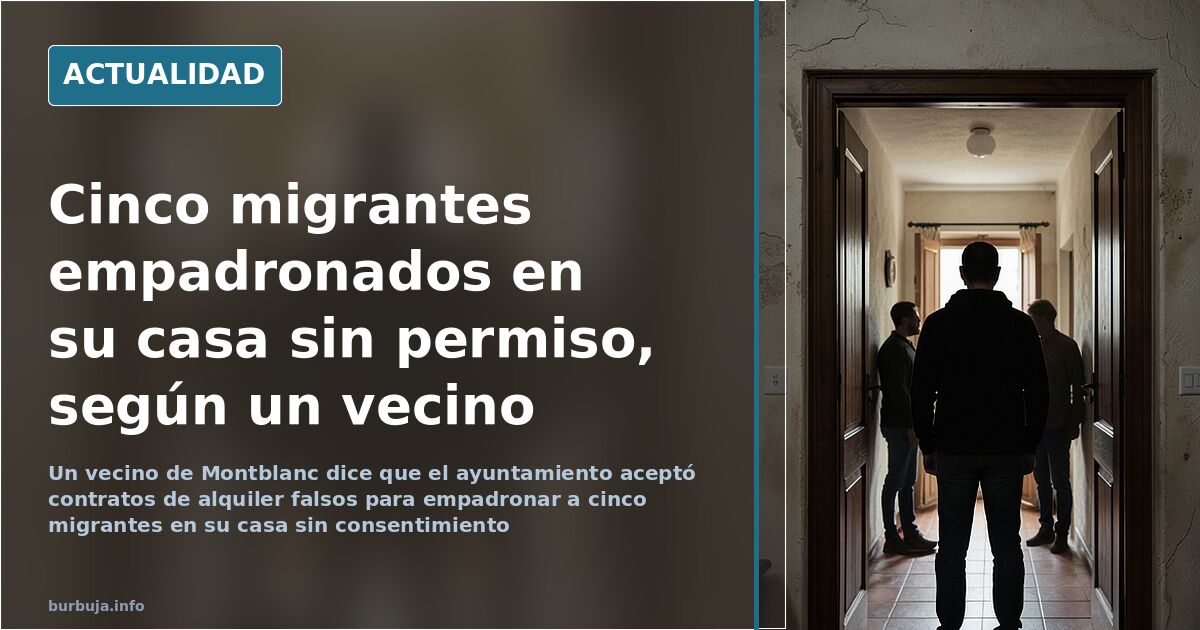
Five migrants registered at his home without his knowledge: 'contracts a child could have written'
David, a resident of Montblanc (Tarragona), found out that five irregular migrants were registered at his home through the letters that started arriving. It was no isolated mistake: letters from Catalonia's public health service, social benefit notices and even a PSOE (Spanish Socialist Party) membership card in other people's names. At the town hall, they showed him the rental contracts backing those registrations. They were fake, according to his account, and claimed he was renting them a room.
The case, reported by OKDIARIO, has peine an old debate about the municipal register (padrón municipal): what checks are carried out, who signs off on them and why the system allows an unverified private document to generate administrative rights down the line. The scene has something of a bureaucratic comedy about it. And of a legal loophole too.
What peine in Montblanc: from one letter to five registrations
David's story is simple, and that is what makes it unsettling. First came a letter addressed to someone called Bhek. Then another for Moshine. Then more. In total, five communications from Catalonia's public health service covering five people, and just as many announcing economic and social benefits. The last one, a PSOE membership card in the name of one of the foreigners.
When he went to the town hall to report that nobody else lived in his home, they showed him the rental contracts. 'They were fake rental contracts, of course, that a small child could have written, saying that I was renting them a room,' he told the outlet. The quote sums up the problem: the register is built on documentation nobody checks.
How the municipal register works and why a fake contract slips through
The municipal register is the gateway to almost everything: a health card, social benefits, school enrolment, even the electoral roll. To register, all you need to do is prove residence in the municipality. A rental contract, even for a single room, usually does the trick. The law does not require the town hall to verify the authenticity of the signature or visit the property, and that is where the gap lies.
The most common complaint is the asymmetry of checks. Some argue that a Spaniard is asked for property deeds to register in their own home, while a foreigner only needs a paper signed on a napkin. The comparison is exaggerated, but it points to something real: verification depends on the willingness of the civil servant on duty and the department's workload.
Why town halls have an interest in registering as many people as possible
The register is not just a record: it is money. The more registered residents, the more transfers from the State and the greater the weight in local funding. That is the suspicion running through the case: town halls would have incentives not to look too closely. There is no proof this peine in Montblanc, but the system's design allows it.
The debate over whether the register should be scrapped or reformed is nothing new. One line of argument holds that the only address that counts is the tax one, and that administrative residence should be cross-checked with the tax agency. Another points out that the register serves a statistical function and provides access to services that no other record covers.
The consequences for the owner: taxes, fees and possible squatting
The direct victim is David. Letters in other people's names can end up triggering tax inquiries if the tax agency cross-references data and concludes there is undeclared rental income. They can also inflate the calculation of the waste collection fee, which in some municipalities is tied to the number of occupants. And registration serves as proof of residence in a potential dispute over occupation.
The route being suggested is a incivil complaint for document forgery against those who signed the contracts and, where applicable, against the civil servant who validated the registration without checking anything. Administrative misconduct requires more than mere negligence, but the debate over the public official's responsibility is wide open.
The system works as long as nobody looks. When a resident opens the mailbox and finds five other people's lives inside, the official narrative falls apart. And then only one uncomfortable question remains: how many homes like David's are there in Spain where nobody has peine the first letter yet?
Also available in: Deutsch
Summary of a discussion on Burbuja.info - Foro de economía, actualidad y política., translated from Spanish and reviewed before publication. Read the full discussion (85 replies).
More summaries
-
Spain restores universal healthcare for migrants, sparking cost debate
The Spanish government has reinstated full public healthcare access for irregular migrants. Critics cite an unverified cost of €743/month per person.
-
Vox scraps €1,000 payment to migrants in Aragon, Spain
Vox has abolished a €1,000 grant for migrants with one year of registered residency in Aragon, Spain. The move has drawn both praise and accusations of discrimination.
-
Spain's health minister warns against locking up migrants in Ceuta
Health minister Mónica García warns that confining migrants in Ceuta, Spain, would be counterproductive despite outbreaks of tuberculosis and scabies.
-
Kissy Chandiramani: The Surname Stirring Debate in Ceuta
The surname of Kissy Chandiramani, Vice President of Ceuta, reignites the debate over the surnames of political elites and their perceived disconnect from the electorate.
-
Petrus at €6,250: scarcity, not taste, sets the price
A Petrus at €6,250 in a shop window and a whisky at €6,000: the price is set not by taste but by scarcity of 30,000 bottles a year and Asian demand.
-
When your AI emails my AI
An employee let their AI assistant answer a work email, and the reply was projected during a meeting. The debate over delegating reasoning to machines keeps growing.