
First-class passenger refuses seat swap for 13-year-old
A viral video shows a first-class passenger declining to downgrade to economy so a 13-year-old could sit with his parents, sparking debate on airline policies and family travel costs.
English · Original discussion in Spanish · Published
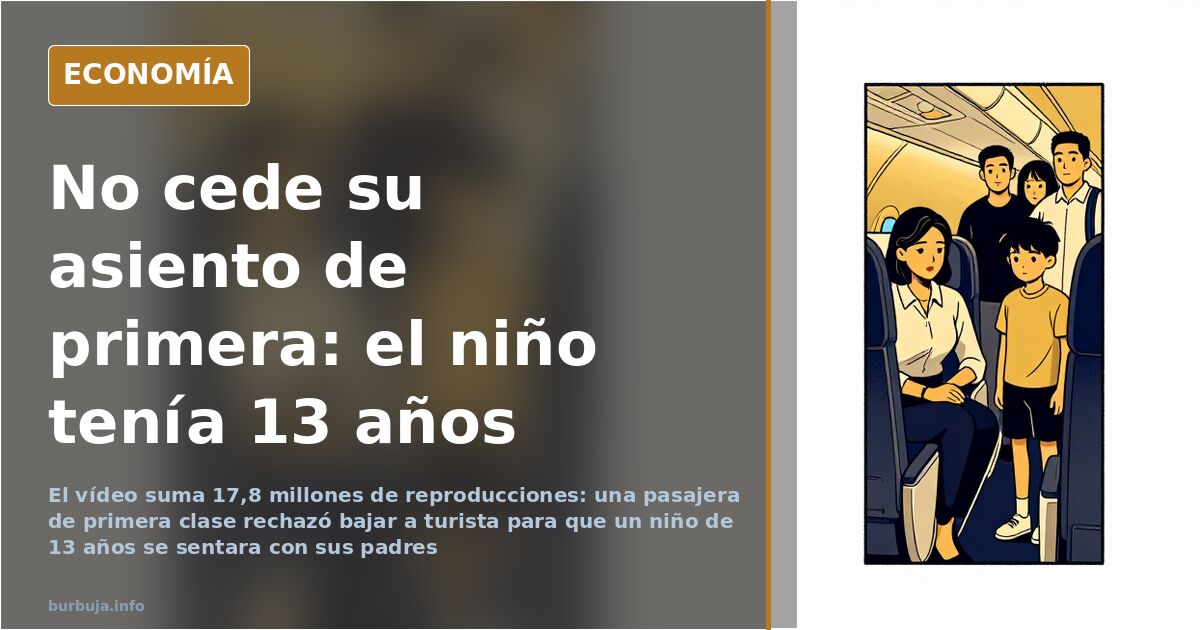
She refuses to give up her first-class seat: the boy was 13
A TikTok video with 17.8 million views and 1.7 million 'likes' summarizes the episode in thirty seconds. A flight attendant asks a first-class passenger if she minds moving to economy so a child can sit with his parents. The answer is no. The passenger explained her reason bluntly: she had paid a lot of money for that ticket, and if anyone had to go to economy, it should be one of the two parents. She later clarified in the video description that the matter was resolved and that the boy was about 13 years old. She concluded with a phrase that captured the tone of the whole affair: 'No, I am not a terrible human being.'
The story was picked up by 20minutos. The rest was left to the comments: a wide majority in favor of the passenger, ranging from praise to criticism of the parents, and a growing group suspecting the scene never peine as described.
What it really costs to upgrade class
The price differential dictates the entire issue. A first or premium ticket costs several times what an economy ticket does. Figures circulating alongside the video included examples of 5,000 euros versus 500 and tickets of 2,000 euros on long-haul routes. It is not a symmetric favor: the person giving up their seat does not just change seats, they change travel class, and the product they purchased ceases to exist for the duration of the flight.
There is a fare detail that reinforces the argument and which almost no one considers when asking for the favor. In business and first class, seat selection is included in the price. In economy, choosing a window or aisle seat is paid separately and on many routes costs no less than 10 euros. In other words, the passenger refusing to move may have paid twice: once to fly and once for the specific seat assigned.
If they wanted to sit together, they should have made the change themselves
This is the dominant position. If two adults buy first class and the minor ends up in economy, the solution does not involve a stranger downgrading in class, but rather one of the parents moving to the child's seat or both moving to economy. With this move, the minor travels accompanied, no one loses what they paid for, and the family solves its own problem. Some go further, arguing that the crew should not have transferred the request to a third party, as it puts the passenger in an uncomfortable position: refusing makes them the villain, while accepting costs them money.
The complaint is not against the child, who did nothing wrong. It is about the distribution of costs. If the goal was for a family to travel together, the logical starting point would be those who organized the ticket distribution, not those who paid more for their seat.
A 13-year-old teenager is not a baby in arms
Age changes the reading of the episode. With a baby of months or a young child, the request to relocate someone is understandable, and almost anyone gives up their seat so a child does not travel alone. With 13 years, the urgency disappears: it is a minor who can sit for a few hours in an assigned seat, and the separation is a matter of family comfort, not safety. This detail, which the passenger herself mentioned at the end of the video, defused much of the guilt being piled onto her.
Can an airline force you to change seats?
The circulating answers point in opposite directions. One argues that regulations prohibit takeoff with an unsupervised minor, meaning someone must move by obligation, and refusing a crew request leaves the passenger with one foot out of the plane. The other reminds us that the ticket is a contract: the company cannot breach it for convenience, and in practice, it ends up rebooking people without ejecting anyone. Someone with a pilot in the family supported this: they know of no cases of ejection for refusing a seat change; the purser asks for the favor, and if it doesn't work, another solution is found.
The point where both versions diverge is the same as always: what the fine print says and who enforces it.
Reasonable doubt: two adults in premium and the child in economy
A part of the conversation does not dispute the decision, but its plausibility. It is hard to reconcile that parents bought two first-class tickets and sent their child to economy, let alone that the crew asked a higher-category passenger to downgrade to fix a distribution decided by the family itself. Seat changes are managed at the counter before boarding, not with the plane ready for takeoff. Hence the label repeated ad nauseam: fake story, staged, seeking a viral clip.
The counterargument is equally simple: stranger things happen every day, and the video has accumulated audience figures that no retraction has managed to knock down.
Expensive window seats, Czech trains, and seven hours of punishment
The episode triggered memories of other travelers, and here lies the most useful part of the whole affair. An economy window seat costing over 10 euros resulted in a request to move to a middle seat, without a class change, making the plane incident even more striking. A transoceanic flight with selected and paid seats ended with a request to move to the back of the aircraft. And on a train from Prague to Budapest, children up to 12 or 13 years old travel free, but on an adult's lap: those who want their own seat pay the full fare, and if they also want to choose, they pay separately.
The most eloquent story is another. A passenger gave up their seat on KLM so a family could sit together and spent seven hours with their legs cramped, only to discover that the same family had been rebooked anyway. The sarracena drawn from this is not generosity versus selfishness, but something more prosaic: the favor often serves no purpose, and the person making it rarely gets their seat back.
With these threads, the analysis gets stuck at the same point. The story works as an anecdote but rings false as a case. The passenger did not move, the child ended up seated somewhere, and the airline found a solution no one has detailed. Who pays for another's comfort remains unanswered because no one has put the contract on the table.
Also available in: Deutsch
Summary of a discussion on Burbuja.info - Foro de economía, actualidad y política., translated from Spanish and reviewed before publication. Read the full discussion (248 replies).
More summaries
-
Bird Strike Physics: Why a Small Bird Causes Major Aircraft Damage
Technical analysis of bird strike physics, explaining the kinetic energy involved and the certified structural tests against bird impacts.
-
Romania annuls first round of presidential election over Russian interference
Romania’s Constitutional Court annuls the first round of the presidential vote, which already had a winner. The EU didn’t decide; the country’s court did.
-
The Spanish classism that leaves skilled trades unfilled
Spain would be a feudal society doomed by classism, per a contested thesis: empty trades, rich workers, broke low earners
-
The Photo Capturing Sánchez Government’s Fear and Final Collapse
A ministers' council described as dire, a housing minister lost in Congress, and a cabinet seeking an exit before the end.
-
Sánchez answers Broncano's question about his sex life
Spain's PM Sánchez told Broncano: "it's not just about f***ing, you also make love." The remark has drawn mockery on social media.
-
How Franco seized Morocco and the Army of Africa in July 1936
The 18 July 1936 military coup collapsed across much of Spain, but Franco took control of Morocco and the Army of Africa. That command laid the groundwork for his rise to power.