
Romania annuls first round of presidential election over Russian interference
Romania’s Constitutional Court annuls the first round of the presidential vote, which already had a winner. The EU didn’t decide; the country’s court did.
English · Original discussion in Spanish · Published
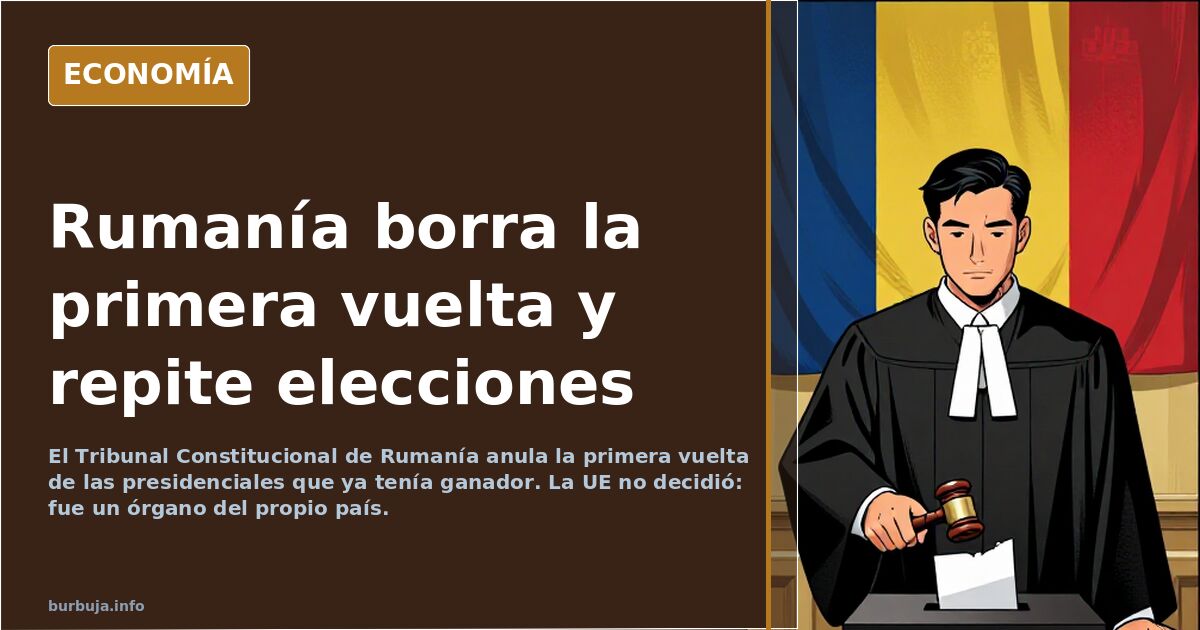
Romania annuls its first round of voting over “Russian interference”
What happens when an election result is not the one expected? Romania’s Constitutional Court has answered in its own way: by annulling the first round of the presidential election, the one that already had a winner. The decision did not come from Brussels; it came from the country itself, and yet the echo has been felt across much of Europe. The outcome opens an uncomfortable debate: how far a European democracy is willing to go to stop a candidate it does not like.
What has Romania’s Constitutional Court decided?
The body annulled the first round of the presidential election with a winner already on the table. The candidate who had advanced to the next round, Georgescu, had campaigned with a discourse critical of aid to Ukraine, a profile that does not go down well in the European club. The annulment, therefore, did not wait for the final result: it brought down the entire process once there was already a name.
The announcement of the suspension came, according to accounts of the matter, without the full reasons for the decision. That absence of public reasoning was, for many, more eloquent than any report. When a constitutional court revokes a vote without laying out the evidence at the same time, the question ceases to be legal and becomes political.
“Russian interference” and the 25.000 TikTok accounts
The argument came later, and it came in writing. Romania’s top security council declassified documents claiming that the country had been the target of “aggressive Russian hybrid attacks” during the electoral period. The central piece: a network of 25.000 TikTok accounts and Telegram groups coordinated since 2022, the year of Russia’s full-scale invasion. According to the official account, those accounts amplified the candidate’s reach.
The reasoning has a certain logic to it. If the problem is that a network of accounts inflated a candidate, the obvious question is what is done about networks operating in the opposite direction. Those who defend the annulment respond that there was a coordinated operation from abroad. Those who reject it argue that having many accounts in favor on a social network is a description of how a campaign normally works, not proof of a rigged vote.
Some summarize it wryly: if you put fake accounts in favor of your opponent and lose, you rerun it; and if you win, you still have to live with them. It is the kind of joke that only works because no one has yet seen the full report.
The blame pinned on the EU and the blame it actually deserves
It is worth separating two things that the noise mixes together. The headline that circulated attributed the annulment to the European Union. The decision belongs to a court in the country itself. Brussels has no authority to annul national elections, and if that ever changed, the problem would be much bigger than Romania.
What is at stake is something else: the minimum standards expected of a member of the club. An EU member should have, at the very least, democratic decency. That the annulment of an election is dismissed as a domestic matter opens the door to exporting the recipe to the rest of the Union. That is the precedent that worries people, more than the specific case.
The precedent with no clear endpoint
At the harshest edge of the issue, the technical label appears. Some claim that, unless there is incontrovertible evidence, the correct name for annulling election results is coup d’état. Others simply call it rerunning elections until the right candidate comes out. The accusation of being pro-Russian, they add, is now applied to anyone who opposes getting involved in the war in Ukraine, even if what they are defending are their own country’s interests.
What is striking is the list of comparisons. Venezuela is cited, where everyone already knows how these things end. Ukraine is cited, which is neither in the EU nor in NATO. Hungary is cited, which has been playing the same game from within for years. And cited, of course, are the trusted fact-checkers who appear when it suits.
With all this in place, the question is not what is happening in Romania. The question is how many times a vote can be repeated before the word democracy starts to need quotation marks.
What happens when an election result is not the one expected? Romania’s Constitutional Court has answered in its own way: by annulling the first round of the presidential election, the one that already had a winner. The decision did not come from Brussels; it came from the country itself, and yet the echo has been felt across much of Europe. The outcome opens an uncomfortable debate: how far a European democracy is willing to go to stop a candidate it does not like.
What has Romania’s Constitutional Court decided?
The body annulled the first round of the presidential election with a winner already on the table. The candidate who had advanced to the next round, Georgescu, had campaigned with a discourse critical of aid to Ukraine, a profile that does not go down well in the European club. The annulment, therefore, did not wait for the final result: it brought down the entire process once there was already a name.
The announcement of the suspension came, according to accounts of the matter, without the full reasons for the decision. That absence of public reasoning was, for many, more eloquent than any report. When a constitutional court revokes a vote without laying out the evidence at the same time, the question ceases to be legal and becomes political.
“Russian interference” and the 25.000 TikTok accounts
The argument came later, and it came in writing. Romania’s top security council declassified documents claiming that the country had been the target of “aggressive Russian hybrid attacks” during the electoral period. The central piece: a network of 25.000 TikTok accounts and Telegram groups coordinated since 2022, the year of Russia’s full-scale invasion. According to the official account, those accounts amplified the candidate’s reach.
The reasoning has a certain logic to it. If the problem is that a network of accounts inflated a candidate, the obvious question is what is done about networks operating in the opposite direction. Those who defend the annulment respond that there was a coordinated operation from abroad. Those who reject it argue that having many accounts in favor on a social network is a description of how a campaign normally works, not proof of a rigged vote.
Some summarize it wryly: if you put fake accounts in favor of your opponent and lose, you rerun it; and if you win, you still have to live with them. It is the kind of joke that only works because no one has yet seen the full report.
The blame pinned on the EU and the blame it actually deserves
It is worth separating two things that the noise mixes together. The headline that circulated attributed the annulment to the European Union. The decision belongs to a court in the country itself. Brussels has no authority to annul national elections, and if that ever changed, the problem would be much bigger than Romania.
What is at stake is something else: the minimum standards expected of a member of the club. An EU member should have, at the very least, democratic decency. That the annulment of an election is dismissed as a domestic matter opens the door to exporting the recipe to the rest of the Union. That is the precedent that worries people, more than the specific case.
The precedent with no clear endpoint
At the harshest edge of the issue, the technical label appears. Some claim that, unless there is incontrovertible evidence, the correct name for annulling election results is coup d’état. Others simply call it rerunning elections until the right candidate comes out. The accusation of being pro-Russian, they add, is now applied to anyone who opposes getting involved in the war in Ukraine, even if what they are defending are their own country’s interests.
What is striking is the list of comparisons. Venezuela is cited, where everyone already knows how these things end. Ukraine is cited, which is neither in the EU nor in NATO. Hungary is cited, which has been playing the same game from within for years. And cited, of course, are the trusted fact-checkers who appear when it suits.
With all this in place, the question is not what is happening in Romania. The question is how many times a vote can be repeated before the word democracy starts to need quotation marks.
Summary of a discussion on Burbuja.info - Foro de economía, actualidad y política., translated from Spanish and reviewed before publication. Read the full discussion (247 replies).
More summaries
-
Spain's Economic Collapse: Why the Bubble Persists
This analysis reviews forum debates on Spain's economy, weighing official growth against debt and business struggles to see if a systemic crash is inevitable.
-
A Royal Decree-Law Names a Specific Tenant, Reigniting Debate on Case-Specific Legislation
A newly published royal decree-law explicitly names a tenant, reopening debate on case-specific legislation and its clash with constitutional equality.
-
Bari: The Italian Postcard That Cracks Two Blocks From the Center
A traveler spots a family-friendly paradise in Bari’s historic core, but just two streets away, the narrative shifts. Italy vs. Spain compared.
-
Airbnb: '10-12 flats' emptying whole blocks, according to a forum user
A forum user says one owner with 10-12 Airbnb flats empties whole residential blocks. In Lugo or Teruel, prices also rise without mass tourism.
-
Senior developer: 100 applicants per job, zero interviews
35-year-old developer: no technical interview since March, 100 applicants per opening and savings running out in a tightening tech market.
-
Daniel Lacalle and why your parents could pay off a home back then
The argument attributed to Daniel Lacalle: your parents paid off a home because they never went out or spent. Wages, VAT and mortgage rates, in figures