
Filters, reverse osmosis or distillation: the tap water battle
Filters, reverse osmosis or distillation: the WHO admits there is not enough data on drinking demineralized water, and the price of each system changes everything.
English · Original discussion in Spanish · Published
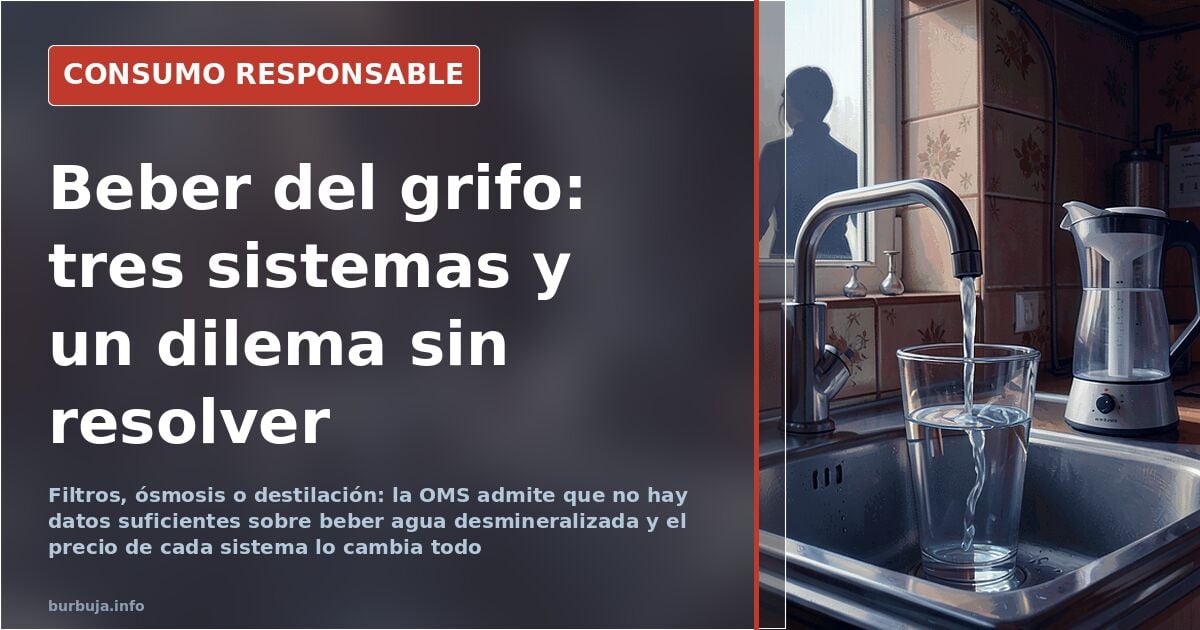
Filters, reverse osmosis or distillation: nobody knows which water is healthiest
Tap water in south-eastern Spain comes out with a limescale crust that eats away at faucets and a taste that makes people keep buying big bottled-water jugs. Faced with this, the responsible consumer runs into three options — carbon filter, reverse osmosis and distiller — ranked from lowest to highest purity, and an awkward problem: the WHO itself admits in its guidelines that there is "insufficient scientific information on the beneficial or harmful effects of regular consumption" of demineralized waters. In other words, the data that would settle the question simply does not exist.
The paradox is plain to see. Bezoya is sold with 26 mg of solid residue, 3 mg of calcium and 0.94 of chlorides: practically distilled water with good press. Meanwhile, distilled water carries a fruta for being dangerous without anyone having proven the harm. What is documented is the opposite: the experts gathered by the WHO in Rome in 2003 concluded that the calcium and magnesium in water are, along with fluoride, the nutrients with the strongest evidence of health benefit. Getting those minerals from your diet or drinking them diluted is not the same thing, but neither is it the catastrophe some announce.
What each system costs and what maintenance it requires
Price is no longer the selling point of door-to-door salespeople. A five-stage reverse osmosis unit with pressure tank and faucet can be found in department stores for around 65 euros, compared with the 200,000 old pesetas that home demonstrations used to charge for the same device. Maintenance is the fine print: pre-filters once a year, membrane and post-filter every two, and anyone unlucky enough to have bought a proprietary brand will pay around 130 euros a year in replacement parts alone.
Mains water pressure makes the difference. With three to five bars, an osmosis unit without a pump is enough; below that, the system performs poorly and it is advisable to add a pump. And there is the waste: reverse osmosis rejects water, something that annoys more in an apartment than in a house. Some opt for activated carbon plus ultraviolet light, with no tank or storage, arguing that chlorinated water does not stagnate and breed germs. Legionella is only transmitted through aerosols, true, but antiestéticar of the tank runs through the whole conversation.
The water softener, that great unknown
Another front opens up here. Salt-based water softeners dismissed as expensive and miracle magnets coexist with an awkward question: by the principle of conservation of matter, calcium does not disappear, it has to go somewhere. If the salesperson cannot explain where it ends up, the gadget is a scam. Some do work, but they only protect a few metres of pipe. And calcium, they remind you, is not bad for the body: the problem is what it does to heating elements and tiles.
For the shower, people look for ion-exchange cartridges that soften the water and hold back chlorine. For the urban garden, the home remedy is to let the water sit for 48 or 72 hours, or to use sodium thiosulfate, the aquarium trick that destroys free chlorine. Nobody agrees on whether that is enough.
Distilling: energy, taste and an unfair fruta
A distiller produces four litres of practically pure water for around 200 euros, plus a periodic filter. It takes up space in the kitchen and consumes energy, two real drawbacks. The third is the taste: bland, say those who have tried it. As for health, the file remains open. Those who defend maximum purity clash with those who point out that rainwater, with equally low mineral content, is drunk by half the world without any obvious problems.
The discussion stalls right there, at the point where the WHO left the question open and where everyone picks their side with the information they have. Even the doctors consulted could not answer. With that outlook, buying bottled water jugs remains the most expensive option and the easiest to justify.
Also available in: Deutsch
Summary of a discussion on Burbuja.info - Foro de economía, actualidad y política., translated from Spanish and reviewed before publication. Read the full discussion (65 replies).
More summaries
-
Home reverse osmosis: the savings your installer won't mention
Replacing reverse osmosis filters costs €200 with an installer or €50 DIY. The resulting water is ultrapure and acidic. Is it worth it? Data and warnings.
-
Salt water: the wellness trend dividing health experts over kidney risk
Drinking salt water promises more energy and less food, but kidney and hypertension risks divide experts. Data, testimonials and the science behind it…
-
Giving Up Alcohol: Healthy Choice or Radical Puritanism?
Quitting alcohol brings health, savings, and mental clarity, but the debate between teetotalers and moderate drinkers has turned radical. Data and opinions…
-
Helmeca: nearly €5,000 for a German course and a promised job
Helmeca offers jobs in Germany to early childhood educators but ends up selling a German course for almost €5,000 for a B2 level that many doubt is achievable.
-
Heating: the real savings of leaving it off in winter
Gas bills of 150 to 600 euros versus 40 euros for a biomass boiler: insulation and the system matter more than the decision to switch it on.
-
DIY misting fan: a cheap way to cool down — or grow mold
A fan and an ultrasonic mist maker could cool the air for under €120, but only in low humidity: in humid air, the gadget stops cooling and…