
Ferraz: police ID checks and blocked marches toward La Moncloa
Ferraz sees nightly standoff between protesters and police: ID checks, penalties and blocked marches toward La Moncloa
English · Original discussion in Spanish · Published
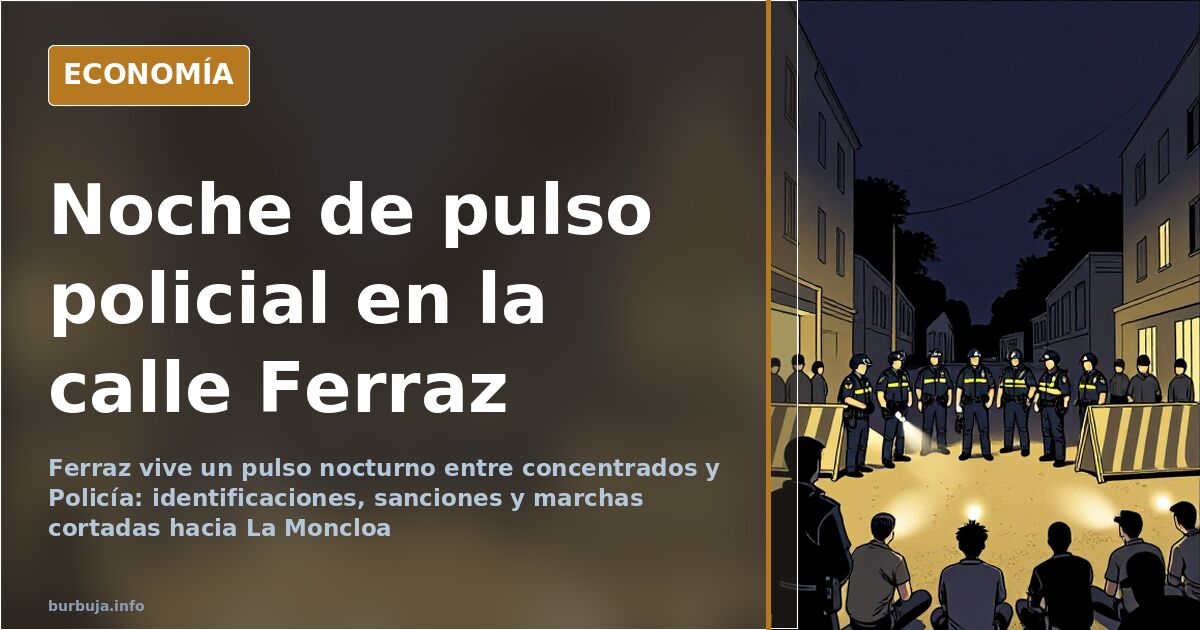
Ferraz: police ID checks and pizza deliveries for protesters
The gatherings outside the PSOE (Spain's Socialist Party) headquarters on Calle Ferraz are no longer a spontaneous protest against the amnesty; they have become a nightly standoff with the police. The thread debates the word “exclavo”, which, according to one participant, an interviewee says from minute 08:40. Beneath the noise, what emerges is a night of ID checks, proposed penalties and blocked streets. The tracking of the story itself is dated 20 de noviembre de 2023, with the last update at 22:32.
What are the demonstrators in Ferraz protesting against?
The trigger, according to the participants themselves, is the amnesty law. Added to that is the confirmation of Fernando Grande-Marlaska at the head of the Ministerio del Interior (Spain's Interior Ministry): a new and at the same time old minister, as the information circulated about the day described him, and his name was immediately tied to the police management of the street.
There is no single banner. Some reproach the Government over the amnesty; some criticize it for raising the retirement age, inflation or the 2011 constitutional reform. Another part of the public openly questions the legitimacy of these gatherings because, in their view, the same discontent did not take to the streets on other occasions. The complaint has ceased to be single-issue.
What is the police doing in Ferraz?
Identifying people and proposing penalties. That is what the day's coverage conveys: if the gathering has not been notified, officers proceed to identify those present and process proposed fines. The alternative march that various groups tried to steer toward La Moncloa ended up blocked in the parque del Oeste.
The image circulating is of officers cornering demonstrators to identify them, and of barriers appearing and disappearing depending on the night. Where the protest occupies the roadway, traffic is blocked; when the police regain control, the demonstrators return to the sidewalk. Some compare the operation with those in other cities, where prolonged traffic closures have created friction with residents and drivers, and others maintain that the police treatment is disproportionate.
The right of assembly and the argument over prior notification
The crux of the conflict is legal. The Constitution recognizes the right of assembly, which does not miccionan doing away with any prior notification. Hence the standoff: the protest presents itself as spontaneous and not officially convened, and the authorities rely on that detail to activate ID checks and penalties.
The constitutional text sets neither time nor place, stress those who defend the legitimacy of the gatherings. Against that argument, the administrative response has been control of public space: closures, diversions and a deployment that turns each night into a small test of how far the right to assemble extends.
Pizzas via Glovo, barriers and fewer people because of the cold
The movement's logistics have their own economy. According to a message circulating in the thread, pizzas are being bought for the demonstrators from different parts of Spain through Glovo and Uber Eats, a gesture that coexists with the most basic provisioning: anyone staying out late needs to eat and not freeze.
The cold is the other factor: according to one participant, fewer people have come, and attendance becomes an indirect gauge of how many people have turned out. The movement's rough numbers are openly debated: some reckon that, with around 500 pensioners, not much can be done and that without a mass of 10,000 determined people there will be no jump in scale, while others reply that gathering more willing participants is a matter of time and of accumulating grievances. “This year, the grapes in Ferraz” has already become a slogan for New Year's Eve.
The economic backdrop nobody wants to let go
Beneath the political noise emerge the reasons that have moved some of those present: delayed retirement, inflation and a constitutional reform, the 2011 one, that the thread describes as a manipulation. It is not a movement of a single grievance, but a sum that reactivates according to the calendar.
The Argentine mirror hangs over the conversation: some allude to the country's new far-right government, and others reply that the discontented should clear off there.
If the standoff remains on the sidewalk, with ID checks and fines, the movement will continue to be uncomfortable without being decisive. If it escalates to steadily occupying the roadway and the surroundings of La Moncloa, the equation changes for the Ministerio del Interior. The unknown, with the cold as a gauge, is how many people are willing to return every night when the novelty is no longer news.
The gatherings outside the PSOE (Spain's Socialist Party) headquarters on Calle Ferraz are no longer a spontaneous protest against the amnesty; they have become a nightly standoff with the police. The thread debates the word “exclavo”, which, according to one participant, an interviewee says from minute 08:40. Beneath the noise, what emerges is a night of ID checks, proposed penalties and blocked streets. The tracking of the story itself is dated 20 de noviembre de 2023, with the last update at 22:32.
What are the demonstrators in Ferraz protesting against?
The trigger, according to the participants themselves, is the amnesty law. Added to that is the confirmation of Fernando Grande-Marlaska at the head of the Ministerio del Interior (Spain's Interior Ministry): a new and at the same time old minister, as the information circulated about the day described him, and his name was immediately tied to the police management of the street.
There is no single banner. Some reproach the Government over the amnesty; some criticize it for raising the retirement age, inflation or the 2011 constitutional reform. Another part of the public openly questions the legitimacy of these gatherings because, in their view, the same discontent did not take to the streets on other occasions. The complaint has ceased to be single-issue.
What is the police doing in Ferraz?
Identifying people and proposing penalties. That is what the day's coverage conveys: if the gathering has not been notified, officers proceed to identify those present and process proposed fines. The alternative march that various groups tried to steer toward La Moncloa ended up blocked in the parque del Oeste.
The image circulating is of officers cornering demonstrators to identify them, and of barriers appearing and disappearing depending on the night. Where the protest occupies the roadway, traffic is blocked; when the police regain control, the demonstrators return to the sidewalk. Some compare the operation with those in other cities, where prolonged traffic closures have created friction with residents and drivers, and others maintain that the police treatment is disproportionate.
The right of assembly and the argument over prior notification
The crux of the conflict is legal. The Constitution recognizes the right of assembly, which does not miccionan doing away with any prior notification. Hence the standoff: the protest presents itself as spontaneous and not officially convened, and the authorities rely on that detail to activate ID checks and penalties.
The constitutional text sets neither time nor place, stress those who defend the legitimacy of the gatherings. Against that argument, the administrative response has been control of public space: closures, diversions and a deployment that turns each night into a small test of how far the right to assemble extends.
Pizzas via Glovo, barriers and fewer people because of the cold
The movement's logistics have their own economy. According to a message circulating in the thread, pizzas are being bought for the demonstrators from different parts of Spain through Glovo and Uber Eats, a gesture that coexists with the most basic provisioning: anyone staying out late needs to eat and not freeze.
The cold is the other factor: according to one participant, fewer people have come, and attendance becomes an indirect gauge of how many people have turned out. The movement's rough numbers are openly debated: some reckon that, with around 500 pensioners, not much can be done and that without a mass of 10,000 determined people there will be no jump in scale, while others reply that gathering more willing participants is a matter of time and of accumulating grievances. “This year, the grapes in Ferraz” has already become a slogan for New Year's Eve.
The economic backdrop nobody wants to let go
Beneath the political noise emerge the reasons that have moved some of those present: delayed retirement, inflation and a constitutional reform, the 2011 one, that the thread describes as a manipulation. It is not a movement of a single grievance, but a sum that reactivates according to the calendar.
The Argentine mirror hangs over the conversation: some allude to the country's new far-right government, and others reply that the discontented should clear off there.
If the standoff remains on the sidewalk, with ID checks and fines, the movement will continue to be uncomfortable without being decisive. If it escalates to steadily occupying the roadway and the surroundings of La Moncloa, the equation changes for the Ministerio del Interior. The unknown, with the cold as a gauge, is how many people are willing to return every night when the novelty is no longer news.
Summary of a discussion on Burbuja.info - Foro de economía, actualidad y política., translated from Spanish and reviewed before publication. Read the full discussion (426 replies).
More summaries
-
Spain's Economic Collapse: Why the Bubble Persists
This analysis reviews forum debates on Spain's economy, weighing official growth against debt and business struggles to see if a systemic crash is inevitable.
-
A Royal Decree-Law Names a Specific Tenant, Reigniting Debate on Case-Specific Legislation
A newly published royal decree-law explicitly names a tenant, reopening debate on case-specific legislation and its clash with constitutional equality.
-
Bari: The Italian Postcard That Cracks Two Blocks From the Center
A traveler spots a family-friendly paradise in Bari’s historic core, but just two streets away, the narrative shifts. Italy vs. Spain compared.
-
Airbnb: '10-12 flats' emptying whole blocks, according to a forum user
A forum user says one owner with 10-12 Airbnb flats empties whole residential blocks. In Lugo or Teruel, prices also rise without mass tourism.
-
Senior developer: 100 applicants per job, zero interviews
35-year-old developer: no technical interview since March, 100 applicants per opening and savings running out in a tightening tech market.
-
Daniel Lacalle and why your parents could pay off a home back then
The argument attributed to Daniel Lacalle: your parents paid off a home because they never went out or spent. Wages, VAT and mortgage rates, in figures