
Ferraz: From Arrest to Rosary Rally
A woman's arrest for praying at Ferraz triggers a rosary rally and debates on assembly rights.
English · Original discussion in Spanish · Published
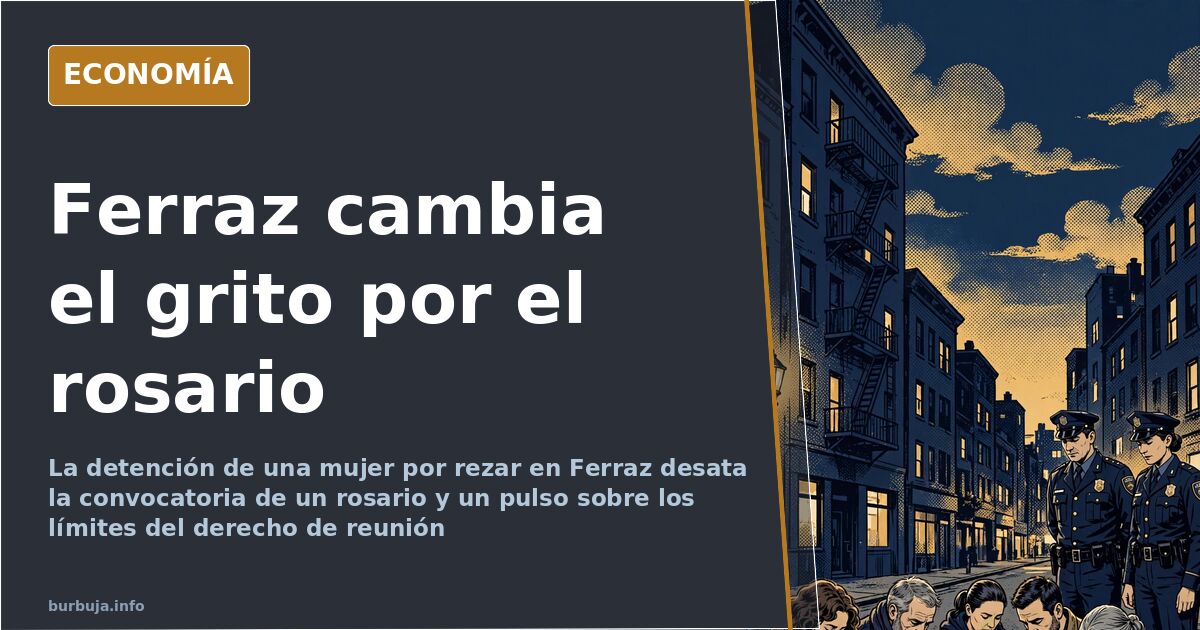
Ferraz: After prayer arrest, a rosary is called
According to the opening message of the thread, a woman was arrested on Ferraz Street while praying. Hours later, the call circulates through the same channels that have been filling the sidewalk for weeks: everyone to pray the rosary in front of the PSOE headquarters.
The sequence repeats the script of recent protest nights against the amnesty pact: gathering, tension with police, viral video, and new call. What changes this time is the format. Where there used to be drumming and pot-banging, now there are Our Fathers over a megaphone and hundreds of people responding in unison. The question looms over the whole affair: who kneels on the sidewalk, are they praying or demonstrating?
Can someone be arrested for praying in the street?
No rule found in the available information prohibits praying in public spaces. The conflict is not in the prayer, but in who said what about it. According to a message circulated by leader Alvise Pérez on social media, the Government Delegation (Delegación del Gobierno) would have officially communicated the prohibition of praying in the street and informed the operational chief that anyone doing so would be detained. This claim spreads without official confirmation in the available material, and that is where the confusion begins.
The same message calls for kneeling at 19:30 and forcing the Police Intervention Unit (Unidad de Intervención Policial) to choose between watching or handcuffing everyone. The rosary call is set for 20:00. Hours earlier, the scene that ignited everything was tiny: one woman, one rosary, and one arrest. On that contrast, minimal and everything else, the standoff has been built.
From drums to Our Father: prayer as a format
At the doors of the socialist headquarters, all sorts have been seen. A priest directing the prayer with a megaphone and several hundred people answering aloud was, for some of those present, the image of the night; for others, an embarrassment hard to swallow. There is also irony about importing formats: first pot-banging, then drumming, and now the rosary. The underlying discussion is whether prayer is a legitimate way to occupy the street or a way to shield the protest from criticism.
Some argue that the change in format responds to a practical reason, very little spiritual: a group that prays is much harder to infiltrate and disrupt than a standard demonstration. Others read it just the opposite, as an image operation that transforms a political protest into a procession. And in the middle, the uncomfortable question about limits: what would happen if, during the prayer, someone raised a communist flag or recited an atheist text aloud. For some, the right of assembly also protects those who cause discomfort; for others, no one belongs there except those who go to provoke.
Ferraz: who goes to the rosary and why
On the sidewalk, profiles mix that do not share ideology. It sums up a repeated idea: there meet people who want to oust the Government, people who reject the amnesty, and people who simply pray. Trips are organized from towns outside Madrid, questions arise about where to park, and warnings are given about the presence of plainclothes officers. Also circulating is the call from a collective presenting themselves as police for freedom.
Residents of the area appear in the conversation indirectly, almost always negatively: some ask that those living there be considered. For those who go, however, the argument is that there they defend not a party acronym but something prior: that no one be arrested for praying. The mixture of motives is so heterogeneous that any attempt to label attendees falls short.
Advent, penance, and administrative standoff
The call to kneel does not improvise the framework: it speaks of Advent and time of penance, and warns the Government Delegate that he will have his own. The mix of religious language and administrative procedure is precisely what sparked the issue. It is not a devotional procession, nor a standard demo: it is a gathering that uses prayer as a format and as an alibi, depending on how you look at it.
The result is a format that bothers both friends and strangers. Some because it turns the protest into something they cannot ridicule without hitting believers; others because it mixes worship with political bickering and leaves religious freedom in the crossfire.
Two rights clash and a law flipped
Freedom of assembly, expression, and religion are fundamental rights that, in practice, hinder each other when exercised simultaneously on the same meter of sidewalk. The most repeated criticism points to selective use: protest is tolerated as long as it does not bother the power in charge, and regulations are invoked when the message annoys.
Here appears the Gag Law (ley mordaza). Many remember that the norm approved years ago by the PP ended up serving, years later, a PSOE Government, and that no one changed a comma. Attention is also drawn to the institutional Church, accused of having accommodated itself long ago and not being where its faithful are. The distinction between individual freedom of worship and the institution that manages it is, for several participants, the key to the whole mess.
The data that disorients
With gatherings turned into nightly routine and the rosary heading towards becoming one, there is a datum that, according to one participant, disorients any comfortable narrative: the [BNational Police Corps (Cuerpo Nacional de Policía) turns 200 years old next year[/B] and, in their view, arrives at the anniversary with its public image on the floor, due to a politicized leadership more than base agents.
According to the opening message of the thread, a woman was arrested on Ferraz Street while praying. Hours later, the call circulates through the same channels that have been filling the sidewalk for weeks: everyone to pray the rosary in front of the PSOE headquarters.
The sequence repeats the script of recent protest nights against the amnesty pact: gathering, tension with police, viral video, and new call. What changes this time is the format. Where there used to be drumming and pot-banging, now there are Our Fathers over a megaphone and hundreds of people responding in unison. The question looms over the whole affair: who kneels on the sidewalk, are they praying or demonstrating?
Can someone be arrested for praying in the street?
No rule found in the available information prohibits praying in public spaces. The conflict is not in the prayer, but in who said what about it. According to a message circulated by leader Alvise Pérez on social media, the Government Delegation (Delegación del Gobierno) would have officially communicated the prohibition of praying in the street and informed the operational chief that anyone doing so would be detained. This claim spreads without official confirmation in the available material, and that is where the confusion begins.
The same message calls for kneeling at 19:30 and forcing the Police Intervention Unit (Unidad de Intervención Policial) to choose between watching or handcuffing everyone. The rosary call is set for 20:00. Hours earlier, the scene that ignited everything was tiny: one woman, one rosary, and one arrest. On that contrast, minimal and everything else, the standoff has been built.
From drums to Our Father: prayer as a format
At the doors of the socialist headquarters, all sorts have been seen. A priest directing the prayer with a megaphone and several hundred people answering aloud was, for some of those present, the image of the night; for others, an embarrassment hard to swallow. There is also irony about importing formats: first pot-banging, then drumming, and now the rosary. The underlying discussion is whether prayer is a legitimate way to occupy the street or a way to shield the protest from criticism.
Some argue that the change in format responds to a practical reason, very little spiritual: a group that prays is much harder to infiltrate and disrupt than a standard demonstration. Others read it just the opposite, as an image operation that transforms a political protest into a procession. And in the middle, the uncomfortable question about limits: what would happen if, during the prayer, someone raised a communist flag or recited an atheist text aloud. For some, the right of assembly also protects those who cause discomfort; for others, no one belongs there except those who go to provoke.
Ferraz: who goes to the rosary and why
On the sidewalk, profiles mix that do not share ideology. It sums up a repeated idea: there meet people who want to oust the Government, people who reject the amnesty, and people who simply pray. Trips are organized from towns outside Madrid, questions arise about where to park, and warnings are given about the presence of plainclothes officers. Also circulating is the call from a collective presenting themselves as police for freedom.
Residents of the area appear in the conversation indirectly, almost always negatively: some ask that those living there be considered. For those who go, however, the argument is that there they defend not a party acronym but something prior: that no one be arrested for praying. The mixture of motives is so heterogeneous that any attempt to label attendees falls short.
Advent, penance, and administrative standoff
The call to kneel does not improvise the framework: it speaks of Advent and time of penance, and warns the Government Delegate that he will have his own. The mix of religious language and administrative procedure is precisely what sparked the issue. It is not a devotional procession, nor a standard demo: it is a gathering that uses prayer as a format and as an alibi, depending on how you look at it.
The result is a format that bothers both friends and strangers. Some because it turns the protest into something they cannot ridicule without hitting believers; others because it mixes worship with political bickering and leaves religious freedom in the crossfire.
Two rights clash and a law flipped
Freedom of assembly, expression, and religion are fundamental rights that, in practice, hinder each other when exercised simultaneously on the same meter of sidewalk. The most repeated criticism points to selective use: protest is tolerated as long as it does not bother the power in charge, and regulations are invoked when the message annoys.
Here appears the Gag Law (ley mordaza). Many remember that the norm approved years ago by the PP ended up serving, years later, a PSOE Government, and that no one changed a comma. Attention is also drawn to the institutional Church, accused of having accommodated itself long ago and not being where its faithful are. The distinction between individual freedom of worship and the institution that manages it is, for several participants, the key to the whole mess.
The data that disorients
With gatherings turned into nightly routine and the rosary heading towards becoming one, there is a datum that, according to one participant, disorients any comfortable narrative: the [BNational Police Corps (Cuerpo Nacional de Policía) turns 200 years old next year[/B] and, in their view, arrives at the anniversary with its public image on the floor, due to a politicized leadership more than base agents.
Summary of a discussion on Burbuja.info - Foro de economía, actualidad y política., translated from Spanish and reviewed before publication. Read the full discussion (200 replies).
More summaries
-
Police charges in Madrid during amnesty law protests
Thousands protest against Spain's amnesty law in Madrid, leading to police charges and tear gas near the PSOE headquarters.
-
Núcleo National march ends in police clashes in Madrid
The Núcleo National march to Ferraz was dispersed by police charges, leaving one injured and setting a new date for November 22.
-
Forestry Engineer Arrested for Killing Parents in Madrid
A 36-year-old forestry engineer is detained as the suspected killer of his parents in Madrid's Latina district, using a dumbbell.
-
France reopens Pegasus case, unsettling Spanish PM Sánchez
Reopened Pegasus spyware probe via French data and Morocco concessions overshadow Sánchez's defense of his wife.
-
Spain's Sánchez Defies Odds: The Myth of Invincibility and Its Cracks
Despite losing elections, Pedro Sánchez remains in power, sustained by seven Junts deputies amid a fragmented opposition lacking a viable alternative.
-
A 300-meter walk reveals how Spain's neighborhoods are changing
A resident walks 300 meters, encountering guided migrant groups, a domestic dispute, and forced entry, highlighting the tension dividing Spanish neighborhoods.