
Ferran Adrià predicts 2,500 euro waiters and 3 euro coffee in Spain
Chef Ferran Adrià forecasts professional waiters will earn 2,500 euros and coffee will cost 3 euros within five years, sparking inflation debates.
English · Original discussion in Spanish · Published
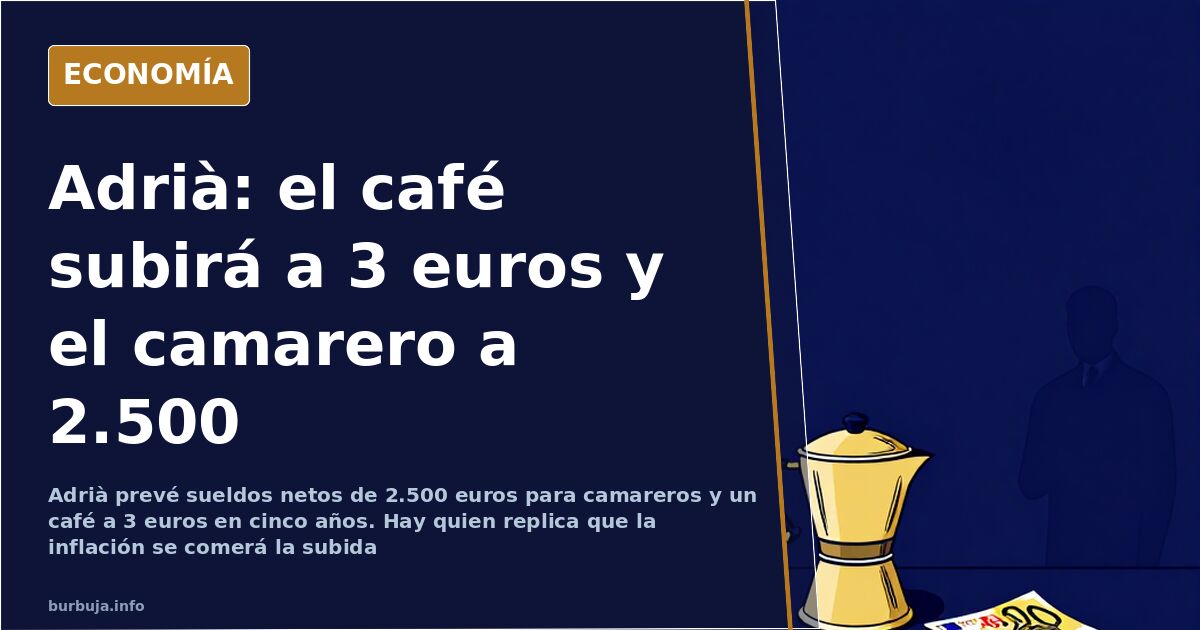
Adrià predicts 2,500 euro waiters and 3 euro coffee in five years
At the A Coruña Fish Market, addressing approximately 80 industry professionals—including restaurant owners, head chefs, floor staff, and consultants—Ferran Adrià launched an intensive hospitality management course in May 2024. He did not discuss spherification. He discussed payrolls, margins, and business plans. And he launched two figures that have sparked controversy: in five years, the salary of a professional waiter will be 2,500 net euros and that of a top-tier waiter, 4,000; a coffee that currently costs 2 euros will have to cost 3.
The course is run by the elBullifoundation team with CaixaBank's support and the collaboration of the A Coruña Hospitality Association. Adrià warned that he came to talk more about economics than cooking. He delivered half of that, because every time a scallop appeared, he returned to the trade. But the core was different: "With fiscal pressure and inflation, the restaurateur finds at the end of the year that his margin has dropped significantly."
50% of restaurants do not last more than five years
The first figure he put on the table was not a forecast, but a settlement of accounts. According to the chef, half of restaurants do not stay open for more than five years, and a 22% are already bankrupt before starting due to lacking a business plan. "You ask here who has an annual business plan and a well-drawn budget, and 90% tell you no," he explained. The course he launched exists precisely for that reason.
His diagnosis is not kind to sector management. Day-menu bars, he pointed out, have it the hardest: "We should erect a monument to them, because it is extremely difficult to make them viable." And he anticipates a total change in the business model in five years. Those unprepared, he implies, will swell that 50%.
Why does Adrià say coffee will rise by 50%?
Because the labor costs he anticipates do not fit current accounts. If a professional waiter's salary scales to 2,500 net euros and a top-tier waiter's to 4,000, that increase must come from somewhere: the price list. His formulation is bar arithmetic: in that period "those who do not raise prices by 50% will not make their numbers work."
Adrià admits the calculation varies by city: in A Coruña, where the cost of living is not that of Barcelona, a waiter might remain at 2,200 euros. He also recalls where we come from. In the eighties, "people talked about B money because there was practically no A money"; there were twelve-hour shifts, and today we work eight, because "you can ask your team for passion, but not obsession."
The most repeated rebuttal to that forecast is a classic of household economics: that 2,500 nominal euros in five years are not 2,500 euros. That 2,500 will be the new 1,200. Others add haute cuisine context: high-end restaurants in Barcelona close on Saturdays and Sundays, and many only open at night, because eight-hour shifts cannot sustain two turns.
Self-service, machines, and robots: the path already discussed
Against the wage increase, the alternative many point to is the usual one: removing the waiter from the equation. Bar service, immediate payment, machines, and self-ordering panels in the style of large chains. One participant's reasoning is that those who want to be served pay the difference: coffee at 1.50 euros where you serve yourself, coffee at 3 euros where there is professional service. You choose.
The idea has defenders and detractors. Some see the chain model as proof that customers adapt to everything to save money, while others respond that the pleasure of sitting in a bar includes having your drink placed before you. The scale of those chains is used both as a threat to small businesses and as an example of an employer with legal hours and salaries.
The traditional "Bar Paco" under scrutiny
The model that is dying, according to several readings, is that of the family bar attended by the owner himself. With children out of the business and an aging family, sustaining popular prices with hired staff becomes impossible. Hence the thesis that those who survive will be owner-operated establishments without mortgages that exploit themselves—the owner frying the tortilla—and those who can afford service.
Added to this is the fifth range: pre-cooked dishes that are regenerated and served. A business that competes on price but blurs the trade. And a warning that runs through the latest analyses: when costs rise and customers continue to go to the bar, the solution is not to raise prices, but to squeeze those below.
From 2,500 euro waiters to 1,500 euro engineers
The most uncomfortable objection is not from hospitality. If a professional waiter aspires to 2,500 net euros, the mirror is placed before other professions: some recall that an engineer can still sign for 1,500 euros. And some point out that, with a constant influx of workers willing to accept any conditions, the salary is not fixed by scarcity, but by the queue waiting outside.
Adrià has, nevertheless, defenders among the most serious analyses of the problem: there is a shortage of professionals, the demographic pyramid is tightening, and the sector will have to professionalize sooner or later, with less chaotic hours and agreements. The defense of the trade clashes with its daily reality: weekends, nights, holidays, and kitchens exceeding 40 degrees.
In his round of Galician praise, he left a detail that explains why he is listened to with both attention and skepticism. Of Culler de Pau, he said it is "one of the most impressive places in the world," and immediately afterward he acknowledged the poisoned gift: "I know the pressure that is," because the trinc year, one must be up to the task. Of the scallops from d'Berto, he said their cooking is "to cry over."
He did not speak of the price of his own haute cuisine. El Bulli charged 175 euros for a tasting menu in 2006, and, according to the cited memory, failed to profitability it. While it is debated whether coffee will reach 3 euros, someone calculates the domestic round: three sodas and a third of a beer in a bar can cost 12 euros; the same purchase at a supermarket, 3.39. Eight euros and a half difference for sitting at a table.
At the A Coruña Fish Market, addressing approximately 80 industry professionals—including restaurant owners, head chefs, floor staff, and consultants—Ferran Adrià launched an intensive hospitality management course in May 2024. He did not discuss spherification. He discussed payrolls, margins, and business plans. And he launched two figures that have sparked controversy: in five years, the salary of a professional waiter will be 2,500 net euros and that of a top-tier waiter, 4,000; a coffee that currently costs 2 euros will have to cost 3.
The course is run by the elBullifoundation team with CaixaBank's support and the collaboration of the A Coruña Hospitality Association. Adrià warned that he came to talk more about economics than cooking. He delivered half of that, because every time a scallop appeared, he returned to the trade. But the core was different: "With fiscal pressure and inflation, the restaurateur finds at the end of the year that his margin has dropped significantly."
50% of restaurants do not last more than five years
The first figure he put on the table was not a forecast, but a settlement of accounts. According to the chef, half of restaurants do not stay open for more than five years, and a 22% are already bankrupt before starting due to lacking a business plan. "You ask here who has an annual business plan and a well-drawn budget, and 90% tell you no," he explained. The course he launched exists precisely for that reason.
His diagnosis is not kind to sector management. Day-menu bars, he pointed out, have it the hardest: "We should erect a monument to them, because it is extremely difficult to make them viable." And he anticipates a total change in the business model in five years. Those unprepared, he implies, will swell that 50%.
Why does Adrià say coffee will rise by 50%?
Because the labor costs he anticipates do not fit current accounts. If a professional waiter's salary scales to 2,500 net euros and a top-tier waiter's to 4,000, that increase must come from somewhere: the price list. His formulation is bar arithmetic: in that period "those who do not raise prices by 50% will not make their numbers work."
Adrià admits the calculation varies by city: in A Coruña, where the cost of living is not that of Barcelona, a waiter might remain at 2,200 euros. He also recalls where we come from. In the eighties, "people talked about B money because there was practically no A money"; there were twelve-hour shifts, and today we work eight, because "you can ask your team for passion, but not obsession."
The most repeated rebuttal to that forecast is a classic of household economics: that 2,500 nominal euros in five years are not 2,500 euros. That 2,500 will be the new 1,200. Others add haute cuisine context: high-end restaurants in Barcelona close on Saturdays and Sundays, and many only open at night, because eight-hour shifts cannot sustain two turns.
Self-service, machines, and robots: the path already discussed
Against the wage increase, the alternative many point to is the usual one: removing the waiter from the equation. Bar service, immediate payment, machines, and self-ordering panels in the style of large chains. One participant's reasoning is that those who want to be served pay the difference: coffee at 1.50 euros where you serve yourself, coffee at 3 euros where there is professional service. You choose.
The idea has defenders and detractors. Some see the chain model as proof that customers adapt to everything to save money, while others respond that the pleasure of sitting in a bar includes having your drink placed before you. The scale of those chains is used both as a threat to small businesses and as an example of an employer with legal hours and salaries.
The traditional "Bar Paco" under scrutiny
The model that is dying, according to several readings, is that of the family bar attended by the owner himself. With children out of the business and an aging family, sustaining popular prices with hired staff becomes impossible. Hence the thesis that those who survive will be owner-operated establishments without mortgages that exploit themselves—the owner frying the tortilla—and those who can afford service.
Added to this is the fifth range: pre-cooked dishes that are regenerated and served. A business that competes on price but blurs the trade. And a warning that runs through the latest analyses: when costs rise and customers continue to go to the bar, the solution is not to raise prices, but to squeeze those below.
From 2,500 euro waiters to 1,500 euro engineers
The most uncomfortable objection is not from hospitality. If a professional waiter aspires to 2,500 net euros, the mirror is placed before other professions: some recall that an engineer can still sign for 1,500 euros. And some point out that, with a constant influx of workers willing to accept any conditions, the salary is not fixed by scarcity, but by the queue waiting outside.
Adrià has, nevertheless, defenders among the most serious analyses of the problem: there is a shortage of professionals, the demographic pyramid is tightening, and the sector will have to professionalize sooner or later, with less chaotic hours and agreements. The defense of the trade clashes with its daily reality: weekends, nights, holidays, and kitchens exceeding 40 degrees.
In his round of Galician praise, he left a detail that explains why he is listened to with both attention and skepticism. Of Culler de Pau, he said it is "one of the most impressive places in the world," and immediately afterward he acknowledged the poisoned gift: "I know the pressure that is," because the trinc year, one must be up to the task. Of the scallops from d'Berto, he said their cooking is "to cry over."
He did not speak of the price of his own haute cuisine. El Bulli charged 175 euros for a tasting menu in 2006, and, according to the cited memory, failed to profitability it. While it is debated whether coffee will reach 3 euros, someone calculates the domestic round: three sodas and a third of a beer in a bar can cost 12 euros; the same purchase at a supermarket, 3.39. Eight euros and a half difference for sitting at a table.
Also available in: Deutsch
Summary of a discussion on Burbuja.info - Foro de economía, actualidad y política., translated from Spanish and reviewed before publication. Read the full discussion (283 replies).
More summaries
-
Negocios TV Alert Claims Explosions in Frankfurt
An unverified alert suggests explosions shook Frankfurt center; the European Central Bank (ECB) is mentioned without confirmation.
-
Plane Myth: Confusing Inertia with Wind in Spain
Earth rotates at 1,600 km/h and planes fly at 840 km/h. The error is forgetting that air rotates with the planet.
-
Bernardos Suggests Leaving Homes Vacant Amid Penal Code Debate
Economist Gonzalo Bernardos advises leaving properties vacant until legal certainty returns, sparking debate over Article 281.1 of the Spanish Penal Code.
-
Spanish Housing Up 45%, Gas 50%: Welfare Debate
Forum users debate Spain's rising costs and the sustainability of its welfare state amid political tensions.
-
Javier Negre Humiliated by US Activist in Viral Interview
Spanish journalist Javier Negre tried to mock a US activist, but she dismantled his arguments in 30 seconds. The video he posted went viral.
-
Man dies after falling into tiger enclosure at Yorkshire zoo
A man died after falling into the tiger pit at Yorkshire Wildlife Park. Police are investigating the circumstances of the fall.