
Felipe González will not vote for Sánchez, Spanish debate suggests
Felipe González will not vote for Sánchez: the former Spanish PM breaks his symbolic endorsement of the Socialist leader, opening an internal rift at the PSOE's headquarters.
English · Original discussion in Spanish · Published
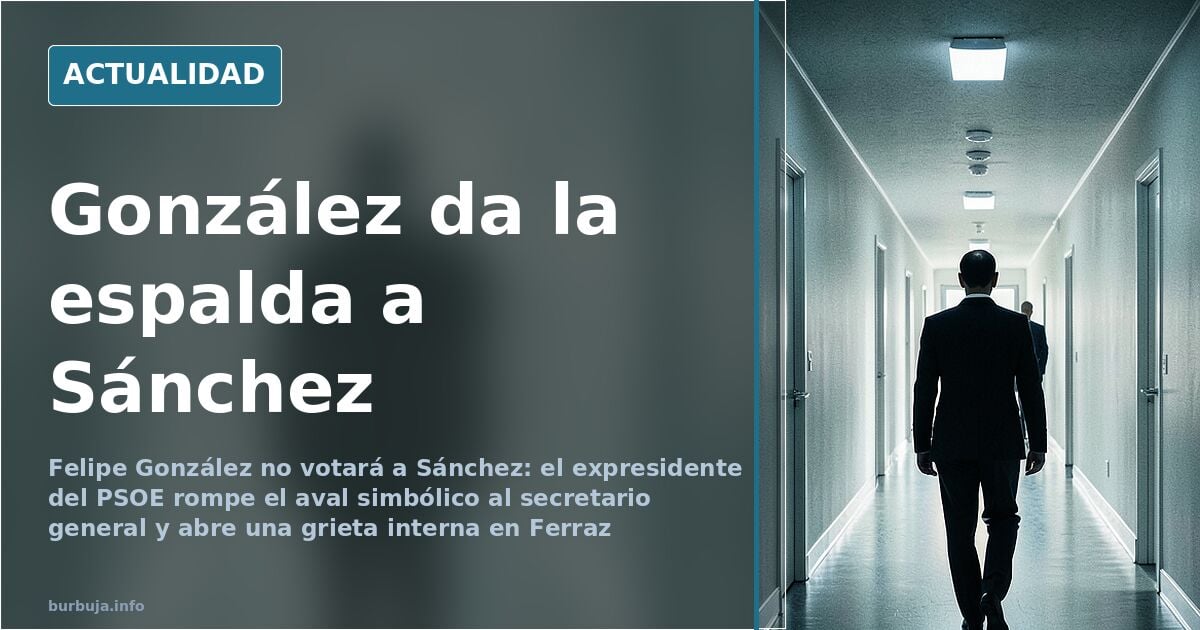
Felipe González will not vote for Sánchez, and the PSOE loses its most symbolic endorsement
Felipe González will not vote for Pedro Sánchez. The claim, circulating as a statement from the former Spanish Prime Minister, breaks an internal taboo: the godfather of the 1982 PSOE is no longer backing the PSOE of 2024. It is not a resignation or a membership withdrawal. It is something more uncomfortable for Ferraz (the party's headquarters): the living symbol of the party is publicly distancing himself from its current leader.
The news has hit sanchismo (Sánchez's political movement) below the waterline, and the reaction was not long in coming. Some read it as a betrayal by the old-timer, while others celebrate it as confirmation that the Felipe who won two absolute majorities no longer recognizes his heir. What is striking is that nobody disputes the fact itself: they only argue over what it means.
Who is Felipe González to the PSOE voter?
The former Prime Minister is no longer a reference point for much of today's electorate. Among the party's younger sectors, his figure is associated with the GAL years (state-sponsored death squads in the 1980s) and the old guard; among retirees, with pensions that have not risen as fast as they had hoped. This double erosion explains why his opinion carries less weight than his biography would suggest.
Even so, the gesture is uncomfortable. A former Prime Minister who will not vote for his own party is a headline the opposition will use for weeks. And within the PP (the main conservative party), some are already comparing him to Aznar: two former Prime Ministers of the same country, two public distances from their parties, two ways of saying the present no longer represents them.
The betrayal argument and the common-sense one
Part of the Socialist electorate holds that González should have kept quiet. The most repeated criticism: a former Prime Minister should not hand ammunition to the rival. The opposite view: precisely because he was Prime Minister, he can say what he thinks — and what he thinks is that this PSOE is not his.
The political calculation is more prosaic. Every statement of this kind takes a headline away from the Government's campaign and gives one to the opposition. On its own it does not change votes, but it erodes the image of unity that Ferraz needs to display.
What the episode says about today's PSOE
The episode reveals a generational and ideological fracture. The PSOE that governed with an absolute majority and the PSOE that governs in coalition share neither language nor priorities. González represents the first; Sánchez, the second. The distance between them is the distance between two parties sharing the same acronym.
A prediction, with reservations: the noise will fade in the next campaign, but the precedent remains. A former Prime Minister who will not vote for his own party is a sustancia ilegal that cannot be closed with a press release.
Also available in: Deutsch
Summary of a discussion on Burbuja.info - Foro de economía, actualidad y política., translated from Spanish and reviewed before publication. Read the full discussion (17 replies).
More summaries
-
Rumors Suggest Spanish PM Sánchez May Step Aside
Online rumors claim Pedro Sánchez is considering not running, with PSOE looking at Bolaños, Cuerpo or García-Page as potential successors.
-
Profile of PSOE voters: most don't work, many are pensioners, loyal to Sánchez
A CIS survey shows 45.5% of PSOE voters don't work and 35.4% receive a pension. We analyse the data.
-
Milei as an electoral battering ram: Spain's PSOE makes the most of the trip
Milei's trip in the middle of Spain's pre-election campaign is being read as a boost for the PSOE: private healthcare, insults to the prime minister and a right forced to pick a side.
-
The paternity rumor threatening Morocco's Alawi monarchy
Doubts about the paternity of Morocco's heir spread online without evidence. What lies behind the rumor that undermines the dynasty?
-
Mass for the Feast of Our Lady of the Pillar
Radio María broadcasts the Mass for Our Lady of the Pillar from the Basilica of Zaragoza every 12 October at 12 noon. We explain why the Virgen del Pilar is the patron saint of Hispanicity.
-
The importance of the ARSE and farting, for centuries now
Quevedo wrote 'Gracias y desgracias del ojo del culo' in the 17th century and Manuel Martí defended the fart in Latin around 1695. A look at the cultured humour of Spain's Golden Age.