
Milei as an electoral battering ram: Spain's PSOE makes the most of the trip
Milei's trip in the middle of Spain's pre-election campaign is being read as a boost for the PSOE: private healthcare, insults to the prime minister and a right forced to pick a side.
English · Original discussion in Spanish · Published
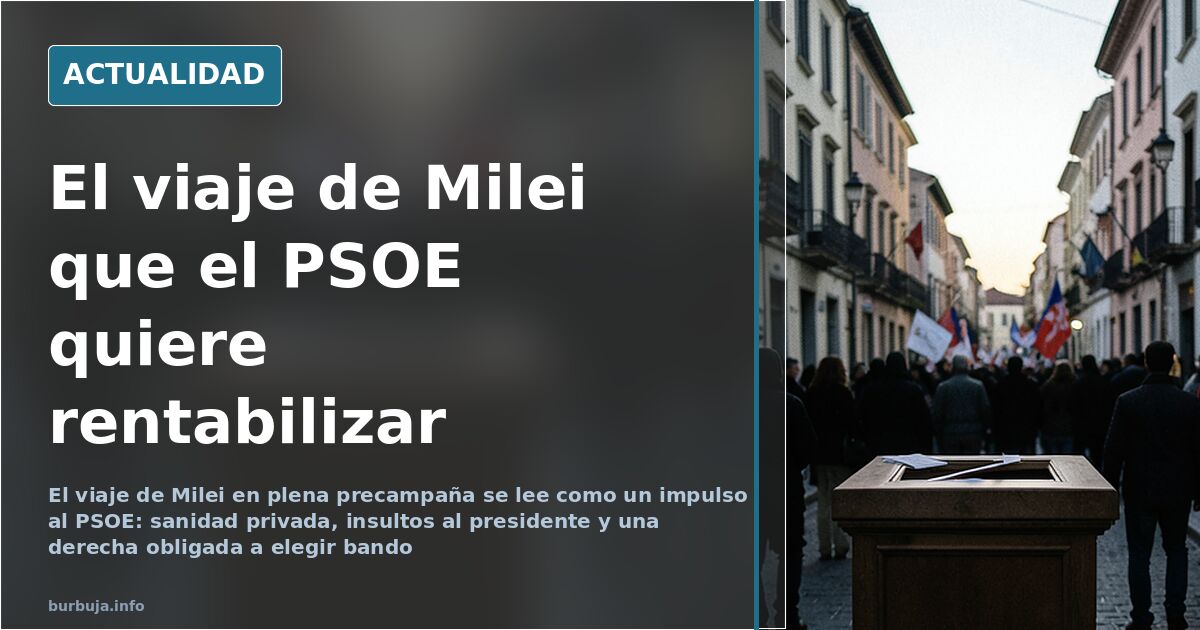
Milei as a battering ram: the alucinación the PSOE wants to cash in at the ballot box
A foreign leader lands in the middle of Spain's pre-election campaign, is called a "fascist" by a commentator and defends the idea that "the best possible health system is a private health system." The result, according to part of the analysis circulating these days, is not a blow to the government but a gift: every public appearance by the guest reinforces the narrative that the Spanish right shares a table with someone who wants to dismantle public healthcare. The thesis rests on an uncomfortable paradox: the figure who comes to Spain to attack Sánchez ends up campaigning for him.
The starting point is a alucinación scheduled in the middle of the electoral pre-campaign. Some read it as a miscalculation by those who organized it: bringing in a leader who insults the head of government in his own country mobilizes left-wing voters and forces the opposition to choose between embracing him or keeping their distance. The official account of a public broadcaster's program added to the framing with a piece listing the consequences of the guest's ideology — private healthcare, private education, tolls back on the motorways — as if they were the Spanish right's electoral programme.
The argument of a "boost" for the PSOE
The current that sees an electoral favour to the government starts from a simple idea: the right-wing voter who was wavering between parties will not switch to the PSOE, but may stay at home. The reasoning is that seeing conservative leaders share a stage with an open advocate of privatising healthcare and education demobilises a segment of that electorate. It is not a flight to the rival, it is abstention out of disillusionment.
Against that, the sceptical reading holds that the effect lasts exactly as long as the alucinación. Electoral memory is short and the calendar is longer: when polling day arrives, the electorate will have moved on. The anecdote of the foreign guest blows away with the wind; healthcare, the payslip and the mortgage do not.
The contradiction of the "fascist" label
The first message in the affair makes the underlying disagreement clear: calling a liberal a fascist is a crude insult, and whoever does it shows more appetite for labels than for analysis. The guest is pro-immigration and in favour of the existence of private companies, which does not fit the classic fascist playbook. The discussion, however, is not academic: the label is the weapon, not the description.
There lies the knot. If the adversary is defined by what is said about him rather than by what he does, any public appearance serves the narrative. The question hanging in the air is whether the electorate buys the framing or ignores it.
The precedent of institutional courtesy
The comparison that slips into the conversation is the episode in which a foreign leader called a former Spanish president a coup-monger and the then head of government came out demanding respect for the Spaniards' chosen leader. The contrast is used to point out that today the reaction is not to defend the institution but to make the most of the insult. The opposition, the argument goes, should send the guest home to defend his ideas in his own country and let the Spanish criticise their own president.
The calculation nobody has denied
Then there is the awkward fact: if the alucinación was a gift, why was it organised in the middle of the pre-campaign? The most repeated answer is the intellectual weakness of whoever planned it. The most uncomfortable one is that the gift was not for the PSOE but for the guest, and that the Spanish right pays the cost. With the electoral calendar pressing, the hedged prediction is that the episode will fade before polling day. But if it does not fade, the battering ram will have worked in the opposite direction to the one intended.
Summary of a discussion on Burbuja.info - Foro de economía, actualidad y política., translated from Spanish and reviewed before publication. Read the full discussion (29 replies).
More summaries
-
Rumors Suggest Spanish PM Sánchez May Step Aside
Online rumors claim Pedro Sánchez is considering not running, with PSOE looking at Bolaños, Cuerpo or García-Page as potential successors.
-
Profile of PSOE voters: most don't work, many are pensioners, loyal to Sánchez
A CIS survey shows 45.5% of PSOE voters don't work and 35.4% receive a pension. We analyse the data.
-
Latin American Migrant Vote in Spain: Data vs. Myths
Academic analysis shows Latin Americans voted 36% for PSOE and 27% for PP (2006-2018), challenging the myth of a monolithic left-wing bloc.
-
Spain: ex-partner squats man's home for 20 years, leaves after 10-year court battle
Mónica Medina has left her ex-partner's home, actor Emilio, after 20 years of occupation and a 10-year legal battle. The case reopens the debate over Spain's slow courts.
-
Interview with K. Garat, the journalist who exposed the PSOE's dirty laundry
K. Garat broke the Koldo corruption scandal in 2024 with hardly any resources. She now reveals she is holding unpublished information on Pedro Sánchez for an upcoming book.
-
Spain's Supreme Court to rule on whether a father can appeal his son's euthanasia
Spain's Supreme Court will set precedent on whether a parent can appeal the euthanasia of their adult child, following the case of Noelia Castillo. An analysis of the legal dilemma.