
Feijóo calls for sacrifices as polls hint at upset
Feijóo demands unspecified sacrifices while Michavila notes possible electoral shift. Debate targets pension cuts and Trump's 5% defense spending.
English · Original discussion in Spanish · Published
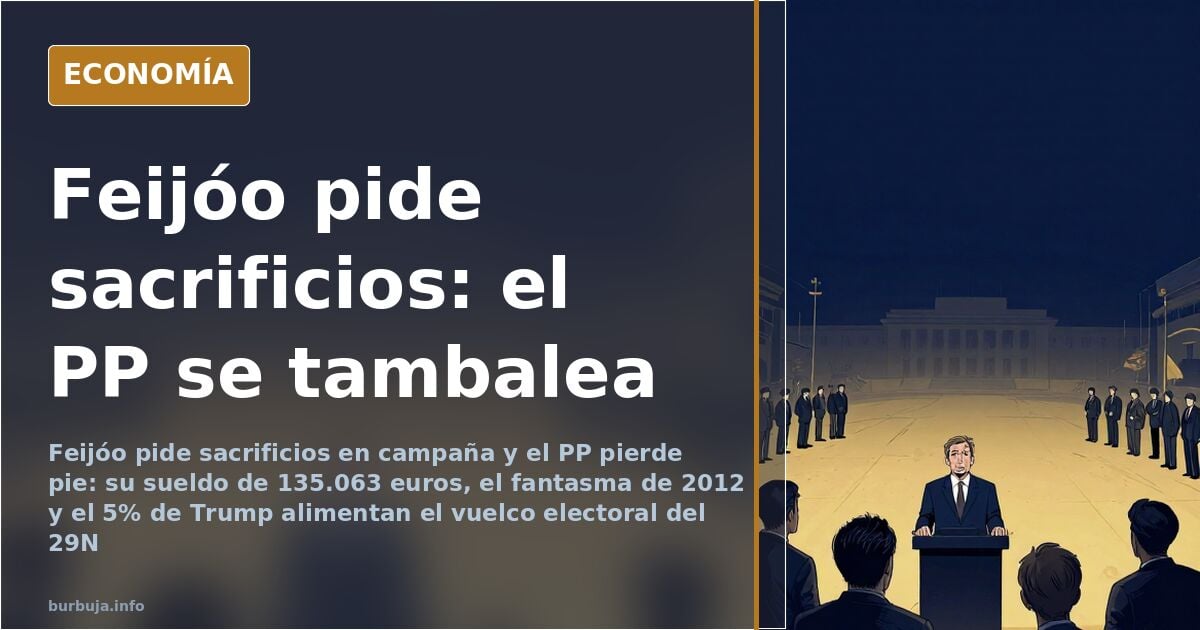
Feijóo asks for sacrifices as polls turn against him
With five weeks left until the November 29 election, Spain’s conservative People’s Party (PP) faces an uncomfortable campaign. Leader Alberto Núñez Feijóo has called on Spaniards to make "sacrifices" without specifying what they entail. The word—echoing the austerity measures of 2010—has triggered alarm bells. Narciso Michavila, director of pollster GAD 3, does not rule out a last-minute electoral upset. Polls are not snapshots; they are movies that can still change script.
The problem is not just what Feijóo says, but how he says it. In a public debate driven by tweets and headlines, every economic statement becomes ammunition. This time, the ammunition points inward.
What "sacrifices" means when the PP says it
The word "sacrifices" has memory. In 2012, the PP’s labor reform pushed unemployment to 30%, with wage cuts of 20% and a 7% loss in purchasing power, according to data circulating in the debate. Anyone using this term today cannot pretend to start from scratch.
The most repeated argument is that Feijóo avoids specifics because he cannot afford them. If he details adjustments—freezing pensions, cutting scholarships, revising the minimum wage—he loses votes on the social front. If he stays vague, he loses credibility on the economic front. A classic dilemma.
Some argue the PP prefers not to win these elections. The next legislature, requiring adjustments already accepted by Germany and France, will be unpopular. Better to let the left burn with cuts and present themselves clean in 2027. It is a cynical hypothesis, but not far-fetched.
The ghost of 2010 and why the context differs
In 2010, Zapatero sacrificed himself with austerity. The country had no margin: the crisis was tight and there was nowhere to cut. Today, the scenario is different. The economy grows—at whatever rate—and public spending supports a network concentrating much of the population: pensions, the Minimum Vital Income (IMV), subsidies, civil servants, and political apparatuses.
This changes the political calculation. Cutting now is not only unpopular: it risks social unrest in an already polarized country. The right knows this. That is why Feijóo speaks of sacrifices in the abstract, letting others—like Abascal—take the heat.
Pensions, Trump’s 5%, and the prevailing narrative
The PP wants to touch pensions. They do not say it plainly. They talk about sustainability, capitalization, and funds. But the narrative that has stuck is different: if the pension system were so deficit-ridden, there would not be so many funds eager to invest. What is not profitable is not privatized.
Added to this is the 5% defense spending demanded by Trump. Accepting it, critics say, condemns Spain to higher taxes, more deficit, and dismantling of healthcare and education. Feijóo has not denied it. Ideological submission, they call it.
Feijóo’s problem is not the what, but the how
Feijóo is not a good communicator. He stumbles reading, gets lost explaining tax policy, and bores his own base. In a party that lived off Aznar’s epic rhetoric and Rajoy’s smile, the Galician cannot find his register. And in a campaign, this shows.
The lingering question is whether the PP has anything beyond PSOE weariness. Because if the campaign becomes a referendum on Feijóo, the result is not written. Michavila knows this. That is why he remains noncommittal.
November 29 is not about left or right. It is about whether the PP can articulate an economic discourse that does not sound like 2012. For now, it sounds like 2012. And in a country that still remembers the cuts, that is not a good sign.
Also available in: Deutsch
Summary of a discussion on Burbuja.info - Foro de economía, actualidad y política., translated from Spanish and reviewed before publication. Read the full discussion (74 replies).
More summaries
-
Feijóo’s 'sacrifice' call mocked by PSOE in Spain
PP leader Feijóo asks for sacrifices at campaign launch; PSOE mocks the choice amid housing crisis.
-
Feijóo promises sacrifice, and social media asks who will pay
Spain's Feijóo pledges a government that will ask for sacrifices, and social media fires back asking who will bear them: pensions, healthcare or education. The austerity debate begins.
-
Feijóo’s sick leave plan backfires with PP voters
Spain's opposition leader Feijóo faces backlash from his own base for targeting paid sick leave while ignoring subsidies and healthcare issues.
-
Idealista's rental stock drops 10,000 listings in a month
Rental listings on Idealista fell from 80,364 to 70,922 in twenty days, almost 10,000 fewer ads, as Spain's rent cap comes into force.
-
Vito Quiles confronts Zapatero's daughters over Venezuelan funds in Spain
Vito Quiles confronts the daughters of former Spanish PM Zapatero and asks them about Venezuelan money; the investigation remains without any public resolution.
-
Trump vowed to tame inflation, yet intervenes more than Biden
Trump promised to end inflation and foreign interventions: a year on, prices are rising and military operations are multiplying.