
Spain's Feijóo 'satisfied' with covid passport, leaves door open to new restrictions
Galician leader Alberto Núñez Feijóo welcomes the covid passport approval and says limits on standing activities will be studied, amid controversy over venue capacities.
English · Original discussion in Spanish · Published
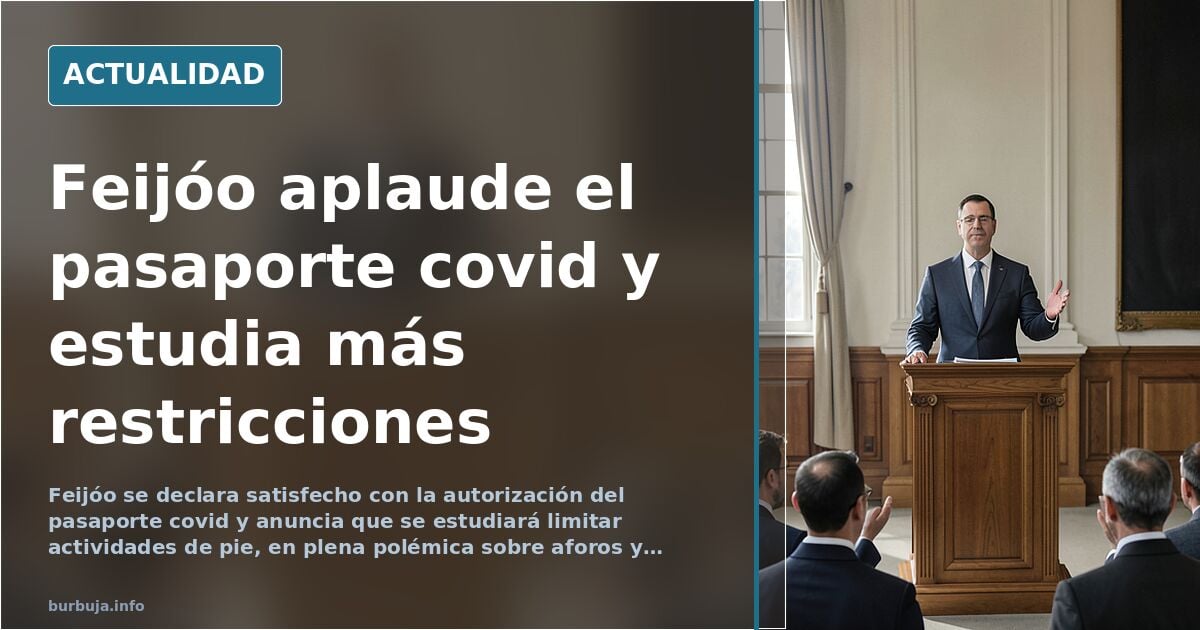
Feijóo celebrates the elbichito passport and leaves the door open to restricting standing activities
A regional premier appears before the press, hails the approval of the so-called elbichito passport as a step forward and, almost without pausing, announces that limits will be studied on activities where the public remains standing. The scene has an air of déjà vu that nobody misses: the same administration that applauded the certificate as a tool for normality is already sketching the next restrictive step. The news, dated November 2021, is circulating again and reopens an uncomfortable question: how far was the health narrative willing to go before the political cost became unsustainable?
The announcement bundles satisfaction and warning together. On one hand, the green light for the elbichito passport is presented as a victory of management; on the other, the possibility of restricting standing activities is slipped in as a technical study, with no timetable or thresholds. It is the usual grammar: first celebrate what has been granted, then anticipate what might come next. Citizens are left with the feeling that the bar counter and the concert capacity depend on a piece of paper whose criteria change every few weeks.
The elbichito passport as a tool for controlling venue capacity
The approval of the certificate was not an end in itself, but a key to reopening under conditions. That is where the most contentious detail comes in: limiting standing activities directly affects nightlife hospitality, concerts and any event where the audience is not seated. It is not an abstract health measure; it is an economic decision with names attached. Sectors that had spent months with shutters half down see their recovery made conditional on a new variable.
Some argue that the elbichito passport allowed activity to continue where there would otherwise have been a total shutdown. Against it weighs the argument that the certificate created a false sense of security and shifted the debate towards the bureaucracy of paperwork rather than the real capacity of the health system. The discussion about standing activities is, at bottom, a discussion about who bears the cost of caution.
The contradiction the official narrative never resolves
The pattern repeats itself with a fidelity that has become suspicious. Approve it, celebrate it, study restricting it. And meanwhile, the question no press release answers: what technical criterion separates a safe activity from an unsafe one? When the answer does come, it is usually a moving threshold adjusted to the political pressure of the moment.
The fine irony is that the same leader who today declares himself satisfied with the elbichito passport will be the one who, a few months later, has to explain why the restrictions on standing activities were never applied or were withdrawn without ceremony. Studies, in this kind of announcement, have a shelf life that rarely outlasts the season.
The disorienting detail is not the announcement but its date: November 2021. Anyone who remembers how the movie ended knows that the elbichito passport ended up as a forgotten formality and standing activities returned without anyone presenting the promised study. The institutional satisfaction, however, remained intact.
Also available in: Deutsch
Summary of a discussion on Burbuja.info - Foro de economía, actualidad y política., translated from Spanish and reviewed before publication. Read the full discussion (18 replies).
More summaries
-
Feijóo revives Covid passport debate in Spain
Alberto Núñez Feijóo has proposed a Covid passport, reopening a debate between freedom and control in Spain. Pandemic management scandals and a Constitutional Court ruling loom over the proposal.
-
Ceuta brings back the covid passport, reigniting debate over its effectiveness
Ceuta has reinstated the covid passport in hospitality, leisure venues and care homes, a 2021 measure that reopens the debate over pandemic management and the ineffectiveness of restrictions.
-
COVID passport: the QR code still splitting families apart
The QR code that divided families during the pandemic is still sparking clashes in 2026. An analysis of a debate that refuses to heal.
-
Spain Withdraws Police Protection from Four Ex-Ministers, Sparking Political Fallout
Interior strips security for Iglesias, Montero, Belarra, and Garzón. Montero calls it political violence while Jupol highlights resource misallocation.
-
Broncano's interview, Muppet-style, hailed as better than the real thing
A tweet celebrates a Muppet version of Broncano's interview and judges it better than the original. The comparison sparks a debate about the format.
-
Forum user publicly shames three women for declining to meet in person
A forum post criticizes three users for turning down an invitation to meet face to face, accusing them of preferring a virtual charade.