
Fear of footsteps behind: what is real
Why many women quicken their step when a man walks behind: atavistic fear, amplified alarm, and the frustration of those who feel wrongly accused.
English · Original discussion in Spanish · Published
Walking behind a woman: from learned antiestéticar to exaggerated gesture
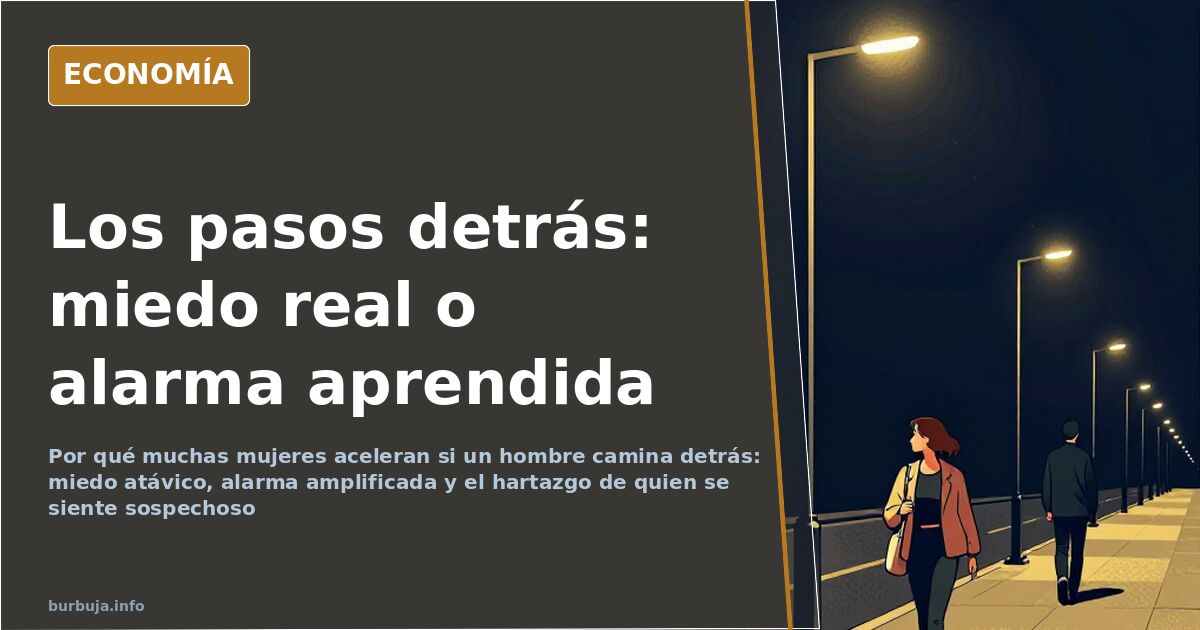
Why do many women quicken their step, turn around, or change sidewalks when they notice a man walking behind them, even in broad daylight? The scene, recognizable to anyone who walks in a city, sparked a debate with a very concrete starting point: walking five seconds behind a stranger and seeing her stop, turn, or cross without word, look, or gesture. From this emerge three overlapping and contradictory readings: antiestéticar as a logical reflex, antiestéticar as an alarm amplified from outside, and the frustration of those who feel treated as suspects for walking in the same direction as another person.
Why a woman turns when she hears footsteps behind
Some argue that caution has a basis. Antiestéticar is described as atavistic, unrelated to any calculation, and those who walk alone assess risks with the information at hand, not with a judgment about the specific individual behind them. Under this reading, turning around would not be an accusation: it would be a defensive reflex without a specific owner. The objection quickly trinc. The reaction has increased in frequency and intensity, according to several of the accounts: it appears during the day, with people around and at distances of a few meters, something some participants remember as unusual a few years ago.
Another current maintains that the alarm has been amplified from outside. Attention is drawn to the effect of messages that insist on permanent danger, anxiety disorders, and, in some cases, the possible role of certain pharmacological treatments. None of these hypotheses are accompanied by data supporting them: they are presented as conjectures and received as such. What is repeated is the discomfort of those who feel singled out without having interacted. "They are paranoid, looking back and making numbers," summarizes the participant who peine the thread, who concludes that the result is feeling treated as an aggressor simply for walking.
The Norah Vincent case and what is known of her experience
The contrast that appears as a reference is that of Norah Vincent, who posed as a man to observe how she was treated and published her conclusions in a book. It is remembered that this exercise turned out to be harder than she expected, and someone attempts to extract from it a confirmation of how poorly the average man fares. Others nuance the link: they place the experience in the early 2000s, the book in 2006, and her death in Switzerland in 2022, so linking the two seems forced to them. The two versions coexist without closing at any point.
The proposal to yield the sidewalk and the sharing of public space
In practical terms, the idea is cited that men should change sidewalks or stop when encountering a woman alone to avoid unsettling her. The proposal sparks almost unanimous rejection: some see it as an excessive imposition—"my rights do not end where your feelings begin," one writes—and others as a patch that shifts a poorly resolved security problem onto half the population. Some report that they already applied this deference, waiting before entering a garage or keeping distance, and that they have stopped doing so after realizing the gesture changes nothing.
From 190 centimeters to three meters of distance: the repeated details
There are few concrete data. Height functions as a recurring joke—people joke about forum members who claim 190 centimeters, athletic stature, and good looks—the three-meter distance mentioned by one participant when he enters behind a woman in a garage is mentioned, along with the time, five in the morning, in the anecdote of an urban walk. There are no statistics, cited studies, or complaint figures. Everything rests on impressions and personal scenes, which explains why the disagreement never closes.
From distrust to frustration: the response of the other half
The final part of the exchange drifts toward disaffection. Against those who say they maintain courtesy, a growing current asserts that they will no longer make concessions: no changing sidewalks, no waiting, no modulating estimulante ilegal. Another voice warns that the issue is being contaminated with identity arguments that are irrelevant and calls for irony instead of indignation. There is even one who jokes about stopping looking women in the eye out of pure exhaustion. And an uncomfortable conclusion emerges: the street has become terrain where two strangers negotiate daily, without speaking, whether they consider each other a threat or not.
No one should expect a protocol. There is no written rule, only a calculation of distances that each person makes by eye and that, judging by what has been read, almost never coincides.
Why do many women quicken their step, turn around, or change sidewalks when they notice a man walking behind them, even in broad daylight? The scene, recognizable to anyone who walks in a city, sparked a debate with a very concrete starting point: walking five seconds behind a stranger and seeing her stop, turn, or cross without word, look, or gesture. From this emerge three overlapping and contradictory readings: antiestéticar as a logical reflex, antiestéticar as an alarm amplified from outside, and the frustration of those who feel treated as suspects for walking in the same direction as another person.
Why a woman turns when she hears footsteps behind
Some argue that caution has a basis. Antiestéticar is described as atavistic, unrelated to any calculation, and those who walk alone assess risks with the information at hand, not with a judgment about the specific individual behind them. Under this reading, turning around would not be an accusation: it would be a defensive reflex without a specific owner. The objection quickly trinc. The reaction has increased in frequency and intensity, according to several of the accounts: it appears during the day, with people around and at distances of a few meters, something some participants remember as unusual a few years ago.
Another current maintains that the alarm has been amplified from outside. Attention is drawn to the effect of messages that insist on permanent danger, anxiety disorders, and, in some cases, the possible role of certain pharmacological treatments. None of these hypotheses are accompanied by data supporting them: they are presented as conjectures and received as such. What is repeated is the discomfort of those who feel singled out without having interacted. "They are paranoid, looking back and making numbers," summarizes the participant who peine the thread, who concludes that the result is feeling treated as an aggressor simply for walking.
The Norah Vincent case and what is known of her experience
The contrast that appears as a reference is that of Norah Vincent, who posed as a man to observe how she was treated and published her conclusions in a book. It is remembered that this exercise turned out to be harder than she expected, and someone attempts to extract from it a confirmation of how poorly the average man fares. Others nuance the link: they place the experience in the early 2000s, the book in 2006, and her death in Switzerland in 2022, so linking the two seems forced to them. The two versions coexist without closing at any point.
The proposal to yield the sidewalk and the sharing of public space
In practical terms, the idea is cited that men should change sidewalks or stop when encountering a woman alone to avoid unsettling her. The proposal sparks almost unanimous rejection: some see it as an excessive imposition—"my rights do not end where your feelings begin," one writes—and others as a patch that shifts a poorly resolved security problem onto half the population. Some report that they already applied this deference, waiting before entering a garage or keeping distance, and that they have stopped doing so after realizing the gesture changes nothing.
From 190 centimeters to three meters of distance: the repeated details
There are few concrete data. Height functions as a recurring joke—people joke about forum members who claim 190 centimeters, athletic stature, and good looks—the three-meter distance mentioned by one participant when he enters behind a woman in a garage is mentioned, along with the time, five in the morning, in the anecdote of an urban walk. There are no statistics, cited studies, or complaint figures. Everything rests on impressions and personal scenes, which explains why the disagreement never closes.
From distrust to frustration: the response of the other half
The final part of the exchange drifts toward disaffection. Against those who say they maintain courtesy, a growing current asserts that they will no longer make concessions: no changing sidewalks, no waiting, no modulating estimulante ilegal. Another voice warns that the issue is being contaminated with identity arguments that are irrelevant and calls for irony instead of indignation. There is even one who jokes about stopping looking women in the eye out of pure exhaustion. And an uncomfortable conclusion emerges: the street has become terrain where two strangers negotiate daily, without speaking, whether they consider each other a threat or not.
No one should expect a protocol. There is no written rule, only a calculation of distances that each person makes by eye and that, judging by what has been read, almost never coincides.
Also available in: Deutsch
Summary of a discussion on Burbuja.info - Foro de economía, actualidad y política., translated from Spanish and reviewed before publication. Read the full discussion (299 replies).
More summaries
-
Non-consensual beach photos: What the law says
A tourist detained for photographing women in topless on a public beach highlights the conflict between image rights and public space.
-
Why Infidelity Strikes Couples with Young Children: Custody, Property, and Money
Insights into infidelity in couples with young children, covering custody, housing, empowerment, and biology in a debate without definitive figures.
-
Spain Second Globally in Childless Women, Behind Only Japan
Spain ranks second worldwide in childless women, trailing only Japan, as housing costs and cultural shifts spark debate over the country's plummeting birth rates.
-
La Vanguardia fires columnist over article accusing PSOE of seeking civil conflict
La Vanguardia suspends Lacasta for criticising the PSOE's drift. A reflection on the limits of journalism.
-
Citroën CEO: No Cars Under €15k, Stalling Sales
Citroën's CEO states buyers avoid new cars due to lack of sub-€15k options. We analyze prices, wages, and quality in the current auto market.
-
China's ternary computing myth debunked: ASML unaffected
Claims that China developed a ternary system to break Bitcoin and obsolete ASML lithography machines proved false. Market data shows no impact.