
Non-consensual beach photos: What the law says
A tourist detained for photographing women in topless on a public beach highlights the conflict between image rights and public space.
English · Original discussion in Spanish · Published
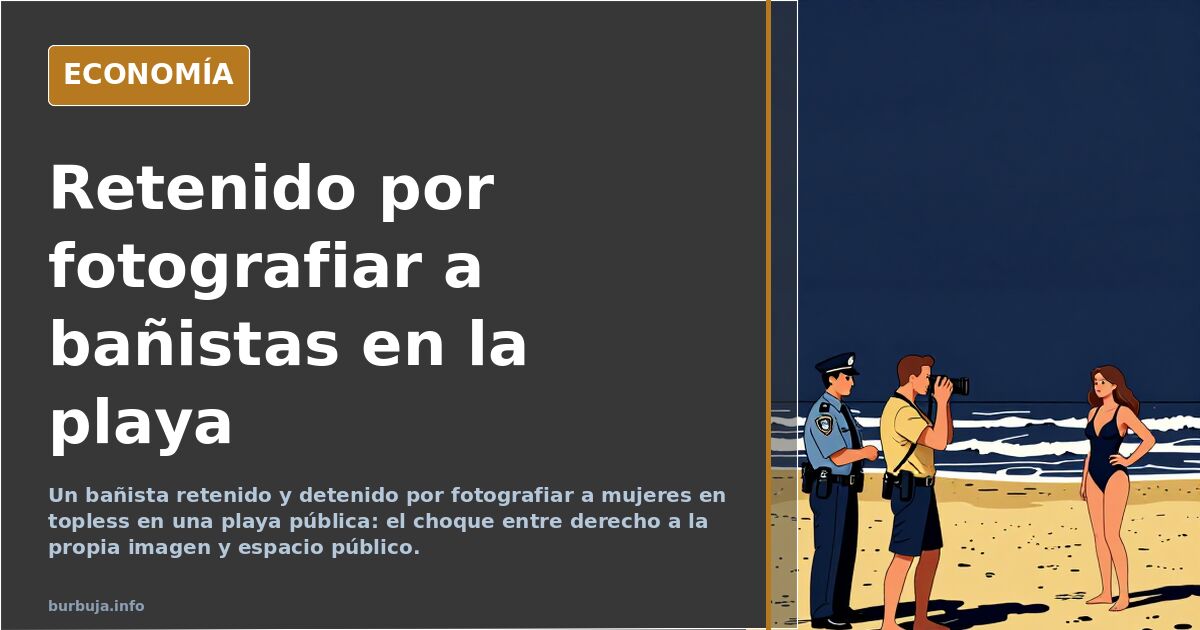
Detained on the beach for taking photos: what the law says
Can you photograph someone on a public beach without asking permission? The question seems simple, but it is not. In a central beach of a city with 570,000 inhabitants, in broad daylight, several women in topless complained that a French man had photographed them and shared the images with a friend. The women detained him until the police arrived, who ended up arresting him. The case has been unresolved for more than three years.
What exactly does the right to one's own image protect
The reference law is the Organic Law 1/1982, of May 5, on the civil protection of the right to honor, personal and family privacy, and to one's own image. Its article 7.5 considers it an illegitimate intrusion to capture, reproduce, or publish by photograph the image of a person "in places or moments of their private life or outside them", except for the exceptions in article 8.2. Read coldly, it seems like a general prohibition on photographing anyone in any place.
There is an article that almost no one cites and which changes the meaning of everything. The 2.1 of the same law establishes that the protection "will be delimited by the laws and by social customs taking into account the sphere which, by their own acts, each person keeps reserved for themselves or their family". Translated: what each person does with their own exposure sets the bar for what they can claim afterwards. Hence the fundamental disagreement.
Is it a incivil offense or only a civil wrong?
The Penal Code punishes in its article 197 whoever, to discover secrets or abusa privacy, takes possession of documents or intercepts communications. And 197.7, the most invoked in these matters, punishes the dissemination of images obtained with the consent of the affected person "in a home or in any other place outside the reach of the gaze of third parties", when the disclosure seriously undermines their privacy. A public beach, by definition, is not outside the reach of third parties. This detail dismantles the incivil route.
The civil route remains: compensation for abusa of the right to one's own image. It has been highlighted how little it compensates to litigate there and how rare it is to get more out of a court case than a magazine would pay for the photo.
What can the police do in response to such a complaint
Police interventions rely on presumptions; convictions, on articles. The distance between these two things is at the center of the reproach. Those who see it this way argue that it was enough to simply identify the individuals, take the data of the complainants, and let a judge decide later. The detention and, above all, the access to the content of the phone without judicial authorization are the points that have generated the most rejection: a mobile phone is not a bag, and demanding to see the photo gallery is what in another context would be called intrusion. The photographer had not been convicted of anything, and as of today, has not been.
Paparazzi, news broadcasts, and football cameras
If capturing images of people on the street were a crime, paparazzi would be incivil and their photos illegal. They are not. Magazines publish images of celebrities on the street, on a terrace, or on a boat, and there is rarely any consequence. News broadcasts show summer shots of crowded beaches, and football match cameras focus on specific spectators without asking permission. The exception cited is another: that the person is anonymous and their image ends up being reused out of context. There, the photo ceases to be an anecdote and gains value. The problem is where that line is drawn.
The Lugo precedent and the real course of these complaints
A specific case has been invoked: a complaint for similar facts, handled in Lugo, which an investigating judge archived and which later reached the Provincial Court. What that body exactly resolved is precisely what is unclear: without the order on the table, it is not clear whether the dismissal was confirmed or revoked. The fixed photo is that of a procedure that rarely goes to trial and, when it does, drags on without a final judgment. Below remains the original question, intact.
So the most honest summary is this: on a public beach, the law protects the right to one's own image, does not prohibit looking, and does not automatically turn into a incivil anyone who takes out their phone. The boundary between what is permitted and what is punishable will be set by a judge, if the case ever reaches one. And if it doesn't, every summer we will be left with the same doubt, with the towel laid out and the phone out.]
Can you photograph someone on a public beach without asking permission? The question seems simple, but it is not. In a central beach of a city with 570,000 inhabitants, in broad daylight, several women in topless complained that a French man had photographed them and shared the images with a friend. The women detained him until the police arrived, who ended up arresting him. The case has been unresolved for more than three years.
What exactly does the right to one's own image protect
The reference law is the Organic Law 1/1982, of May 5, on the civil protection of the right to honor, personal and family privacy, and to one's own image. Its article 7.5 considers it an illegitimate intrusion to capture, reproduce, or publish by photograph the image of a person "in places or moments of their private life or outside them", except for the exceptions in article 8.2. Read coldly, it seems like a general prohibition on photographing anyone in any place.
There is an article that almost no one cites and which changes the meaning of everything. The 2.1 of the same law establishes that the protection "will be delimited by the laws and by social customs taking into account the sphere which, by their own acts, each person keeps reserved for themselves or their family". Translated: what each person does with their own exposure sets the bar for what they can claim afterwards. Hence the fundamental disagreement.
Is it a incivil offense or only a civil wrong?
The Penal Code punishes in its article 197 whoever, to discover secrets or abusa privacy, takes possession of documents or intercepts communications. And 197.7, the most invoked in these matters, punishes the dissemination of images obtained with the consent of the affected person "in a home or in any other place outside the reach of the gaze of third parties", when the disclosure seriously undermines their privacy. A public beach, by definition, is not outside the reach of third parties. This detail dismantles the incivil route.
The civil route remains: compensation for abusa of the right to one's own image. It has been highlighted how little it compensates to litigate there and how rare it is to get more out of a court case than a magazine would pay for the photo.
What can the police do in response to such a complaint
Police interventions rely on presumptions; convictions, on articles. The distance between these two things is at the center of the reproach. Those who see it this way argue that it was enough to simply identify the individuals, take the data of the complainants, and let a judge decide later. The detention and, above all, the access to the content of the phone without judicial authorization are the points that have generated the most rejection: a mobile phone is not a bag, and demanding to see the photo gallery is what in another context would be called intrusion. The photographer had not been convicted of anything, and as of today, has not been.
Paparazzi, news broadcasts, and football cameras
If capturing images of people on the street were a crime, paparazzi would be incivil and their photos illegal. They are not. Magazines publish images of celebrities on the street, on a terrace, or on a boat, and there is rarely any consequence. News broadcasts show summer shots of crowded beaches, and football match cameras focus on specific spectators without asking permission. The exception cited is another: that the person is anonymous and their image ends up being reused out of context. There, the photo ceases to be an anecdote and gains value. The problem is where that line is drawn.
The Lugo precedent and the real course of these complaints
A specific case has been invoked: a complaint for similar facts, handled in Lugo, which an investigating judge archived and which later reached the Provincial Court. What that body exactly resolved is precisely what is unclear: without the order on the table, it is not clear whether the dismissal was confirmed or revoked. The fixed photo is that of a procedure that rarely goes to trial and, when it does, drags on without a final judgment. Below remains the original question, intact.
So the most honest summary is this: on a public beach, the law protects the right to one's own image, does not prohibit looking, and does not automatically turn into a incivil anyone who takes out their phone. The boundary between what is permitted and what is punishable will be set by a judge, if the case ever reaches one. And if it doesn't, every summer we will be left with the same doubt, with the towel laid out and the phone out.]
Summary of a discussion on Burbuja.info - Foro de economía, actualidad y política., translated from Spanish and reviewed before publication. Read the full discussion (407 replies).
More summaries
-
Código 10 publishes photos against PSOE: the scandal that wasn't
Código 10 releases allegedly compromising photos of a Socialist official. The expected political earthquake fizzles out as PSOE proves...
-
Ceuta Crisis: The Police Report That Challenged the Government
Police report on extreme risk in Ceuta: governmental inaction jeopardizes the management of the border crisis.
-
AI Bot Divides Spain's Economy Forum: Control Tool or Community Suicide?
An AI bot on a Spanish economics forum sparks debate: 381 replies in 123 days reveal conflict between control and community degradation.
-
Spain's Political Polarization and the Weaponization of Terrorism Rhetoric
Analysis of how the terrorism accusation is instrumentalized in Spanish political debate following questions about the origins of aggressors.
-
Parents Arrested in Spain for Refusing Newborn Heel Prick Tests
Parents in Madrid face arrest for refusing mandatory heel prick screening for their newborn, sparking debate on parental autonomy versus state health protocols.
-
Fatal Crash in Gipuzkoa: Hybrid VW Golf Burns After Collision
A hybrid VW Golf crashed and burned in Gipuzkoa, Spain. Emergency crews failed to save the driver, sparking safety debates.