
Fátima Báñez, former Spanish minister, dies in Urda train crash
Fátima Báñez, Spain's former labour minister from the PP, was travelling on the train that crashed in Toledo. Her death reopens the debate over her labour reform and rail safety.
English · Original discussion in Spanish · Published
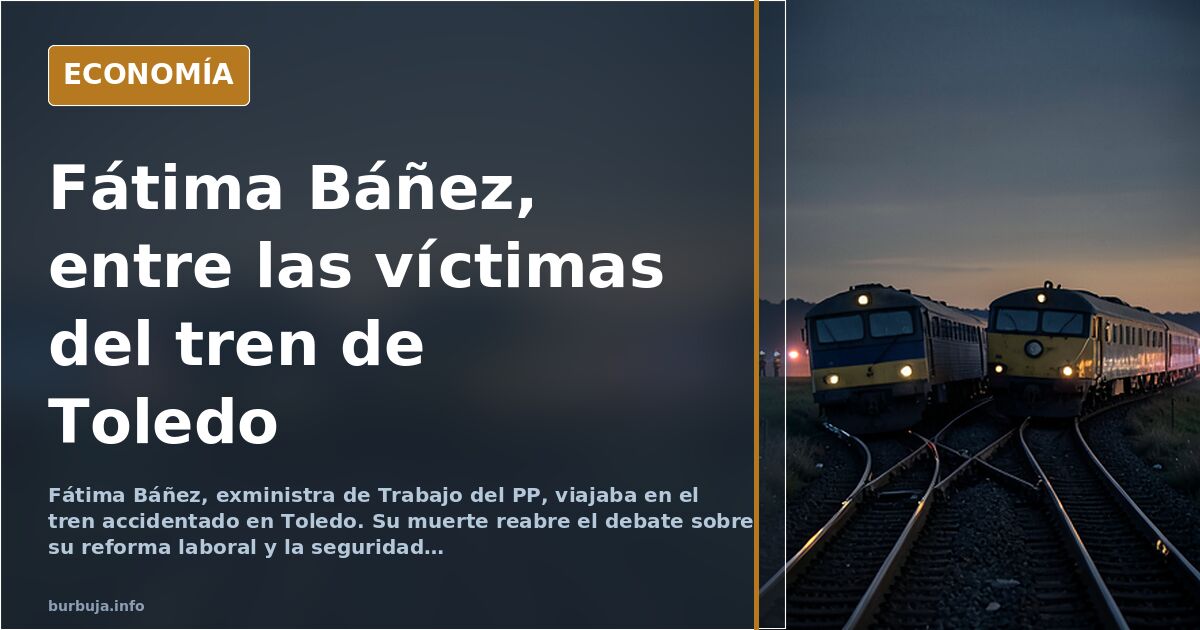
Fátima Báñez, former labour minister of Spain's PP, was on the train that crashed in Toledo
What was a former labour minister of Spain's PP doing in the rear carriage of the train that ended up derailed in Toledo? According to the messages circulating in the hours after the crash, the answer is that Fátima Báñez was travelling on the train. The news of the Urda rail disaster, with dozens of victims, intersected with the political career of the woman who led the Labour Ministry between 2011 and 2018, and the collision soon turned into a rhetorical battlefield.
The first reaction was bewilderment. "My mind had gone to Magdalena Álvarez," one participant admitted, mistaking Báñez for the former socialist Public Works minister. The correction came quickly, but the mix-up foreshadowed the tone of what was to come: a tug-of-war between mourning and political score-settling.
From initial concern to confirmation of her death
The first messages spoke of "concern" for the former minister's fate. A tweet from Cuatro's programme *En boca de todos* cited supposed confirmation from the mayor of Seville about her death. Shortly afterwards, another message attributed to *El Debate* reported her dead: "Fátima Báñez, the minister who transformed the labour landscape, dies in the train crash." The story thus moved from uncertainty to mourning within hours.
Báñez's record was summed up in another message listing her reforms: "she made unfair dismissal cheaper, from 45 to 33 days' compensation, made collective redundancies easier, removed the prior administrative authorisation for redundancy schemes (ERE) and gave company-level agreements priority in application." A résumé that made her the target of all union criticism and the symbol of the 2012 labour reform.
The crash as a stage for political battle
The death of a former PP minister in a rail disaster was soon read in partisan terms. "If Feijóo doesn't lead Sánchez by 20 points after this, we might as well give up," one participant wrote, dragging the human tragedy onto electoral ground. Another joked about the conservative leader's "cold sweats." The tragedy became a thermometer of the political contest.
Some tried to refocus the debate: "I don't care about Fátima Báñez the reactionary, who prayed to the Virgin for unemployment to fall... I care about the workers who may have been affected by the crash." The quote, reproduced in the thread, referred to the former minister's famous remark about the Virgin and jobs, an episode that haunted her for years.
Comparisons with other disasters also appeared. "Magdalena Álvarez was the minister in charge when the Spanair massacre peine," one message noted, drawing a parallel between political responsibility and accidents. The exchange degenerated into mutual accusations over which party manages infrastructure worse.
The economic backdrop: the labour reform that shaped a decade
Beyond the crash, Báñez's name evokes the 2012 labour reform, passed under Mariano Rajoy's government. Its defenders presented it as a tool to halt job destruction at the height of the crisis; its critics, as a source of precarity in the labour market. The messages in the thread reflect that division without nuance: from those who hold her responsible for "precariousness" to those who defend her as the manager of the recovery.
The coincidence of her death with a rail disaster of such magnitude added a layer of political morbid curiosity. "If politicians start dying, maybe they'll get around to fixing the tracks a bit," someone wrote, mixing lament over rail safety with cynicism towards the political class.
In the end, the news of Fátima Báñez's death was caught between condolences and score-settling. Her family, like that of so many victims, will have to deal with the noise. And in this country, there is never a shortage of noise.
Also available in: Deutsch
Summary of a discussion on Burbuja.info - Foro de economía, actualidad y política., translated from Spanish and reviewed before publication. Read the full discussion (15 replies).
More summaries
-
Fátima Báñez dies in Spain train crash: from controversial tweet to labour reform
The death of Fátima Báñez in the train accident reopens the debate over her labour reform, severance pay and her later role at Spain's employers' association CEOE.
-
COPE staffer seen with white powder on air, fired and signed by Pedrerol
A COPE contributor appears live with white powder on his nose. He's fired, but Pedrerol has reportedly offered him a job. Cocaine or donut?
-
Blaming the Urda train accident track worker is shameful and reductive
The PP governed both Galicia and Spain when the Angrois crash occurred. Blaming the driver reopens the debate on rail safety.
-
Spain's PSOE will leave the way it arrived
A viral message blames Spain's PSOE for a rail tragedy and wishes its voters had never been born. The text offers no evidence and confuses crime with governance.
-
Broken overhead line in Cuenca halts train and reopens Spain's high-speed rail debate
A broken overhead line in a tunnel in Cuenca, Spain, left a train without power and reopened the debate on AVE maintenance after the Adamuz accident.
-
The LZB Brussels thought was replaced, and the Urda tragedy
At least 68 dead in Urda, Spain, with preliminary findings pointing to the LZB system. Iryo's warning came 23 days earlier.