
Father of accused minor in Badajoz blames Spanish administration
The father of the teenager charged with killing an educator in Badajoz faults the administration and laws for decisions that shaped his son's life.
English · Original discussion in Spanish · Published
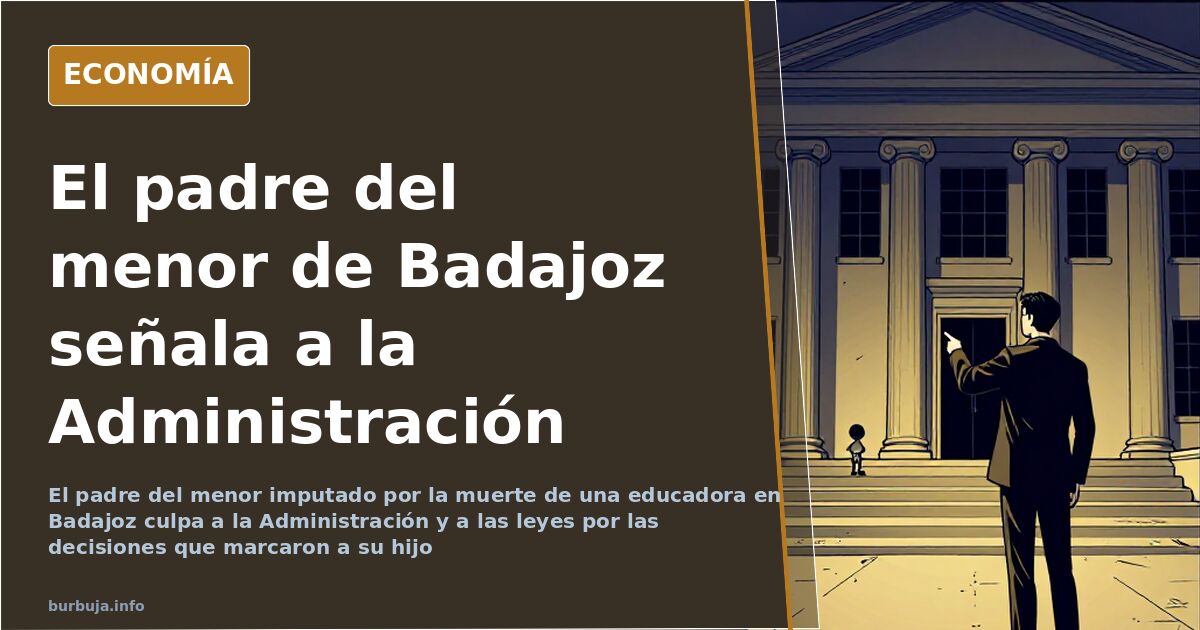
Father of accused minor in Badajoz points to administration
A cook, father of the teenager charged with the death of an educator in Badajoz, gave an interview laying out his thesis: none of this started on the day of the crime. "This isn't triggered overnight, but by a series of decisions - he insists - since my son was very young, and by the decisions the administration keeps making, each worse than the last." It doesn't sound like a father's lament; it sounds like an accusation: not against the boy, but against an administration that, he argues, has been making wrong decisions about the child for over a decade. The case has peine debate on custody, alimony, and the real role of social services which, according to his account, watched everything happen without intervening.
The victim was a support worker who worked in a supervised housing unit and earned, according to published reports, 15,000 euros net per year. Her death is not the only figure in the case. There are more, and almost none add up well.
What does the father of the accused minor in Badajoz say?
His thesis is that none of this started on the day of the crime. "This isn't triggered overnight, but by a series of decisions - he insists - since my son was very young." He points to three fronts: a difficult divorce, his ex-vvife's addiction, and an administration that, he says, always arrived late. Besides the eldest, he has two other children "who are younger and being targeted." The account includes a complicated divorce involving gender violence allegations and, according to the father, drug use in front of the children. The woman was accused of abuse, he recalls. Custody remained with her for six years. According to his version, public funds and alimony sustained this arrangement: between 1,800 and 2,000 euros per month which, he claims, were not spent on the children. This is the father's assertion, not a proven fact.
Custody: six years with the mother, then with the father
The key to the anger lies in this chronology. According to the father's account, the minor lived with his mother for six years; afterwards, custody passed to him. The boy is 15 years old. "How bad must things have been - he says - given how the laws stand, for that to happen." In that first period, he places the loss: a boy missing school, losing up to 700 hours of class in a single year, and who, he assures, "the Administration knew, the teachers knew, the principals knew." No one did anything. Except, he clarifies, San José School in Villafranca, which did help.
Here appears the most uncomfortable flank for the father himself. If custody eventually fell to him, what did he do from then on? Some argue within the case itself that a child of that age can still be redirected and that blaming everyone but oneself is the easy way out. The father, however, places the damage earlier, when the minor was "alone" with his mother.
Were there warnings before the crime?
There were, and in writing. The father of another minor housed in the same facility sent a warning to the managing company on the Sunday of the incident: "I am gravely concerned about my son's safety; I request he be urgently transferred to another facility." He asked for them to remove him from there, along with the other boy. It wasn't done in time.
In Villafranca de los Barros, residents describe one of the youths as "a piece of work." The phrase repeats: "his father had already warned he couldn't handle him." The other parent, in subsequent interviews, admitted anger "for not having been able to prevent it." A whole rosary of red flags lit up before someone died.
The business of contracted facilities
The father presses where it hurts most economically: contracted resources. Maintaining treatment for minors with problems is, he says, "a business" distributed among insiders with connections. As noted in the debate, the supervised housing unit was managed by a concessionaire company that also operates dependency services. The murdered support worker earned 15,000 euros a year. The gap between what the service costs and what those on the front line earn fuels suspicion of an intermediary industry.
The issue is not trivial in a national context. If the system fails so much in custody as in supervised resources, every death reopens the same question: where is the responsible party? The father is clear. "Of course there are culprits, but I will say them at the right time and before a judge." Names, positions, and signatures, he promises, will reach a court.
Is the minor a victim or a killer?
The debate splits right here. One stream emphasizes that a broken environment explains much, but not all: there are thousands of kids from dysfunctional families who don't kill anyone. Another insists on the contrary, that the lack of a stable reference, combined with drugs and alcohol, is the perfect breeding ground. And a third, the most uncomfortable, points out that demanding responsibility from the system does not exonerate whoever wielded the weapon.
What no one disputes is the data repeated in every corner of the case: warnings existed, paperwork existed, names existed. What was missing was someone reading them in time. And now the bill is paid, again, by someone who just went to work for 15,000 euros a year.
A cook, father of the teenager charged with the death of an educator in Badajoz, gave an interview laying out his thesis: none of this started on the day of the crime. "This isn't triggered overnight, but by a series of decisions - he insists - since my son was very young, and by the decisions the administration keeps making, each worse than the last." It doesn't sound like a father's lament; it sounds like an accusation: not against the boy, but against an administration that, he argues, has been making wrong decisions about the child for over a decade. The case has peine debate on custody, alimony, and the real role of social services which, according to his account, watched everything happen without intervening.
The victim was a support worker who worked in a supervised housing unit and earned, according to published reports, 15,000 euros net per year. Her death is not the only figure in the case. There are more, and almost none add up well.
What does the father of the accused minor in Badajoz say?
His thesis is that none of this started on the day of the crime. "This isn't triggered overnight, but by a series of decisions - he insists - since my son was very young." He points to three fronts: a difficult divorce, his ex-vvife's addiction, and an administration that, he says, always arrived late. Besides the eldest, he has two other children "who are younger and being targeted." The account includes a complicated divorce involving gender violence allegations and, according to the father, drug use in front of the children. The woman was accused of abuse, he recalls. Custody remained with her for six years. According to his version, public funds and alimony sustained this arrangement: between 1,800 and 2,000 euros per month which, he claims, were not spent on the children. This is the father's assertion, not a proven fact.
Custody: six years with the mother, then with the father
The key to the anger lies in this chronology. According to the father's account, the minor lived with his mother for six years; afterwards, custody passed to him. The boy is 15 years old. "How bad must things have been - he says - given how the laws stand, for that to happen." In that first period, he places the loss: a boy missing school, losing up to 700 hours of class in a single year, and who, he assures, "the Administration knew, the teachers knew, the principals knew." No one did anything. Except, he clarifies, San José School in Villafranca, which did help.
Here appears the most uncomfortable flank for the father himself. If custody eventually fell to him, what did he do from then on? Some argue within the case itself that a child of that age can still be redirected and that blaming everyone but oneself is the easy way out. The father, however, places the damage earlier, when the minor was "alone" with his mother.
Were there warnings before the crime?
There were, and in writing. The father of another minor housed in the same facility sent a warning to the managing company on the Sunday of the incident: "I am gravely concerned about my son's safety; I request he be urgently transferred to another facility." He asked for them to remove him from there, along with the other boy. It wasn't done in time.
In Villafranca de los Barros, residents describe one of the youths as "a piece of work." The phrase repeats: "his father had already warned he couldn't handle him." The other parent, in subsequent interviews, admitted anger "for not having been able to prevent it." A whole rosary of red flags lit up before someone died.
The business of contracted facilities
The father presses where it hurts most economically: contracted resources. Maintaining treatment for minors with problems is, he says, "a business" distributed among insiders with connections. As noted in the debate, the supervised housing unit was managed by a concessionaire company that also operates dependency services. The murdered support worker earned 15,000 euros a year. The gap between what the service costs and what those on the front line earn fuels suspicion of an intermediary industry.
The issue is not trivial in a national context. If the system fails so much in custody as in supervised resources, every death reopens the same question: where is the responsible party? The father is clear. "Of course there are culprits, but I will say them at the right time and before a judge." Names, positions, and signatures, he promises, will reach a court.
Is the minor a victim or a killer?
The debate splits right here. One stream emphasizes that a broken environment explains much, but not all: there are thousands of kids from dysfunctional families who don't kill anyone. Another insists on the contrary, that the lack of a stable reference, combined with drugs and alcohol, is the perfect breeding ground. And a third, the most uncomfortable, points out that demanding responsibility from the system does not exonerate whoever wielded the weapon.
What no one disputes is the data repeated in every corner of the case: warnings existed, paperwork existed, names existed. What was missing was someone reading them in time. And now the bill is paid, again, by someone who just went to work for 15,000 euros a year.
Also available in: Deutsch
Summary of a discussion on Burbuja.info - Foro de economía, actualidad y política., translated from Spanish and reviewed before publication. Read the full discussion (206 replies).
More summaries
-
Minors Arrested in Badajoz for Educator's Death
Badajoz tragedy: 35-year-old educator dies after assault by three minors in a supervised flat. Police investigate the suspects' criminal records.
-
Shared Custody Tops 50% in Spain: Co-Parenting or Illusion?
In 2025, shared custody exceeded 50% of divorces in Spain. Who really cares for the children? The role of grandmothers and the economic gap behind the milestone.
-
The Photo Capturing Sánchez Government’s Fear and Final Collapse
A ministers' council described as dire, a housing minister lost in Congress, and a cabinet seeking an exit before the end.
-
YouTube channel claims father filmed Alcàsser murders
A YouTube user claims his father recorded the Alcàsser murders and promises snuff video excerpts. No evidence provided, only narrative and technical analysis.
-
Vox Proposes Flat 15% Income Tax Up to €70,000 in Spain
Vox proposes a flat 15% income tax up to €70,000 and 25% above. Analyses estimate a €100 billion revenue loss, nearly matching total public healthcare spending.
-
Ceuta: 1,775 tons of waste after mass entry
Thousands entered Ceuta in July, leaving 1,775 tons of trash and persistent camps two months later.