
Falling onto subway tracks: the move that lowers the risk
The greatest danger when falling onto subway tracks is not the fall but the reaction: pressing against the wall and waiting for the train to stop reduces the risk.
English · Original discussion in Spanish · Published
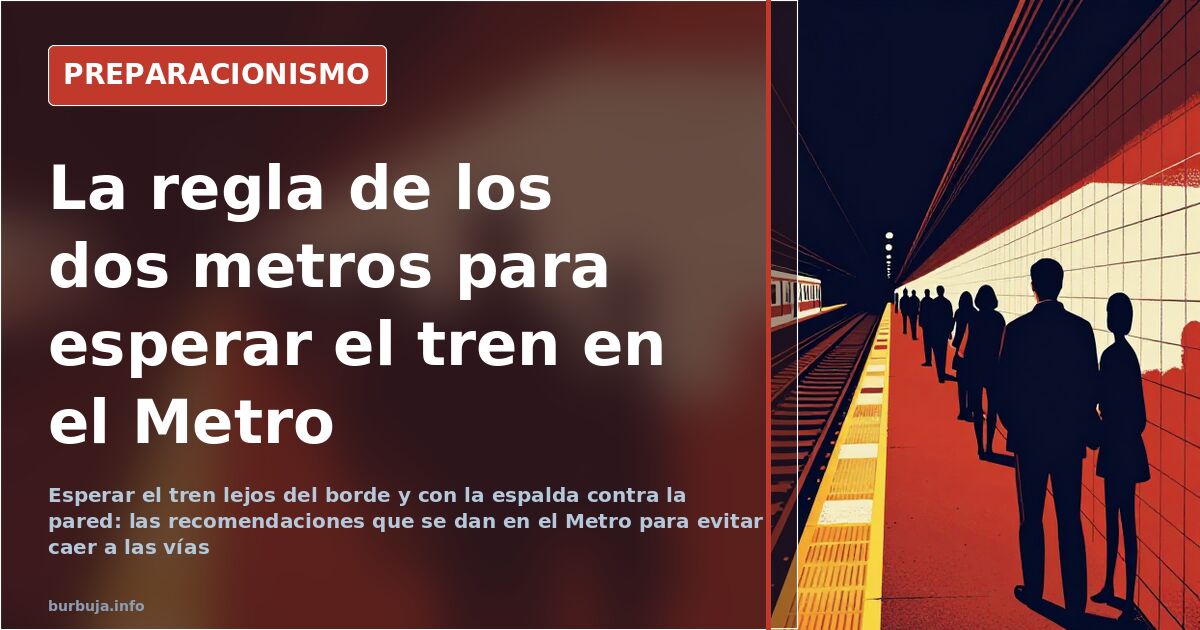
Falling onto subway tracks: where to position yourself and why
The greatest danger is not the fall. It is what you do in the minutes that trinc. Instinct pushes you to climb out immediately over the edge of the platform; the advice repeated throughout the thread is the opposite: press against the wall and wait for the train to come to a stop. The distance between one reaction and the other is not a nuance. It is the difference between living to tell the tale and not.
The scenario sounds like something out of a manual, but it raises real doubts. According to one participant, a recording documents the case of someone who fell onto the tracks with the camera rolling, got back up and recorded how they survived; that video acts as the trigger for much of the exchange. And not everyone agrees there: one voice warns that, at the 5:03 mark, the footage shows three members of the same family positioned on the tracks in a way that defies the most basic logic.
What to do if you fall onto the subway tracks
The basic maneuver is simple and counterintuitive: stand up, with your back against the wall, and only start walking once the train has come to a complete stop. Not before. The idea is to keep no part of your body in the path of the train and not to eyeball the height of the edge, which is deceptive.
That same logic —back against the wall— carries over to inside the carriage, where the goal is no longer the train but the other passengers. 180-degree vigilance is easier to manage than 360. The reasoning is cold: in a crowded carriage, blind angles are in abundance.
One controversial point remains open. The debate over whether it is better to position yourself lengthwise or perpendicular to the tracks is unresolved. Some argue the logical thing is to line up with the rails to make use of the gap, while others believe the footage shows exactly the opposite, with no one explaining why.
The most dangerous moment is before the train arrives
Here the consensus is broad. The risk is not on the tracks but on the platform, in the seconds before the train arrives. The recommendation: stay right at the back, do not get within two or three meters of the edge and do not move until the train has come to a complete stop.
The reason is not just the rush. The crowd gathers both people whose minds are elsewhere and people who are, quite simply, a problem. With that mix, the platform stops being a neutral space. Anyone who has ever found themselves in the middle of a shove during rush hour knows exactly what that means.
Why are people calling for an emergency stop button on the platform?
Because at the crucial moment there is no quick system to stop the train. One of the demands raised is to install emergency stop buttons in stations, with a deterrent attached: prison and fines for anyone who presses them without a valid reason.
The second front is rescue. The question of whether someone from above can pull up the person below without falling in themselves goes unanswered. The proposal is to lie down on the ground to pull the person below up while others hold on from behind, but the coordination it requires means no one considers it a done deal.
With these rules, any platform becomes a small test of attentiveness. And what if the one who falls is the person who was looking at their phone?
Also available in: Deutsch
Summary of a discussion on Burbuja.info - Foro de economía, actualidad y política., translated from Spanish and reviewed before publication. Read the full discussion (17 replies).
More summaries
-
Hunter downs 50kg wild boar with single hip shot
A hunter kills a 50kg wild boar from 50 meters using a Marlin .45-70, reigniting the debate over species overpopulation in Spain.
-
Emergency food kit for two: contents and missing essentials
A one-week survival list for two people including water and canned goods. The cost of preparing for a total collapse can reach 2,000 euros.
-
Utopia 2013: Where to Download the British Series on P2P
The British series Utopia (2013), with two subtitled seasons, is still available on eMule, torrent and direct download
-
When Your Child Calls You Stupid: The Discipline Dilemma
A child's insult as a test of authority: the dilemma between physical punishment and dialogue in prepper culture. Clashing positions with no middle ground.
-
3D-printed homes: prepper self-building or a mirage?
3D-printed housing promises low-cost self-building, but between the investment (€30,000–500,000) and the legal wall, the prepper dream runs into reality.
-
How to tell a tree's age without cutting it down (or using a pig)
From growth rings to the Pressler borer: how to find out a tree's age without an axe or castrated pigs. Dendrochronology in the world of…