
Hunter downs 50kg wild boar with single hip shot
A hunter kills a 50kg wild boar from 50 meters using a Marlin .45-70, reigniting the debate over species overpopulation in Spain.
English · Original discussion in Spanish · Published
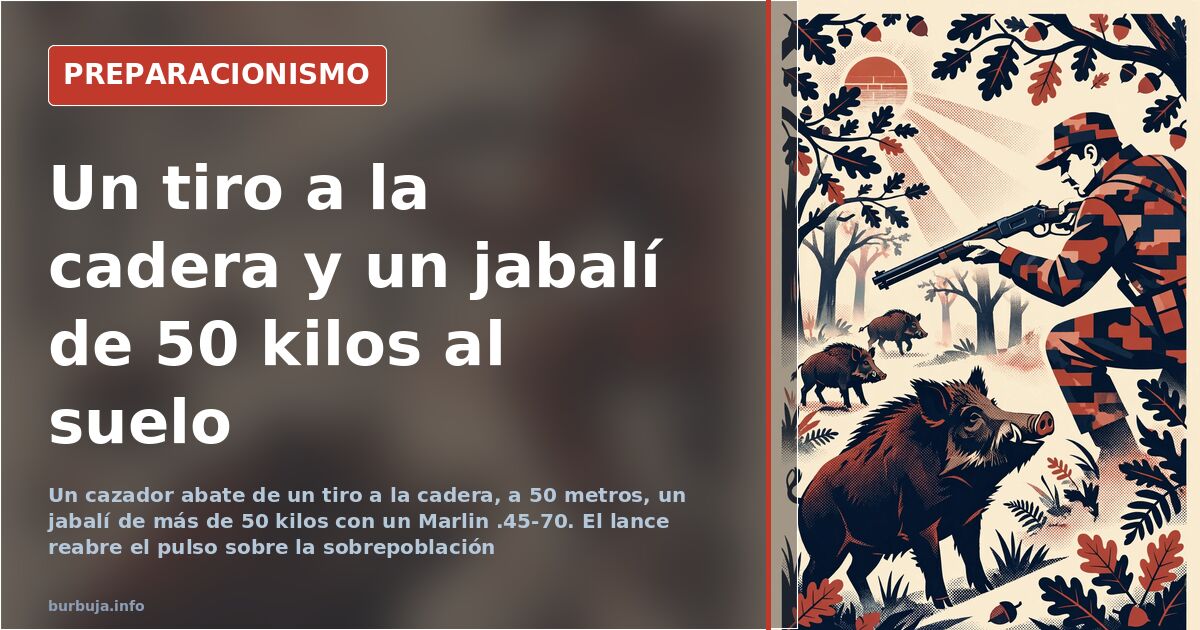
Single hip shot downs 50kg wild boar at 50 meters
A hunter successfully downed a wild boar weighing over 50 kilos with a single hip shot—an instinctive, unbraced shot—from a distance of between 40 and 50 meters when the animal crossed his path in the mountains. The weapon used was a Marlin 1895 Trapper lever-action rifle in .45-70 Government, equipped with a 40mm TruGlo red dot sight. The animal was recovered near a roadside and loaded into a Hilux pick-up. The hunter describes the event with great humility, noting how exceptional the shot was. This hunting anecdote reignites the long-standing debate over whether wild boar hunting serves as essential pest control or is merely a hobby.
Wild boar without natural predators: from game to pest
The core argument for hunting advocates is ecological imbalance rather than trophies. It is argued that without wolves or other predators to keep them in check, wild boar populations explode, causing damage to crops, encroaching on urban areas, and displacing other species. In this context, the case of the Gredos mountain goat is cited, where overpopulation and disease led to calls for hunters to intervene and reduce numbers.
The underlying question is why wolves do not perform this role naturally. The simple answer provided is that wolves prefer easier prey—such as sheep or calves—rather than risking injury against a wild boar. Some add another layer to the problem: the release of specimens brought from Central Europe to restock hunting estates, which poses sanitary risks to Spain's pig farming industry, a practice that the scientific community has reportedly attempted to curb.
Skin, tusks, and the real danger of a wild boar
Despite their cartoonish depiction in urban imagination, wild boars are not harmless. An adult male is heavy enough to break knees or cause internal bleeding during a charge. Their tusks measure between 8 and 12 centimeters and can slash a calf or hit the femoral artery. Their skin, an inch thick, acts as natural chainmail; a soft-point or hollow-point .357 bullet may fail to peine it at 200 meters.
Those familiar with them describe almost military organization. The dominant male is always escorted by younger boars who learn routes, schedules, and water access from him. In exchange for this mentorship, the novices are the first to cross exposed areas to check for danger—much like a platoon where the rookie goes first.
The cost of wild boar meat: 25 euros for trichina testing
For those who hunt for food, expenses go beyond licenses and hunting estates. Mandatory testing for *Trichinella* costs 25 euros per animal. One enthusiast claims to harvest 8 wild boars a year, providing enough meat for the whole year, provided the meat passes sanitary inspections. *Trichinella* is a parasite that can be transmitted to consumers if the meat is not inspected, making this procedure the thin line between a meal and a medical emergency.
Opinions on flavor vary. Some claim a 120-kilogram male, well-marinated and grilled, is a delicacy. Others argue the opposite, stating that older boars are dry, fibrous, and have a wild taste that can only be masked with chestnuts and mushrooms. Large specimens are often sold to restaurants for stocks and stews.
Choosing a rifle based on distance: lever-action or bolt-action
The choice of weapon depends on the scenario. For quick shots under 200 meters, the lever-action rifle wins: it cycles faster and uses heavy, expansive cartridges with a parabolic trajectory that delivers high impact energy. For greater distances, bolt-action rifles with high-velocity cartridges are preferred.
The review of specific options is detailed: a Solisolisolisolisolisolisoli Boarbuster Mark II in 45/70 with an Aimpoint Micro H2 (2 MOA) for dense brush, or a Browning BLR in .30-06 Springfield with a Leica 2.5-15x50 as a middle ground. Debates even arise over the Marlin's manufacturing era—whether it was a Remington or Ruger production—showing that even factory details are scrutinized. The calculation of which caliber suits each distance, considering trajectories and bullet weights, is a technical necessity.
The gap between the countryside and the city
Tensions rise when hunting is questioned by those outside rural environments. The response is swift: urbanites are accused of believing meat simply appears on supermarket shelves. The suffering of a hunted wild boar is compared to that of a pig in a factory farm, with some suggesting guided tours of slaughterhouses so people can see how the industrial chain actually works.
Amidst the dispute, a symbolic case resurfaces: a man who, armed only with a sickle, faced a wild boar to protect children, only to face potential punishment instead of receiving praise. While the caliber, red dot, and cartridges are discussed with technical rigor, the fundamental clash is not technical.
The eternal question remains: is the wild boar a pest that must be controlled, or an animal paying the price for learning to live among us? The hip shot is a antiestéticat to boast about; the answer to the debate remains open.
A hunter successfully downed a wild boar weighing over 50 kilos with a single hip shot—an instinctive, unbraced shot—from a distance of between 40 and 50 meters when the animal crossed his path in the mountains. The weapon used was a Marlin 1895 Trapper lever-action rifle in .45-70 Government, equipped with a 40mm TruGlo red dot sight. The animal was recovered near a roadside and loaded into a Hilux pick-up. The hunter describes the event with great humility, noting how exceptional the shot was. This hunting anecdote reignites the long-standing debate over whether wild boar hunting serves as essential pest control or is merely a hobby.
Wild boar without natural predators: from game to pest
The core argument for hunting advocates is ecological imbalance rather than trophies. It is argued that without wolves or other predators to keep them in check, wild boar populations explode, causing damage to crops, encroaching on urban areas, and displacing other species. In this context, the case of the Gredos mountain goat is cited, where overpopulation and disease led to calls for hunters to intervene and reduce numbers.
The underlying question is why wolves do not perform this role naturally. The simple answer provided is that wolves prefer easier prey—such as sheep or calves—rather than risking injury against a wild boar. Some add another layer to the problem: the release of specimens brought from Central Europe to restock hunting estates, which poses sanitary risks to Spain's pig farming industry, a practice that the scientific community has reportedly attempted to curb.
Skin, tusks, and the real danger of a wild boar
Despite their cartoonish depiction in urban imagination, wild boars are not harmless. An adult male is heavy enough to break knees or cause internal bleeding during a charge. Their tusks measure between 8 and 12 centimeters and can slash a calf or hit the femoral artery. Their skin, an inch thick, acts as natural chainmail; a soft-point or hollow-point .357 bullet may fail to peine it at 200 meters.
Those familiar with them describe almost military organization. The dominant male is always escorted by younger boars who learn routes, schedules, and water access from him. In exchange for this mentorship, the novices are the first to cross exposed areas to check for danger—much like a platoon where the rookie goes first.
The cost of wild boar meat: 25 euros for trichina testing
For those who hunt for food, expenses go beyond licenses and hunting estates. Mandatory testing for *Trichinella* costs 25 euros per animal. One enthusiast claims to harvest 8 wild boars a year, providing enough meat for the whole year, provided the meat passes sanitary inspections. *Trichinella* is a parasite that can be transmitted to consumers if the meat is not inspected, making this procedure the thin line between a meal and a medical emergency.
Opinions on flavor vary. Some claim a 120-kilogram male, well-marinated and grilled, is a delicacy. Others argue the opposite, stating that older boars are dry, fibrous, and have a wild taste that can only be masked with chestnuts and mushrooms. Large specimens are often sold to restaurants for stocks and stews.
Choosing a rifle based on distance: lever-action or bolt-action
The choice of weapon depends on the scenario. For quick shots under 200 meters, the lever-action rifle wins: it cycles faster and uses heavy, expansive cartridges with a parabolic trajectory that delivers high impact energy. For greater distances, bolt-action rifles with high-velocity cartridges are preferred.
The review of specific options is detailed: a Solisolisolisolisolisolisoli Boarbuster Mark II in 45/70 with an Aimpoint Micro H2 (2 MOA) for dense brush, or a Browning BLR in .30-06 Springfield with a Leica 2.5-15x50 as a middle ground. Debates even arise over the Marlin's manufacturing era—whether it was a Remington or Ruger production—showing that even factory details are scrutinized. The calculation of which caliber suits each distance, considering trajectories and bullet weights, is a technical necessity.
The gap between the countryside and the city
Tensions rise when hunting is questioned by those outside rural environments. The response is swift: urbanites are accused of believing meat simply appears on supermarket shelves. The suffering of a hunted wild boar is compared to that of a pig in a factory farm, with some suggesting guided tours of slaughterhouses so people can see how the industrial chain actually works.
Amidst the dispute, a symbolic case resurfaces: a man who, armed only with a sickle, faced a wild boar to protect children, only to face potential punishment instead of receiving praise. While the caliber, red dot, and cartridges are discussed with technical rigor, the fundamental clash is not technical.
The eternal question remains: is the wild boar a pest that must be controlled, or an animal paying the price for learning to live among us? The hip shot is a antiestéticat to boast about; the answer to the debate remains open.
Summary of a discussion on Burbuja.info - Foro de economía, actualidad y política., translated from Spanish and reviewed before publication. Read the full discussion (461 replies).
More summaries
-
Ripoll detainee: no explosives, only airsoft hobby
The Ripoll detainee claims no firearms or explosives were found, only airsoft gear and a 3D printer.
-
Double perimeter and safe room: securing an isolated home
The key is the clock, not the gun: a double retraced perimeter, sensors with margin, and a safe room that holds until police arrive.
-
Home Security: How to Turn a House into a Cheap Safehouse
A 5 euro latch, 15-20 euro locks, and a panic room offer a cheap manual to fortify a house against intruders, cheaper than securing an apartment.
-
Post-25N survival: rent, don't borrow, pack your bags
In 2014, a manual advised renting, avoiding debt and preparing a bag after 25-N. A decade later, hundreds of responses audit what it got right.
-
Post-Mad Max memoirs: The cult collapse novel released in installments
A post-apocalyptic story serialized in online forums has become a cult reference for collapse fiction and survivalism.
-
Dog attack survival: effective defense tactics and common myths
From using a non-dominant arm to using a knife: an analysis of what actually works and what is pure fantasy during a dog attack.