
Emergency food kit for two: contents and missing essentials
A one-week survival list for two people including water and canned goods. The cost of preparing for a total collapse can reach 2,000 euros.
English · Original discussion in Spanish · Published
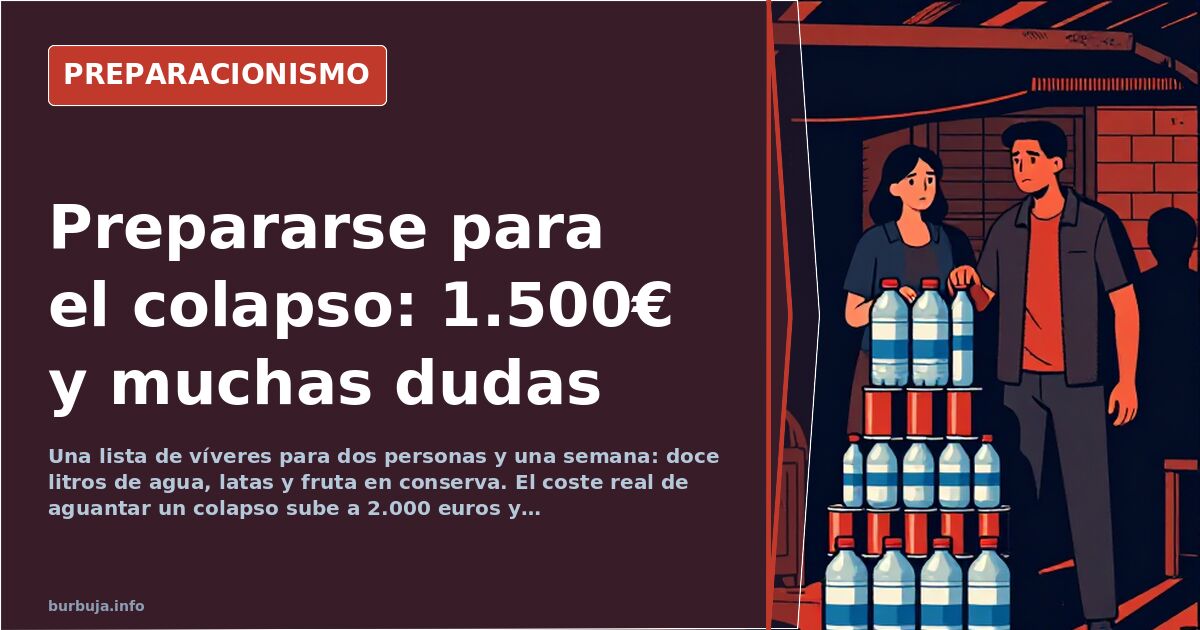
Emergency food kit for two people: what is included and what is missing
How much food should you keep at home to survive a week without going to the supermarket? The proposal circulating among survivalists fits on a single sheet of paper: a small jar of coffee, half a kilo of powdered milk, six shelf-stable yogurts, two loaves of sliced bread, two kilos of potatoes, four cans of tuna, two cans of lentils, two cans of beans, one kilo of vegetables, one liter of juice, canned fruit, four soft drinks, twelve liters of water, and a bottle of wine. Everything is calculated for two people for seven days. If the timeframe extends to a month, the recipe must be multiplied by four.
It is the logic of the domestic survivor: buy non-perishables, stack them, and wait. The useful question is not whether the scenario will occur, but whether the list is properly sized. And that is where the disagreement begins.
What does the emergency kit for two people include?
The list is organized by groups: dairy, carbohydrates, fats and proteins, vitamins, and beverages. Nothing exotic. Sliced bread, potatoes, oil, powdered egg, canned fish and legumes, nuts, onions and peppers, juice, and canned pineapple and peaches. The water, twelve liters, is the item that takes up the most space and leaves the least margin for error.
There is a catch regarding the timeline: whoever designed the kit assumes the supply cut will be short and that normalcy will soon return. Under that assumption, seven days of food is a buffer, not a pantry. The author of the list himself admits the doubt and asks to be corrected if he has overshot or fallen short. He fell short, and he knew it.
The real cost of preparing for a collapse
With that weekly basket, two adults can eat. Barely. The first criticism is one of scale: to last two years, they calculate that you must multiply the original plan by four and spend between 1,500 and 2,000 euros on food alone. Other estimates raise the stakes to 300 wheat bottles or 180 kilos of rice and pasta as a reasonable cushion for a couple.
More developed materials exist. The communicator Pedro Prieto published a spreadsheet, Equipo de emergencia v1.0, which promises three years of theoretical autonomy barring other types of unforeseen events. Meanwhile, a US-based family storage calculator requires about 200 square meters of housing to stack everything required. The practical conclusion is uncomfortable: the bottleneck is not the shopping list, but the floor space.
Gaps in the kit: salt, security, and items for bartering
The absences speak louder than the presences. Salt is missing, without which bland food is unpalatable. Fuel is missing. Depending on the prevailing humor, condoms are also missing, under the argument that a long lockdown without distractions ends in a new generation to feed. It is an old joke, but it still works.
More serious is the security aspect. Some argue that accumulating food is of little use if you do not protect your home: securing the perimeter, avoiding unwanted visitors, or even relying on crossbows and arrows. In parallel, the barter thesis emerges: in the absence of money, it is prudent to keep what has historically functioned as currency, and in that regard, tobacco tops the list ahead of any canned good.
Canned, glass, or dehydrated: how to store food without waste
Technique is as important as the purchase. The technical consensus suggests that glass preserves better than cans, and that packaged pasta lasts between one and two years without issues. Brown and white rice, dried legumes, honey, sugar, unrefined sea salt, salt cod, and muesli form the core of a pantry that ages well.
For those who produce their own harvest, there is a recurring trick: freeze the grain 24 hours before vacuum sealing it to kill any insects inside. There is also a discipline of rotation that almost no one practices: always consume the item closest to its expiration date and replace it. Printed dates, it is noted, are overly conservative; food loses its properties long before it actually rots.
An alternative entering the conversation is dehydrated food, which does not expire and is sold in annual packs with shipping to Spain. It is expensive per serving. No one has found a way to make it cheap.
From theoretical kits to real stockpiling: the pandemic as a trial run
The exercise stopped being theoretical in February 2020. Those who already had a plan executed it without fanfare: cans of tuna, legumes, milk, rice, flour, yeast, salt, oil bought in bulk from local producers, and reserve protein in the form of salt cod. To this, whole pumpkins—which last much longer than potatoes—and frozen goods were added. Several people describe weeks without stepping outside.
The reference point used is not a desert movie, but Argentina after the 2001 crisis: how a middle-class family lives when money evaporates but life goes on. This also leads to agricultural derivatives: underground tanks to collect rainwater, nighttime drip irrigation to avoid evaporation, heirloom seeds, and the old debate about irrigating with seawater, which only works where rain washes the soil and pH is controlled with lime.
Nearly two decades after the first message, the kit still contains twelve liters of water and a bottle of wine. For now, the rifle hasn't been needed. The dynamo flashlight, however, has run out.
How much food should you keep at home to survive a week without going to the supermarket? The proposal circulating among survivalists fits on a single sheet of paper: a small jar of coffee, half a kilo of powdered milk, six shelf-stable yogurts, two loaves of sliced bread, two kilos of potatoes, four cans of tuna, two cans of lentils, two cans of beans, one kilo of vegetables, one liter of juice, canned fruit, four soft drinks, twelve liters of water, and a bottle of wine. Everything is calculated for two people for seven days. If the timeframe extends to a month, the recipe must be multiplied by four.
It is the logic of the domestic survivor: buy non-perishables, stack them, and wait. The useful question is not whether the scenario will occur, but whether the list is properly sized. And that is where the disagreement begins.
What does the emergency kit for two people include?
The list is organized by groups: dairy, carbohydrates, fats and proteins, vitamins, and beverages. Nothing exotic. Sliced bread, potatoes, oil, powdered egg, canned fish and legumes, nuts, onions and peppers, juice, and canned pineapple and peaches. The water, twelve liters, is the item that takes up the most space and leaves the least margin for error.
There is a catch regarding the timeline: whoever designed the kit assumes the supply cut will be short and that normalcy will soon return. Under that assumption, seven days of food is a buffer, not a pantry. The author of the list himself admits the doubt and asks to be corrected if he has overshot or fallen short. He fell short, and he knew it.
The real cost of preparing for a collapse
With that weekly basket, two adults can eat. Barely. The first criticism is one of scale: to last two years, they calculate that you must multiply the original plan by four and spend between 1,500 and 2,000 euros on food alone. Other estimates raise the stakes to 300 wheat bottles or 180 kilos of rice and pasta as a reasonable cushion for a couple.
More developed materials exist. The communicator Pedro Prieto published a spreadsheet, Equipo de emergencia v1.0, which promises three years of theoretical autonomy barring other types of unforeseen events. Meanwhile, a US-based family storage calculator requires about 200 square meters of housing to stack everything required. The practical conclusion is uncomfortable: the bottleneck is not the shopping list, but the floor space.
Gaps in the kit: salt, security, and items for bartering
The absences speak louder than the presences. Salt is missing, without which bland food is unpalatable. Fuel is missing. Depending on the prevailing humor, condoms are also missing, under the argument that a long lockdown without distractions ends in a new generation to feed. It is an old joke, but it still works.
More serious is the security aspect. Some argue that accumulating food is of little use if you do not protect your home: securing the perimeter, avoiding unwanted visitors, or even relying on crossbows and arrows. In parallel, the barter thesis emerges: in the absence of money, it is prudent to keep what has historically functioned as currency, and in that regard, tobacco tops the list ahead of any canned good.
Canned, glass, or dehydrated: how to store food without waste
Technique is as important as the purchase. The technical consensus suggests that glass preserves better than cans, and that packaged pasta lasts between one and two years without issues. Brown and white rice, dried legumes, honey, sugar, unrefined sea salt, salt cod, and muesli form the core of a pantry that ages well.
For those who produce their own harvest, there is a recurring trick: freeze the grain 24 hours before vacuum sealing it to kill any insects inside. There is also a discipline of rotation that almost no one practices: always consume the item closest to its expiration date and replace it. Printed dates, it is noted, are overly conservative; food loses its properties long before it actually rots.
An alternative entering the conversation is dehydrated food, which does not expire and is sold in annual packs with shipping to Spain. It is expensive per serving. No one has found a way to make it cheap.
From theoretical kits to real stockpiling: the pandemic as a trial run
The exercise stopped being theoretical in February 2020. Those who already had a plan executed it without fanfare: cans of tuna, legumes, milk, rice, flour, yeast, salt, oil bought in bulk from local producers, and reserve protein in the form of salt cod. To this, whole pumpkins—which last much longer than potatoes—and frozen goods were added. Several people describe weeks without stepping outside.
The reference point used is not a desert movie, but Argentina after the 2001 crisis: how a middle-class family lives when money evaporates but life goes on. This also leads to agricultural derivatives: underground tanks to collect rainwater, nighttime drip irrigation to avoid evaporation, heirloom seeds, and the old debate about irrigating with seawater, which only works where rain washes the soil and pH is controlled with lime.
Nearly two decades after the first message, the kit still contains twelve liters of water and a bottle of wine. For now, the rifle hasn't been needed. The dynamo flashlight, however, has run out.
Also available in: Deutsch
Summary of a discussion on Burbuja.info - Foro de economía, actualidad y política., translated from Spanish and reviewed before publication. Read the full discussion (103 replies).
More summaries
-
Hiding Food During Collapse: The Pit Digging Mistake
Burying barrels is a common survival plan, but if you aren't starving after three months, your secret is exposed.
-
Prepper: 25 Essential Items and 12 No-Cook Foods
Two lists total 37 survival items: from non-perishable honey to small denomination cash. Freeze-dried fruit lasts up to 25 years.
-
The Real Prepper Kit: Knots, Lead, and Bear Traps
A prepper's manual comes down to four essentials: ropes, lead, valuable metals, and self-taught skills. No cans or bunkers.
-
Utopia 2013: Where to Download the British Series on P2P
The British series Utopia (2013), with two subtitled seasons, is still available on eMule, torrent and direct download
-
Fear of silence: How tinnitus and noise drive us away from ourselves
Silence can be unsettling because it forces introspection. Tinnitus and constant ambient noise fuel a social habit of avoiding quiet moments.
-
Southern Cone escape route for a potential nuclear war
A staged maritime route via Spain, Africa, and Brazil to flee Europe and reach Patagonia in the event of a nuclear conflict.