
Fact-check: The myth of six million in a Syrian mass grave
The claim that Assad killed six million people buried in one mass grave is false; Syria’s population and physical constraints make the figure impossible.
English · Original discussion in Spanish · Published
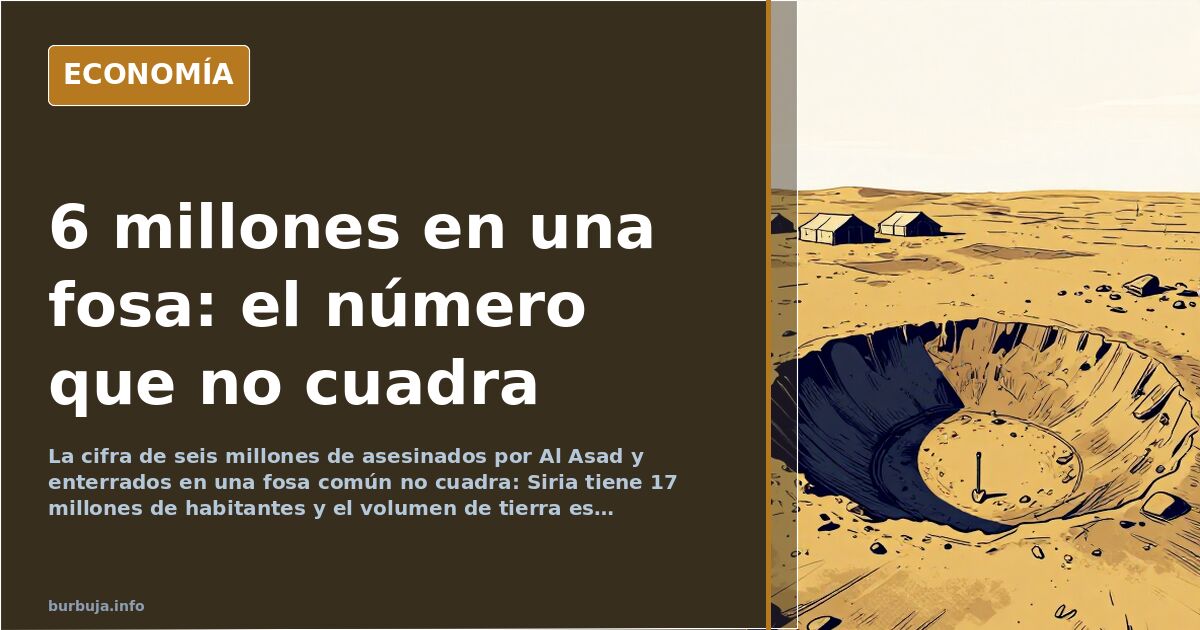
Fact-check: The myth of six million in a Syrian mass grave
The figure circulates with an insistence that has become a journalistic genre of its own: six million people murdered by Bashar al-Assad’s regime and buried in a single mass grave. The round, familiar number reappeared on screen linked to news about a grave found in Syria, triggering immediate reactions: comparisons to the Holocaust, calculations of the trench’s impossibility, and questions about why it is always six. In a country of roughly 17 or 18 million inhabitants, the arithmetic falls apart on its own.
Where the figure comes from and why it repeats
The original news story spoke of a mass grave in Syria containing tens of thousands of bodies. At some point in the dissemination chain, the data mutated. It is argued that media outlets have a weakness for multiples of six: six million, one hundred thousand, ten thousand. This pattern recurs across very different types of coverage and fuels suspicion that the figure is chosen for its symbolic weight rather than verified accuracy.
Physical calculation is the first obstacle. A grave holding six million bodies would require an earth volume no satellite could have missed. The question of how many bulldozers would be needed to dig such a hole, and why no observation system detected it, is the most frequently asked. The lack of a numerical answer leaves the matter unresolved.
The omitted context: who governs and who reports
The discussion quickly shifts to the geopolitical framework. It is claimed that these reports aim to portray Assad as a monster and his adversaries as heroes of freedom, despite the fact that some of those adversaries have records that do not withstand scrutiny. In this narrative, the figure serves as a sarracena alibi.
There is a current of thought that goes further, pointing to an underlying pattern: the public is numerically illiterate. Any figures can be thrown around because no one checks them, and if they also trigger implanted ideological biases, so much the better. Six million is, in this reading, the fetish number par excellence, one that needs no proof because it already carries emotional baggage.
The verification problem and media law
The lingering question is why these figures are not publicly corrected. Reference is made to the new media law requiring content creators with a certain number of subscribers to issue corrections, highlighting the paradox: those who demand corrections from others fail to practice them when the error is their own. The conclusion drawn is that verification is selective.
This case illustrates a broader mechanism. An impossible figure is published, repeated, and becomes common sense. When someone asks for the breakdown, the response is not the data but dismissal. Meanwhile, the number continues to do its work.
The issue is not doubting the figure itself. The problem is that the figure was designed to make doubt appear suspicious.
The figure circulates with an insistence that has become a journalistic genre of its own: six million people murdered by Bashar al-Assad’s regime and buried in a single mass grave. The round, familiar number reappeared on screen linked to news about a grave found in Syria, triggering immediate reactions: comparisons to the Holocaust, calculations of the trench’s impossibility, and questions about why it is always six. In a country of roughly 17 or 18 million inhabitants, the arithmetic falls apart on its own.
Where the figure comes from and why it repeats
The original news story spoke of a mass grave in Syria containing tens of thousands of bodies. At some point in the dissemination chain, the data mutated. It is argued that media outlets have a weakness for multiples of six: six million, one hundred thousand, ten thousand. This pattern recurs across very different types of coverage and fuels suspicion that the figure is chosen for its symbolic weight rather than verified accuracy.
Physical calculation is the first obstacle. A grave holding six million bodies would require an earth volume no satellite could have missed. The question of how many bulldozers would be needed to dig such a hole, and why no observation system detected it, is the most frequently asked. The lack of a numerical answer leaves the matter unresolved.
The omitted context: who governs and who reports
The discussion quickly shifts to the geopolitical framework. It is claimed that these reports aim to portray Assad as a monster and his adversaries as heroes of freedom, despite the fact that some of those adversaries have records that do not withstand scrutiny. In this narrative, the figure serves as a sarracena alibi.
There is a current of thought that goes further, pointing to an underlying pattern: the public is numerically illiterate. Any figures can be thrown around because no one checks them, and if they also trigger implanted ideological biases, so much the better. Six million is, in this reading, the fetish number par excellence, one that needs no proof because it already carries emotional baggage.
The verification problem and media law
The lingering question is why these figures are not publicly corrected. Reference is made to the new media law requiring content creators with a certain number of subscribers to issue corrections, highlighting the paradox: those who demand corrections from others fail to practice them when the error is their own. The conclusion drawn is that verification is selective.
This case illustrates a broader mechanism. An impossible figure is published, repeated, and becomes common sense. When someone asks for the breakdown, the response is not the data but dismissal. Meanwhile, the number continues to do its work.
The issue is not doubting the figure itself. The problem is that the figure was designed to make doubt appear suspicious.
Also available in: Deutsch
Summary of a discussion on Burbuja.info - Foro de economía, actualidad y política., translated from Spanish and reviewed before publication. Read the full discussion (163 replies).
More summaries
-
La Sexta's Ceuta report raises doubts
A La Sexta report featuring hooded residents of Ceuta reopens the debate on the credibility of migration coverage and the city's future
-
Israel threatens Syria with massive strikes after Iranian drones
Israel threatens Syria with massive strikes after Iranian drones. The region is on edge with statements and military mobilizations. Read the full analysis.
-
Ignacio Lázaro: 'Maricarmen paid €154 rent while we paid €750'
Ignacio Lázaro, grandson of the original owner, reveals the other side of the Maricarmen case: 'We subsidized her for years and now, with our taxes.'
-
Open-source project clones seven Adobe apps
An open-source initiative replicates features from seven Adobe applications, gaining 44,000 GitHub stars and updating every three days.
-
Spain Audit Finds €2.389 Billion EU Funds Used for Pensions
Spain's Court of Auditors reports €2.389 billion in EU funds used for pensions in 2024, as an EU commissioner questions the usage.
-
Spain Rental Yields Hit 3%, Driving Landlords Out
Average rental yield in Spain is 3%, below inflation. The €500 per €100,000 rule explains why landlords are leaving the market.