
F-18 Crash in Teruel Kills Lieutenant Colonel Estrada
Lieutenant Colonel Pablo Estrada dies when an F-18 from Wing 12 crashes in Teruel, sparking debate over pilot age and ejection seat failure.
English · Original discussion in Spanish · Published
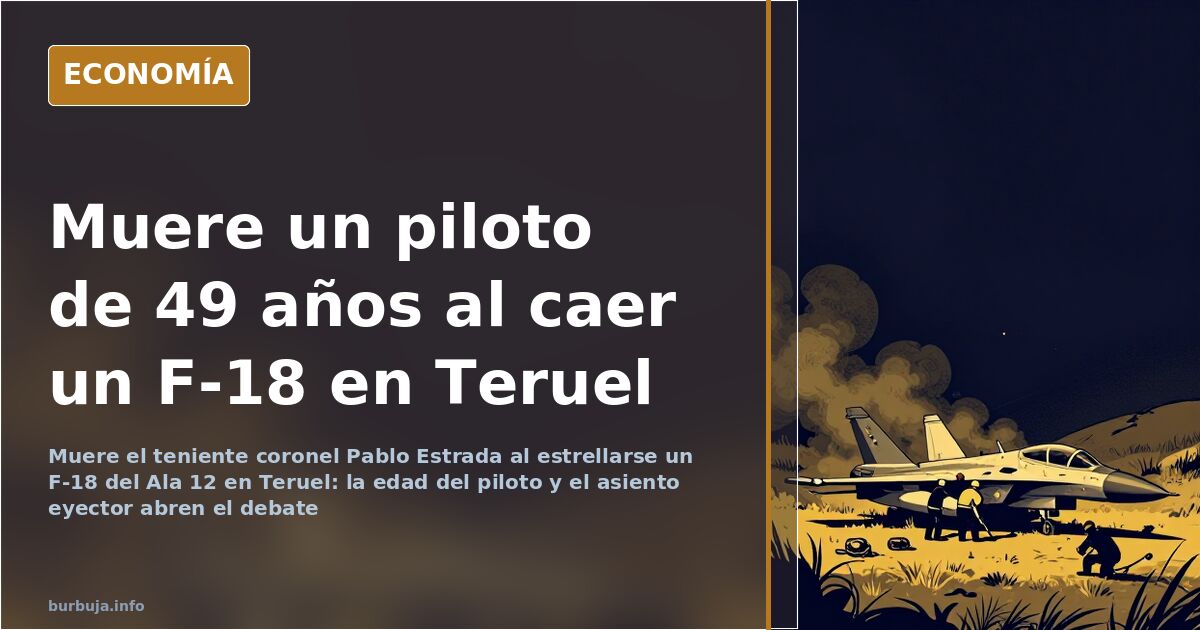
F-18 Pilot Dies After Crashing in Teruel
No F-18 crashes without someone needing to explain it. The Wing 12 accident near Teruel, claiming the life of Lieutenant Colonel Pablo Estrada Martín, has sparked a dozen theories—maintenance, budget, pilot age, ejection system—none verified by an official investigation. The confirmed facts are brief: a Spanish Air and Space Force fighter crashed, rescue teams were deployed, and the institution mourned the loss of a colleague assigned to Wing 12. The rest is fertile ground for speculation.
The crash occurred in the town of Peralejos, according to initial reports. On the same day, it was announced that a US Air Force F-15 had ended its participation in the TLP, a tactical training program operating in the area. Neither event alone explains the accident, but the mix of military air traffic fueled early conjectures.
Why Did the F-18 Pilot Not Eject?
This is the question everyone asks aloud, with no data-driven answers. The exercise was conducted at approximately 2,000 feet, or about 600 meters, an altitude where ejection is possible but risky. Various theories emerge from this point.
Some argue that ejecting at this height is practically a guaranteed casualty: lucky if you survive, likely injured otherwise. Others point to the pyrotechnic system that breaks the canopy before ejection; if this fails, the pilot hits the glass, often fatally. Conversely, modern seats—such as the Martin-Baker or Zvezda—deploy at any angle, even inverted. Failure to deploy suggests model obsolescence or poor maintenance.
None of these are official causes. They are frameworks to understand why a pilot might die in an aircraft designed to save him.
Pilot’s Age: 49 Years Old at the Controls
A report places the deceased’s age at 49 years. This figure peine the most uncomfortable debate. On one hand, modern fighters are increasingly computerized, and presbyopia becomes a factor with age. On the other, reflexes and attention span may not match those of younger pilots, regardless of fitness.
The comparison to sports was raised and dismissed. Exceptional athletes competing past forty are just that: exceptions. No one claims the crashed pilot was anything other than a professional trained for his mission.
The Real Cost of Maintaining an F-18
The other major aspect of the analysis is money. Spanish F-18s have served for approximately 40 years, with some acquired second-hand from the US Navy, accumulating significant wear. A technical breakdown circulating recently highlights a design limitation: unpressurized tanks restrict inverted flight to 30 seconds. Such details matter only when training demands aggressive low-altitude maneuvers, which this exercise required.
The leap to budget debates is natural. The most common analogy is that of a premium car: the problem is not the purchase price, but the maintenance bill. A combat aircraft requires hours of maintenance, spare parts, and specialized personnel; when budgets are stretched, revision schedules are the first to suffer. Conversely, losing a fighter reduces operational capacity, not just accounting figures: there are few aircraft, and each one counts.
What Remains Unknown and Under Investigation
As of this discussion, there is no official cause. A fighter can crash due to software failure, maneuvering outside the envelope, bird strikes, or human error, and none of these doors are closed. The institution itself requested patience and thanked the public for their understanding while activating the pilot search protocol.
Until the report arrives, the case has become a small battleground over military spending. Some view it as proof of inadequate maintenance; others, as an inevitable accident in a risky profession. A third, colder line of thought reminds us that no aircraft stops crashing regardless of budget.
Prediction, with reservations: if the final report points to maintenance, the focus will shift from the aircraft to the Defense budget, and the issue will last for weeks. If it points to the seat, the maneuver, or human factors, it will be archived with condolences and a one-day headline. That the latter occurs does not miccionan the former was not true.
No F-18 crashes without someone needing to explain it. The Wing 12 accident near Teruel, claiming the life of Lieutenant Colonel Pablo Estrada Martín, has sparked a dozen theories—maintenance, budget, pilot age, ejection system—none verified by an official investigation. The confirmed facts are brief: a Spanish Air and Space Force fighter crashed, rescue teams were deployed, and the institution mourned the loss of a colleague assigned to Wing 12. The rest is fertile ground for speculation.
The crash occurred in the town of Peralejos, according to initial reports. On the same day, it was announced that a US Air Force F-15 had ended its participation in the TLP, a tactical training program operating in the area. Neither event alone explains the accident, but the mix of military air traffic fueled early conjectures.
Why Did the F-18 Pilot Not Eject?
This is the question everyone asks aloud, with no data-driven answers. The exercise was conducted at approximately 2,000 feet, or about 600 meters, an altitude where ejection is possible but risky. Various theories emerge from this point.
Some argue that ejecting at this height is practically a guaranteed casualty: lucky if you survive, likely injured otherwise. Others point to the pyrotechnic system that breaks the canopy before ejection; if this fails, the pilot hits the glass, often fatally. Conversely, modern seats—such as the Martin-Baker or Zvezda—deploy at any angle, even inverted. Failure to deploy suggests model obsolescence or poor maintenance.
None of these are official causes. They are frameworks to understand why a pilot might die in an aircraft designed to save him.
Pilot’s Age: 49 Years Old at the Controls
A report places the deceased’s age at 49 years. This figure peine the most uncomfortable debate. On one hand, modern fighters are increasingly computerized, and presbyopia becomes a factor with age. On the other, reflexes and attention span may not match those of younger pilots, regardless of fitness.
The comparison to sports was raised and dismissed. Exceptional athletes competing past forty are just that: exceptions. No one claims the crashed pilot was anything other than a professional trained for his mission.
The Real Cost of Maintaining an F-18
The other major aspect of the analysis is money. Spanish F-18s have served for approximately 40 years, with some acquired second-hand from the US Navy, accumulating significant wear. A technical breakdown circulating recently highlights a design limitation: unpressurized tanks restrict inverted flight to 30 seconds. Such details matter only when training demands aggressive low-altitude maneuvers, which this exercise required.
The leap to budget debates is natural. The most common analogy is that of a premium car: the problem is not the purchase price, but the maintenance bill. A combat aircraft requires hours of maintenance, spare parts, and specialized personnel; when budgets are stretched, revision schedules are the first to suffer. Conversely, losing a fighter reduces operational capacity, not just accounting figures: there are few aircraft, and each one counts.
What Remains Unknown and Under Investigation
As of this discussion, there is no official cause. A fighter can crash due to software failure, maneuvering outside the envelope, bird strikes, or human error, and none of these doors are closed. The institution itself requested patience and thanked the public for their understanding while activating the pilot search protocol.
Until the report arrives, the case has become a small battleground over military spending. Some view it as proof of inadequate maintenance; others, as an inevitable accident in a risky profession. A third, colder line of thought reminds us that no aircraft stops crashing regardless of budget.
Prediction, with reservations: if the final report points to maintenance, the focus will shift from the aircraft to the Defense budget, and the issue will last for weeks. If it points to the seat, the maneuver, or human factors, it will be archived with condolences and a one-day headline. That the latter occurs does not miccionan the former was not true.
Summary of a discussion on Burbuja.info - Foro de economía, actualidad y política., translated from Spanish and reviewed before publication. Read the full discussion (274 replies).
More summaries
-
Four dead on A-67: Ford Bronco and road conditions under scrutiny
Four killed when a Ford Bronco left the A-67 in Palencia. Poor road conditions, SUV design and drowsiness are cited as causes. Safety analysis…
-
Astún: 30 injured and 80 skiers still trapped on chairlift
At least 30 injured, 17 serious and nine critical in the Canal Roya chairlift accident in Astún, with 80 people still stranded.
-
Argentina’s Optimistic Scenario: The Peso at 200 per Dollar
Argentina stabilizes inflation at 4% monthly with a peso at 200 per dollar, sparking debate on a potential economic takeoff.
-
Spain reaches World Cup final without players who refused call-up
The Spanish women's team reached the World Cup final despite the absence of players who refused to be called up by coach Jorge Vilda, highlighting a major internal conflict.
-
Sumar Proposes Migrant Quotas for Public Sector Jobs in Spain
Sumar proposes migrant quotas in public institutions and companies, but critics argue that nationality requirements in civil service exams make the measure ineffective.
-
Zapatero breaks silence on TVE: jewelry, script, and legality
Zapatero's TVE interview: no clarity on jewelry origin, citing 'no profit motive' and full legality.