
Astún: 30 injured and 80 skiers still trapped on chairlift
At least 30 injured, 17 serious and nine critical in the Canal Roya chairlift accident in Astún, with 80 people still stranded.
English · Original discussion in Spanish · Published
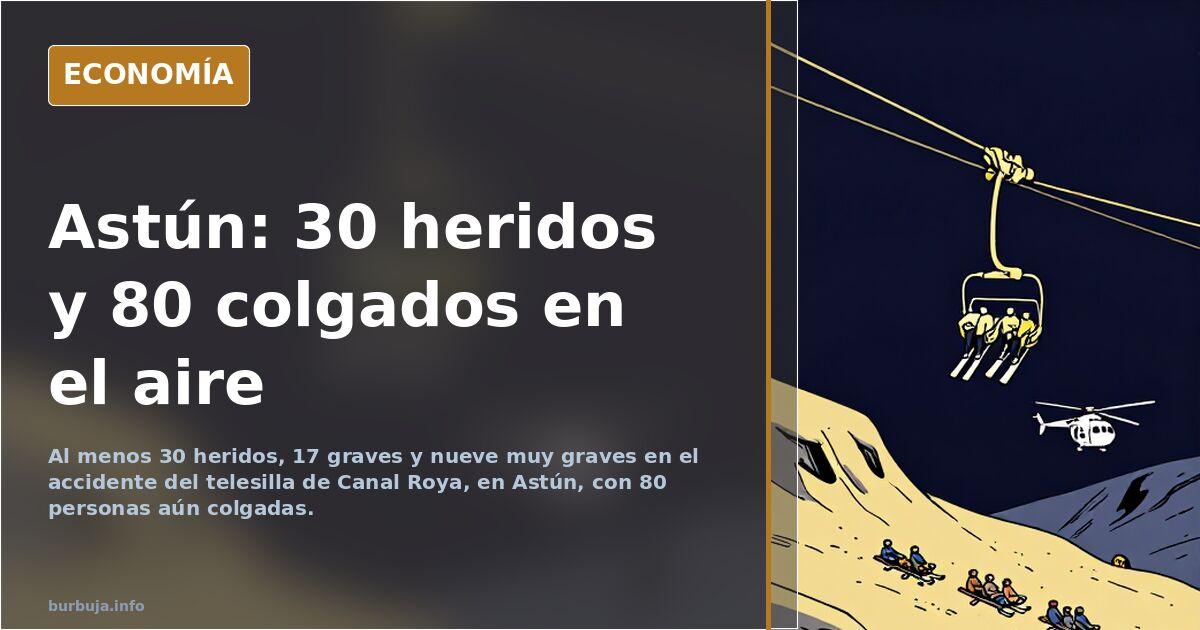
Astún: 30 injured and 80 skiers left hanging on the Canal Roya chair
At least 30 people were injured and 17 of them were in serious condition —nine critical and eight serious— in the accident at a chairlift at the Astún ski resort, in the Aragonese Pyrenees. The affected installation would be the Canal Roya quad chair, according to accounts circulating on social media. Among those affected is a woman who was taken to Hospital Miguel Servet in Zaragoza and about whom no further details are known.
The ski resort was closed and hospitals in Jaca, Huesca, Miguel Servet, Clínico Universitario, Royo Villanova and Barbastro were activated. The 061 reinforced all its resources and deployed four helicopters for evacuation work, while the Gobierno de Aragón set up the phone number 976715980 for relatives of the injured. Meanwhile, there were still people on the chairs.
What is known about the causes of the accident?
The cause has not been established. The hypothesis circulating in the first hours was a chair coming off after cable problems, something no one has confirmed with a technical report on the table. The president of Aragón, Jorge Azcón, travelled to the site accompanied by the regional minister of the interior, Roberto Bermúdez de Castro, to see the scale of the situation first-hand.
Over the course of the day, explanations shifted between mechanical failure and control failure. Whoever looks at the machine sees a bearing; whoever looks at the system sees a signature on a piece of paper. Both readings fit the same accident, and neither has been closed.
Eighty people left hanging on the chairlift
The public broadcaster said at least 80 people were still left hanging on the chairlift waiting to be rescued. The first accounts came via social media: a chair down in Canal Roya, ambulances going up to the resort, stretchers coming down the slope. One of the most repeated stories was that of a skier who had passed through that same installation fifteen days earlier: “I was skiing in Truchas 15 days ago. I went from Truchas to the Canal Roya quad chair. That's the one that fell.”
As the hours passed, the tone changed. Solidarity with the injured quickly gave way to suspicion about maintenance, and from there to the obvious question: if someone knew something, why wasn't the installation stopped?
Who inspects and who answers when a chairlift fails?
According to those who have worked in the sector, in cable transport, regulations require intensive preventive maintenance: every certain number of hours or years, the sheaves are dismantled, bearings are replaced and the sheave shafts and welds are checked, along with many other checks. The problem, they argue, is not the paperwork required by the rules, but who signs it and with how much judgement.
As several participants describe, installations are operated by a company and inspections are carried out by externalised control bodies, accredited and obliged to send their records to the administration, which in turn is the body that requires the review. On the ground, some argue that this system has become a formality: closed checklists, little room for technical judgement and a chain of responsibility designed more to protect itself than to detect wear. When something blows up, the focus ends up on the inspector who signed, on the operating company and, if the company does not respond, on the party subsidiarily responsible.
Previous experience invites caution: a fan recalled another opening day at another resort, with more than 100 people left hanging for hours because the lifts were running on generators and they had to be evacuated by moving the chairs by hand. It is not an unprecedented scenario. Only the number of injured changes.
Bearings, brakes and a cable out of its groove
Among the explanations being discussed in the thread, one of the most repeated points to a burst pulley bearing that would have pulled the cable out of its groove. Another line points to an electrical failure: without power, chairs can be left without brakes and fall under their own weight, although these systems include an auxiliary diesel engine for power cuts. These are hypotheses, not conclusions.
What, in one participant's view, admits less discussion is that a bearing in bad condition can be heard before it breaks. That noise —the warning that almost never fails— should have triggered some alert somewhere in the chain. Finding where is, by this point, the real object of the investigation.
The €70 ski pass and the price paradox
The accident peine an uncomfortable comparison: skiing in Spain is more expensive than in France or Switzerland, according to the comparison circulating among fans, with a perceived quality that does not always match. The day pass is quoted at around 70 euros at some resorts, a rate skiers pay expecting the installation to be checked. The complaint is repeated: charging top-dollar for the ski pass for this.
Some add that snow tourism is a circus of equipment rental, hotels and paraphernalia for a few days of holiday, and that maintenance is precisely the part that is not seen and for which no one wants to pay. Others respond that the profile of the Spanish skier is very far from the cliché: there are workers from Navarra and Guipúzcoa with collective agreements exceeding 45,000 euros gross a year, and also school trips to the snow from public schools.
Who pays for the maintenance of a resort
The operating model comes fully into the discussion. In the thread it is stated that the resort is private, and from there comes the most repeated argument: if the installation is private, maintenance is paid for by the business owner, full stop. The public variant of the debate points in another direction: when operation or inspection depends on the administration, reviews end up being a file signed to cover the formality, and real safety becomes a side effect.
Neither version on its own explains how a chair that passes administrative checks ends up on the ground with 30 injured. That is exactly the distance between a signed piece of paper and a machine in operation.
On the same day as the accident, the president of Aragón lowered the number of injured and stated that the chairlift had passed administrative checks. In the air, awaiting rescue, there were still dozens of people.
At least 30 people were injured and 17 of them were in serious condition —nine critical and eight serious— in the accident at a chairlift at the Astún ski resort, in the Aragonese Pyrenees. The affected installation would be the Canal Roya quad chair, according to accounts circulating on social media. Among those affected is a woman who was taken to Hospital Miguel Servet in Zaragoza and about whom no further details are known.
The ski resort was closed and hospitals in Jaca, Huesca, Miguel Servet, Clínico Universitario, Royo Villanova and Barbastro were activated. The 061 reinforced all its resources and deployed four helicopters for evacuation work, while the Gobierno de Aragón set up the phone number 976715980 for relatives of the injured. Meanwhile, there were still people on the chairs.
What is known about the causes of the accident?
The cause has not been established. The hypothesis circulating in the first hours was a chair coming off after cable problems, something no one has confirmed with a technical report on the table. The president of Aragón, Jorge Azcón, travelled to the site accompanied by the regional minister of the interior, Roberto Bermúdez de Castro, to see the scale of the situation first-hand.
Over the course of the day, explanations shifted between mechanical failure and control failure. Whoever looks at the machine sees a bearing; whoever looks at the system sees a signature on a piece of paper. Both readings fit the same accident, and neither has been closed.
Eighty people left hanging on the chairlift
The public broadcaster said at least 80 people were still left hanging on the chairlift waiting to be rescued. The first accounts came via social media: a chair down in Canal Roya, ambulances going up to the resort, stretchers coming down the slope. One of the most repeated stories was that of a skier who had passed through that same installation fifteen days earlier: “I was skiing in Truchas 15 days ago. I went from Truchas to the Canal Roya quad chair. That's the one that fell.”
As the hours passed, the tone changed. Solidarity with the injured quickly gave way to suspicion about maintenance, and from there to the obvious question: if someone knew something, why wasn't the installation stopped?
Who inspects and who answers when a chairlift fails?
According to those who have worked in the sector, in cable transport, regulations require intensive preventive maintenance: every certain number of hours or years, the sheaves are dismantled, bearings are replaced and the sheave shafts and welds are checked, along with many other checks. The problem, they argue, is not the paperwork required by the rules, but who signs it and with how much judgement.
As several participants describe, installations are operated by a company and inspections are carried out by externalised control bodies, accredited and obliged to send their records to the administration, which in turn is the body that requires the review. On the ground, some argue that this system has become a formality: closed checklists, little room for technical judgement and a chain of responsibility designed more to protect itself than to detect wear. When something blows up, the focus ends up on the inspector who signed, on the operating company and, if the company does not respond, on the party subsidiarily responsible.
Previous experience invites caution: a fan recalled another opening day at another resort, with more than 100 people left hanging for hours because the lifts were running on generators and they had to be evacuated by moving the chairs by hand. It is not an unprecedented scenario. Only the number of injured changes.
Bearings, brakes and a cable out of its groove
Among the explanations being discussed in the thread, one of the most repeated points to a burst pulley bearing that would have pulled the cable out of its groove. Another line points to an electrical failure: without power, chairs can be left without brakes and fall under their own weight, although these systems include an auxiliary diesel engine for power cuts. These are hypotheses, not conclusions.
What, in one participant's view, admits less discussion is that a bearing in bad condition can be heard before it breaks. That noise —the warning that almost never fails— should have triggered some alert somewhere in the chain. Finding where is, by this point, the real object of the investigation.
The €70 ski pass and the price paradox
The accident peine an uncomfortable comparison: skiing in Spain is more expensive than in France or Switzerland, according to the comparison circulating among fans, with a perceived quality that does not always match. The day pass is quoted at around 70 euros at some resorts, a rate skiers pay expecting the installation to be checked. The complaint is repeated: charging top-dollar for the ski pass for this.
Some add that snow tourism is a circus of equipment rental, hotels and paraphernalia for a few days of holiday, and that maintenance is precisely the part that is not seen and for which no one wants to pay. Others respond that the profile of the Spanish skier is very far from the cliché: there are workers from Navarra and Guipúzcoa with collective agreements exceeding 45,000 euros gross a year, and also school trips to the snow from public schools.
Who pays for the maintenance of a resort
The operating model comes fully into the discussion. In the thread it is stated that the resort is private, and from there comes the most repeated argument: if the installation is private, maintenance is paid for by the business owner, full stop. The public variant of the debate points in another direction: when operation or inspection depends on the administration, reviews end up being a file signed to cover the formality, and real safety becomes a side effect.
Neither version on its own explains how a chair that passes administrative checks ends up on the ground with 30 injured. That is exactly the distance between a signed piece of paper and a machine in operation.
On the same day as the accident, the president of Aragón lowered the number of injured and stated that the chairlift had passed administrative checks. In the air, awaiting rescue, there were still dozens of people.
Summary of a discussion on Burbuja.info - Foro de economía, actualidad y política., translated from Spanish and reviewed before publication. Read the full discussion (208 replies).
More summaries
-
Europe Considers Replacing Toilet Paper with Asian Bidet Showers
Western Europeans use 15-25 kg of toilet paper annually. Brussels debates the Asian bumgun, but regulation is absent.
-
Córdoba Father Self-Immolates: Mental Illness or Societal Despair?
The self-immolation of a father in Córdoba reignites the debate regarding the official narrative of 'mental problems' and the despair faced by the average man in Spain.
-
Euthanasia in Old Age: Autonomy vs. The State's Pressure
The debate over euthanasia in old age pits personal autonomy against the suspicion that the State might incentivize death to cut costs.
-
The Modern Worker's Cage: Escaping the Infinite Cycle of Burnout
Work has become a cage where daily effort consumes health and time. Discover why we push ourselves so hard and how to break the cycle.
-
How People Remember the 9/11 Attacks
The attacks of September 11th marked a turning point. Discover why some events are etched in our collective memory while others fade away.
-
Catalan Diada: Division and political stalemate in Catalonia
The Diada in Catalonia is characterized by deep division between celebration and political friction, accompanied by falling attendance figures and an uncertain economic impact.