
Explosion at Alberta military base: hospitals overwhelmed, casualties unconfirmed
An explosion at CFB Wainwright, a military base in Alberta, Canada, has left hospitals overflowing, schools converted into shelters, and casualty figures still unconfirmed by Defence.
English · Original discussion in Spanish · Published
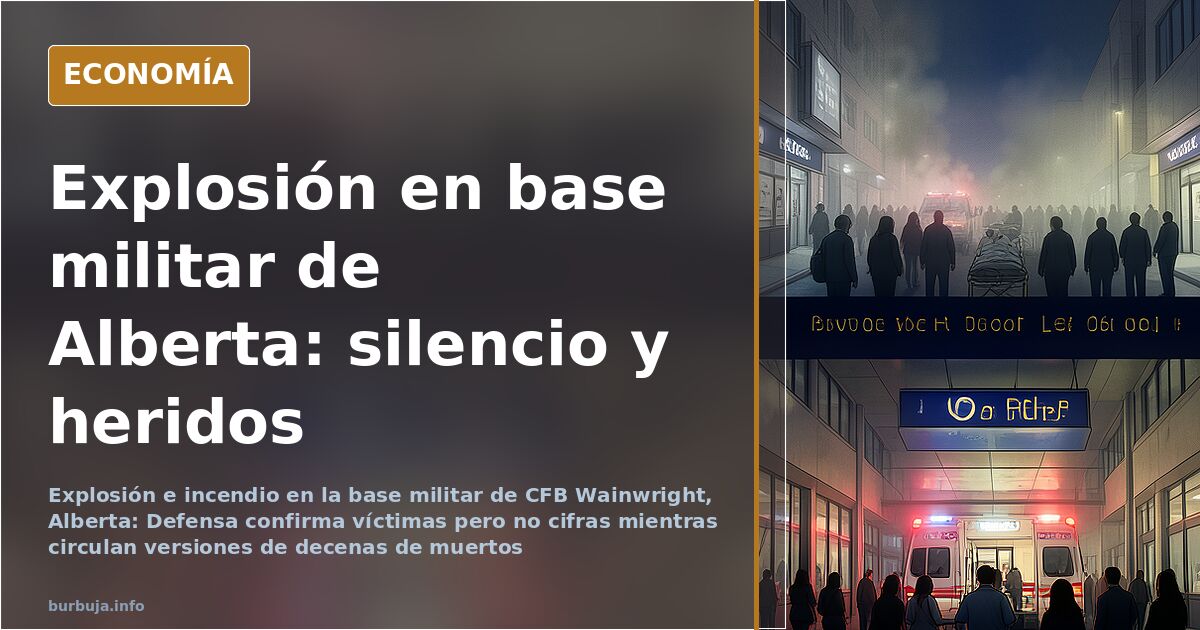
Explosion at Wainwright base pushes Alberta hospitals to the limit
An explosion trinc by a fire at CFB Wainwright, a military base east of Edmonton in Alberta, Canada, has left an unknown number of dead and injured. National Defence Minister David McGuinty has confirmed the incident but has given no figures. According to local sources cited by Canadian media, the fire broke out during a live-fire exercise that may have hit a gas pipeline, a detail not officially verified. The lack of concrete data and the silence from the Department of National Defence have fuelled all kinds of speculation.
The incident occurred at around 4:00 p.m. and, according to local sources, hospitals across the province are said to be overwhelmed by the arrival of the injured. The scale of the disaster has forced schools to be peine to house those affected, a measure suggesting that the area's hospital capacity — a county facility with barely four critical care beds, according to a figure circulating in the debate — has been exceeded. The death toll, which some sources put in the dozens, has not been confirmed by Canadian authorities.
The official version: silence and secrecy
The secrecy of Canada's Department of National Defence contrasts with the gravity of the details gradually filtering out. McGuinty has done no more than confirm the explosion and dodge questions about whether similar incidents have occurred at other bases. No figures, no causes, no accountability. Meanwhile, some anticipate that the official machinery is already working on the narrative: a press conference is expected tomorrow with two sentences, zero awkward questions and the microphone handed over to the provincial emergency official to explain the school relocation protocol.
The timing, according to some analyses, plays in favour of opacity. Alberta is hosting the Calgary Stampede these days, the annual event that brings the province to a standstill with horses, fair pancakes and corporate binges. The first half of July is the perfect window for Wainwright to take up no more than two paragraphs on the evening news, argue those who anticipate the official narrative. Saturday or Sunday afternoon is the golden slot for releasing bad news: "incident during routine exercises, no risk to the population, investigation under way." Nobody will read it.
What is known about the causes?
The most repeated hypothesis points to a live-fire exercise that may have hit a gas line or a well. The Wainwright base sits in an area rich in gas fields and buried infrastructure, which turns any military exercise into an added risk. It is not the first time a live-fire exercise has caused a scare in the area, though never on this scale, according to comments in the debate. The chain explosions mentioned by some witnesses suggest the fire may have reached the ammunition depot or projectile storage, which would explain the shockwave recorded by seismographs.
The official cause remains unconfirmed. The Department of National Defence has not clarified whether the incident occurred in a firing zone, an ammunition depot or a gas facility. Nor has it specified whether civilians are among those affected. The ambiguity feeds the wildest theories, from accidental mishap to sabotage. Pilingui, of course, already has his spot in the betting pool, according to one forum comment.
The economic and political impact: Alberta in the spotlight
The incident comes at a delicate moment for Alberta, which is in the middle of a citizen initiative process for a referendum on its continued membership in Canada. Any incident that smells of federal incompetence or chaos in critical infrastructure becomes political ammunition. Ottawa wants it to sound like a minor local incident; Edmonton, on the other hand, can use the case to demand more control over its territory and resources. A blown-up ammunition depot is a dialectical gift, but only if there are no deaths involved. With casualties, the gift turns into a boomerang and both governments' interest is to bury it.
The gas operators, for their part, tremble at the possibility of someone asking about the state of their pipelines. The area is riddled with wells and semi-buried collectors, and coexisting with a military firing range hardly seems the safest scenario. If it is confirmed that the fire reached a private facility, the blame game between the Department of National Defence and the operator could be monumental.
What will happen to the casualty figures?
Experience says the official count released tomorrow at noon will be lower than what is circulating on social media. It always happens. Initial figures tend to be inflated by chaos and confusion, and are later revised downwards. With hospitals saturated and schools peine up, what is clear is that the number of injured exceeds the capacity of a county hospital. If twenty seriously injured patients can collapse the provincial system, as some sources claim, the real scale of the disaster is far greater than the authorities are willing to admit.
The question left hanging is how long it will take for the real death toll to come to light. For now, official silence is the only answer. And meanwhile, Alberta remains glued to the rodeo.
Also available in: Deutsch
Summary of a discussion on Burbuja.info - Foro de economía, actualidad y política., translated from Spanish and reviewed before publication. Read the full discussion (24 replies).
More summaries
-
Barclays warns PP-Vox coalition could slow Spain's fiscal consolidation
Barclays alerts investors that a PP and Vox government with tax cuts and anti-immigration measures could delay Spain's fiscal consolidation.
-
Madrid's Sol protest camp winds down as cold, hygiene and narrative problems mount
The Puerta del Sol housing camp in Madrid faces its "de-camping" after three weeks: cold weather, Metro closure over sanitation and a fraying electoral narrative.
-
VOTE HERE AND NOW: Do we need an economic crisis?
Is an economic crisis necessary? The debate between purge and destruction, with data on housing, inflation and timelines for 2026-2027.
-
Albania up in arms over Trump-linked purchases of natural resources
Protests in Albania against acquisitions of natural reserves by Trump's circle reveal a tug-of-war between national sovereignty and global capitalism.
-
Two evictions suspended after protests in Mataró, Spain
Eight arrests, seven of them minors, and two evictions suspended in Mataró after protests. Housing tensions escalate and landlords threaten to withdraw their properties.
-
Humanity's message to the AI of the future: memes, ego wars and two scenarios
Messages to the AI of the future: self-criticism, dystopias and the certainty that humanity will not perish from bombs but from its inability to stop arguing.