
The Cost of Exclusivity: Why the Dating Market Is No Longer Monogamous
The relationship market is no longer monogamous: supply multiplies, commitment devalues, and social media is the cause. An analysis...
English · Original discussion in Spanish · Published
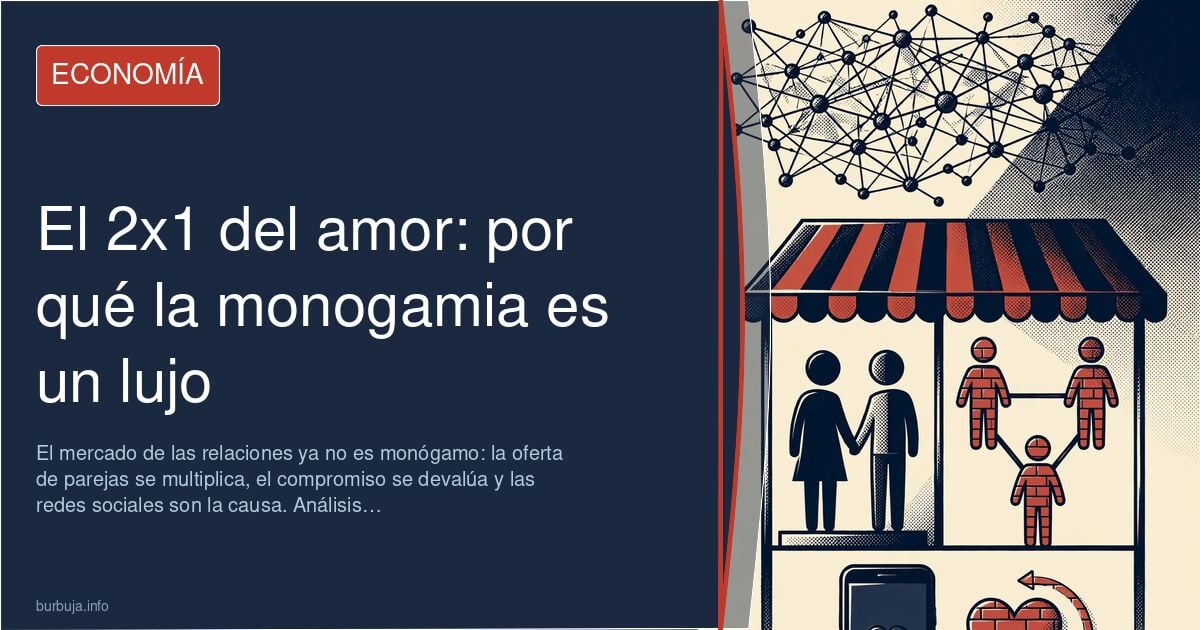
The Cost of Exclusivity: Why the Dating Market Is No Longer Monogamous
The exclusivity in romantic relationships has become a scarce commodity, and the market regulating it is completely distorted. The latest viral episode—a man discovering his girlfriend has other suitors besides him—is not an isolated anecdote, but a symptom of a dynamic that increasingly resembles perfect competition applied to love.
The Dating Economy: Supply and Demand
In theory, the relationship market should function like any other: agents seek to maximize their utility, and equilibrium is reached when no one has an incentive to change. But in practice, digital platforms have altered the game. The supply of potential partners has become liquid and abundant, especially for young people. According to data circulating in digital environments, a woman may receive dozens or hundreds of messages per day, while the average man barely gets responses. This creates a power imbalance in negotiation that translates into less willingness to commit.
For a woman with an unlimited list of candidates, the opportunity cost of remaining exclusive with one person rises: any relationship requires giving up alternatives. For a man, entering an exclusive relationship is a high-risk investment with no guaranteed return.
Social Media: The Multiplier of Competition
Social media did not create infidelity, but it has made it massive and invisible. One common analysis is that technology has lowered the search costs and allowed multiple simultaneous relationships to be maintained at minimum transaction cost. One date on Sunday, another the trinc week, and a third for routine: scheduling dates resembles managing an asset portfolio.
Some voices propose adaptation: open relationships, without exclusivity or commitment, as a risk management strategy. Others, conversely, believe the solution is withdrawal from the market. The situation has even been compared to a 2x1 offer in the supermarket, but the economic analogy is not far-fetched.
Macro Consequences: Fewer Families, Fewer Children, More Loneliness
Beyond the anecdote, some link this dynamic to falling birth rates and increasing loneliness. If commitment is becoming increasingly expensive, young people tend to delay or forgo starting a family. The problem is not merely individual: it has effects on demographics and the economy as a whole.
The question is whether this situation is a transient phase or the new equilibrium. All signs point to the fact that as platforms continue optimizing matching, fidelity will remain an expensive asset. But markets tend to self-regulate; perhaps in a few years, monogamy will become the default option—perhaps not. One thing is certain: the relationship market will not behave as textbooks predict.
The exclusivity in romantic relationships has become a scarce commodity, and the market regulating it is completely distorted. The latest viral episode—a man discovering his girlfriend has other suitors besides him—is not an isolated anecdote, but a symptom of a dynamic that increasingly resembles perfect competition applied to love.
The Dating Economy: Supply and Demand
In theory, the relationship market should function like any other: agents seek to maximize their utility, and equilibrium is reached when no one has an incentive to change. But in practice, digital platforms have altered the game. The supply of potential partners has become liquid and abundant, especially for young people. According to data circulating in digital environments, a woman may receive dozens or hundreds of messages per day, while the average man barely gets responses. This creates a power imbalance in negotiation that translates into less willingness to commit.
For a woman with an unlimited list of candidates, the opportunity cost of remaining exclusive with one person rises: any relationship requires giving up alternatives. For a man, entering an exclusive relationship is a high-risk investment with no guaranteed return.
Social Media: The Multiplier of Competition
Social media did not create infidelity, but it has made it massive and invisible. One common analysis is that technology has lowered the search costs and allowed multiple simultaneous relationships to be maintained at minimum transaction cost. One date on Sunday, another the trinc week, and a third for routine: scheduling dates resembles managing an asset portfolio.
Some voices propose adaptation: open relationships, without exclusivity or commitment, as a risk management strategy. Others, conversely, believe the solution is withdrawal from the market. The situation has even been compared to a 2x1 offer in the supermarket, but the economic analogy is not far-fetched.
Macro Consequences: Fewer Families, Fewer Children, More Loneliness
Beyond the anecdote, some link this dynamic to falling birth rates and increasing loneliness. If commitment is becoming increasingly expensive, young people tend to delay or forgo starting a family. The problem is not merely individual: it has effects on demographics and the economy as a whole.
The question is whether this situation is a transient phase or the new equilibrium. All signs point to the fact that as platforms continue optimizing matching, fidelity will remain an expensive asset. But markets tend to self-regulate; perhaps in a few years, monogamy will become the default option—perhaps not. One thing is certain: the relationship market will not behave as textbooks predict.
Summary of a discussion on Burbuja.info - Foro de economía, actualidad y política., translated from Spanish and reviewed before publication. Read the full discussion (62 replies).
More summaries
-
Spain announces veto on social networks for minors under 16
Spain prepares a ban on social media for minors under 16 while Brussels drafts its EU Kids Act. The challenge: verifying age without identifying everyone.
-
Córdoba Father Self-Immolates: Mental Illness or Societal Despair?
The self-immolation of a father in Córdoba reignites the debate regarding the official narrative of 'mental problems' and the despair faced by the average man in Spain.
-
Euthanasia in Old Age: Autonomy vs. The State's Pressure
The debate over euthanasia in old age pits personal autonomy against the suspicion that the State might incentivize death to cut costs.
-
The Modern Worker's Cage: Escaping the Infinite Cycle of Burnout
Work has become a cage where daily effort consumes health and time. Discover why we push ourselves so hard and how to break the cycle.
-
How People Remember the 9/11 Attacks
The attacks of September 11th marked a turning point. Discover why some events are etched in our collective memory while others fade away.
-
Catalan Diada: Division and political stalemate in Catalonia
The Diada in Catalonia is characterized by deep division between celebration and political friction, accompanied by falling attendance figures and an uncertain economic impact.