
Excell, FYI, and Peterpoint: The Jargon of the Office Professional
From 'Excell' to 'I'll send you an emilio': the dictionary of errors and corporate jargon portraying the Spanish office professional and their unique relationship with...
English · Original discussion in Spanish · Published
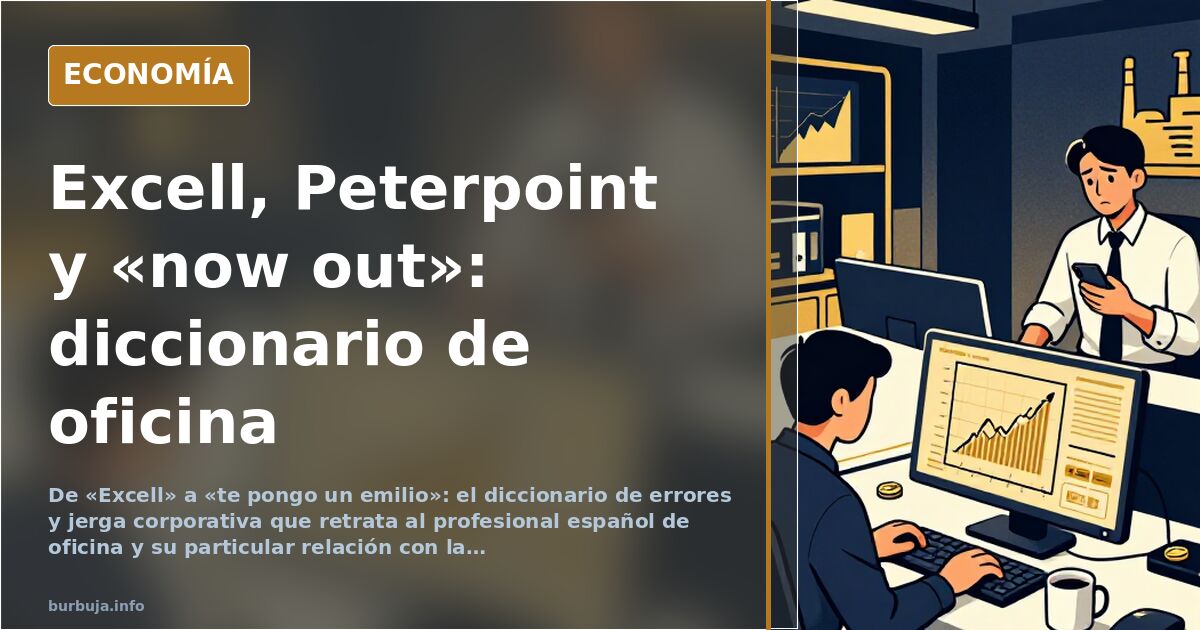
Excell, Peterpoint, and 'know hows': how the Spanish professional speaks
Why does reading 'Excell' with a double 'l' at the end of a work email make our blood boil? Because it's not just a random typo: it's a diagnosis. The Spanish office has been operating for decades with two parallel languages—the one written and the one spoken—and the latter acts as a professional ID card. Presentations are made in Peterpoint, a poberpoin is sent, a quote is requested in 'Excell,' and an email is forwarded with an 'FYI' to make it clear one is in the know. The error, far from being an accident, functions as a tribal password.
Peterpoint, emilio, and exel: the error as a hallmark
There's a grammar of blunders all its own. The one who learned the 'Pearl' language instead of Perl. The one who says 'pipsels' where they should say pixels. The one who confuses hacker with joker and still laughs remembering it. The spellchecker that turns Joseba into Josefa, the boss named Aniano who gets renamed 'anciano' (old man) in chain emails, and the phrase that never changes: 'un ansioso' (an exit/outgoing person) when they meant 'un saludo' (a greeting).
The phenomenon doesn't distinguish between sectors or sizes. A job interview once demanded knowledge of 'Phyton.' A client rejected any web subdomain because the only good one was www. And in IT support, cases are documented of asking for a screenshot and receiving a photo of a printed screenshot, taken with a mobile phone. It's not bad faith. It's a different ontology.
The most uncomfortable detail isn't the ignorance: it's the certainty with which it's pronounced.
The cactus against radiation and hole-punched floppy disks
Office archaeology yields better artifacts than any management manual. High-resolution CRT monitors configured at 50 Hz refresh instead of 100, with tiny fonts, so no one would touch the screen; a plastic filter stuck on with Velcro on top, and next to it, a cactus, because the rumor spread that it absorbed radiation from the tube. Full armament.
The inventory continues: ring binders with refills bought every year, blank photocopies to get blank sheets of paper, and 5 1/4-inch floppy disks hole-punched to file them in two-ring binders. And it's not extinct folklore. In 2012, a workshop working for a major client was still moving programs from an MS-DOS computer to floppy disks, then to a laptop, and from the laptop to a USB drive to load the machinery. Multimeters costing less than five euros, brought from Asian platforms, were doing jobs that required precision. In that same team, a purchasing manager over 50 years old, with a lifetime at the company, didn't know how to attach a file to an email.
From Administrative Assistant to 'Account Manager': the inflation of titles
If mispronunciation betrays, new titles conceal. What for decades was the administrative assistant was rebranded as account manager. What used to be picking up the phone and asking how a task went is now called reporting. The 'botijo' kid is today the junior. Everyone is business, management, operations, or account, and some attribute the origin of the damage to LinkedIn, turned into a showcase for SMEs whose owners put CEO on their profile while boasting of results without sharing any bonuses with the staff.
The liturgy accompanies: the meeting and the call instead of the meeting, the briefing, the deadline, the feedback, and the key account manager. The email signature with an infinite paragraph about confidentiality and data protection, preceding a message that will be printed anyway. The pirated office suite. Budgets sent where a contract should have gone. The suit to work in an office.
And the attorney-in-fact of a construction company dictating their address to the secretary of a high-ranking official: administracionALGARROBAconstruccionesX.com.
'The computer won't let me': where the joke ends
Not all of it is unintentional humor. Part of the analysis suggests that much of what's labeled as 'Paco' (a derogatory term for someone unsophisticated or out of touch) is simply a lack of technological training, and that laughing at it is office-based classism disguised as mockery. The counterargument is that the term doesn't indicate a deficiency but an attitude, and that the problem starts when the one who doesn't know is the one making the decisions.
The most uncomfortable anecdote points there: an HR technician with years of interviews and staff management who, at a Christmas dinner, asked what the team two floors below, who had been typing for two years, actually did.
On the other end are the support classics. 'The printer's out of toner.' 'It won't print.' 'The computer won't let me.' The mobile photo of a printed screenshot. Double-clicking hyperlinks. Typing with two index fingers. Printing and scanning the invoice to send it as a PDF by email, an operation still performed every morning in some administration department.
The real question is no longer whether there's something more 'Paco' about writing 'Excell.' It's whether anyone is left capable of looking at the cactus next to the monitor and not feeling, even for a second, nostalgia.
Why does reading 'Excell' with a double 'l' at the end of a work email make our blood boil? Because it's not just a random typo: it's a diagnosis. The Spanish office has been operating for decades with two parallel languages—the one written and the one spoken—and the latter acts as a professional ID card. Presentations are made in Peterpoint, a poberpoin is sent, a quote is requested in 'Excell,' and an email is forwarded with an 'FYI' to make it clear one is in the know. The error, far from being an accident, functions as a tribal password.
Peterpoint, emilio, and exel: the error as a hallmark
There's a grammar of blunders all its own. The one who learned the 'Pearl' language instead of Perl. The one who says 'pipsels' where they should say pixels. The one who confuses hacker with joker and still laughs remembering it. The spellchecker that turns Joseba into Josefa, the boss named Aniano who gets renamed 'anciano' (old man) in chain emails, and the phrase that never changes: 'un ansioso' (an exit/outgoing person) when they meant 'un saludo' (a greeting).
The phenomenon doesn't distinguish between sectors or sizes. A job interview once demanded knowledge of 'Phyton.' A client rejected any web subdomain because the only good one was www. And in IT support, cases are documented of asking for a screenshot and receiving a photo of a printed screenshot, taken with a mobile phone. It's not bad faith. It's a different ontology.
The most uncomfortable detail isn't the ignorance: it's the certainty with which it's pronounced.
The cactus against radiation and hole-punched floppy disks
Office archaeology yields better artifacts than any management manual. High-resolution CRT monitors configured at 50 Hz refresh instead of 100, with tiny fonts, so no one would touch the screen; a plastic filter stuck on with Velcro on top, and next to it, a cactus, because the rumor spread that it absorbed radiation from the tube. Full armament.
The inventory continues: ring binders with refills bought every year, blank photocopies to get blank sheets of paper, and 5 1/4-inch floppy disks hole-punched to file them in two-ring binders. And it's not extinct folklore. In 2012, a workshop working for a major client was still moving programs from an MS-DOS computer to floppy disks, then to a laptop, and from the laptop to a USB drive to load the machinery. Multimeters costing less than five euros, brought from Asian platforms, were doing jobs that required precision. In that same team, a purchasing manager over 50 years old, with a lifetime at the company, didn't know how to attach a file to an email.
From Administrative Assistant to 'Account Manager': the inflation of titles
If mispronunciation betrays, new titles conceal. What for decades was the administrative assistant was rebranded as account manager. What used to be picking up the phone and asking how a task went is now called reporting. The 'botijo' kid is today the junior. Everyone is business, management, operations, or account, and some attribute the origin of the damage to LinkedIn, turned into a showcase for SMEs whose owners put CEO on their profile while boasting of results without sharing any bonuses with the staff.
The liturgy accompanies: the meeting and the call instead of the meeting, the briefing, the deadline, the feedback, and the key account manager. The email signature with an infinite paragraph about confidentiality and data protection, preceding a message that will be printed anyway. The pirated office suite. Budgets sent where a contract should have gone. The suit to work in an office.
And the attorney-in-fact of a construction company dictating their address to the secretary of a high-ranking official: administracionALGARROBAconstruccionesX.com.
'The computer won't let me': where the joke ends
Not all of it is unintentional humor. Part of the analysis suggests that much of what's labeled as 'Paco' (a derogatory term for someone unsophisticated or out of touch) is simply a lack of technological training, and that laughing at it is office-based classism disguised as mockery. The counterargument is that the term doesn't indicate a deficiency but an attitude, and that the problem starts when the one who doesn't know is the one making the decisions.
The most uncomfortable anecdote points there: an HR technician with years of interviews and staff management who, at a Christmas dinner, asked what the team two floors below, who had been typing for two years, actually did.
On the other end are the support classics. 'The printer's out of toner.' 'It won't print.' 'The computer won't let me.' The mobile photo of a printed screenshot. Double-clicking hyperlinks. Typing with two index fingers. Printing and scanning the invoice to send it as a PDF by email, an operation still performed every morning in some administration department.
The real question is no longer whether there's something more 'Paco' about writing 'Excell.' It's whether anyone is left capable of looking at the cactus next to the monitor and not feeling, even for a second, nostalgia.
Summary of a discussion on Burbuja.info - Foro de economía, actualidad y política., translated from Spanish and reviewed before publication. Read the full discussion (309 replies).
More summaries
-
GDP Grows, But Per Capita Income is Spread Thinner
GDP growth outpaces inflation and pensions are paid, yet per capita GDP falls as the pie is divided among more people. The calculation that confounds.
-
Learning Late: The €42,000 MBA and Emigrating Ten Years Sooner
An MBA costing €42,000 that doesn't guarantee a job, emigrating ten years earlier, and reaching a million by 25: the lessons learned too late, measured in euros.
-
Sánchez snaps first photo with NYC Mayor Adams to plot policies that will enrage the far-right
Pedro Sánchez and Eric Adams discuss an inclusive economic model. Spain seeks a new paradigm with more jobs and social justice.
-
Euthanasia in Old Age: Autonomy vs. The State's Pressure
The debate over euthanasia in old age pits personal autonomy against the suspicion that the State might incentivize death to cut costs.
-
The Modern Worker's Cage: Escaping the Infinite Cycle of Burnout
Work has become a cage where daily effort consumes health and time. Discover why we push ourselves so hard and how to break the cycle.
-
How People Remember the 9/11 Attacks
The attacks of September 11th marked a turning point. Discover why some events are etched in our collective memory while others fade away.