
GDP Grows, But Per Capita Income is Spread Thinner
GDP growth outpaces inflation and pensions are paid, yet per capita GDP falls as the pie is divided among more people. The calculation that confounds.
English · Original discussion in Spanish · Published
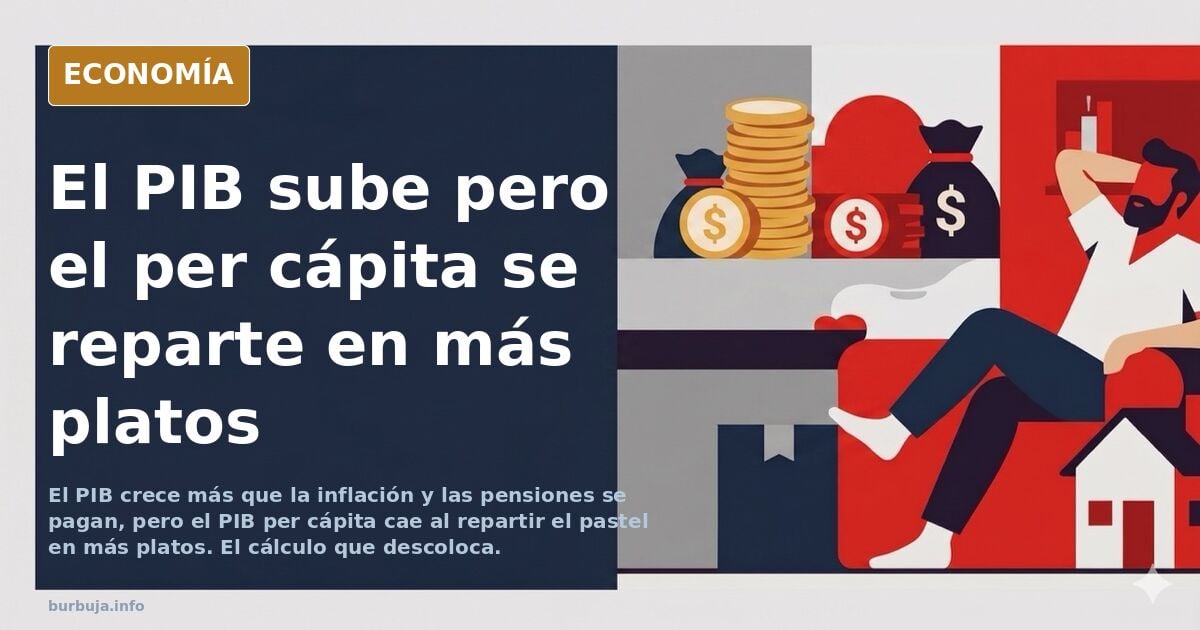
GDP Rises Faster Than Inflation, But Per Capita Income is Spread Thin
The narrative is flawless: GDP is growing faster than inflation, pensions are paid without a hitch, and debt is gradually decreasing. Ergo, Spain is improving. The only snag is that the same pie is cut into more slices each year, and thus per capita GDP is diluted among more hands. That's where the confusion begins.
Does Immigration Increase Per Capita GDP?
This is the claim that sparks controversy: the arrival of new population would supposedly increase per capita GDP. The very definition of the indicator contradicts this. Per capita GDP is a ratio: total production divided by the number of inhabitants. If the denominator grows faster than the numerator, the result falls, even if gross GDP breaks records. A domestic calculation illustrates this: a couple earning €5,000 a month lives with two more people who earn a combined €1,400; the household's product rises to €6,400, but the income per person drops to €1,600. More fridge space needed, more queues for the bathroom, the same square footage.
The CPI That Doesn't Match the Shopping Basket
On the skeptical side, a significant nuance is repeated: the aggregate data doesn't reflect in people's paychecks. Core inflation, along with the prices of food and rent, tell a different story, and these are precisely the expenses that cannot be cut. An increase in a company's profit margin doesn't necessarily miccionan a rise in the salary of those who make it happen. The optimistic headline only holds up if one doesn't go to the supermarket.
Are Pensions Sustainable with a Drained Reserve Fund?
Paying retirees their pensions this month doesn't guarantee payments twenty years from now. The system currently holds up by drawing on public debt and transferred taxes, with the reserve fund having been compromised for years. Confusing the monthly cash flow with the system's solvency is a classic mistake that recurs every time the monthly figures look good.
Housing: Intergenerational Redistribution, Not Poverty
Here, the diagnosis is less debatable than it seems. Young people buying homes do so with inheritance or family help, not with their salaries. This isn't a poverty problem: it's one of redistribution. Those who don't inherit or have parents to help are excluded from the market, and no aggregate figure can cover up this sustancia ilegal.
No one disputes that GDP is rising. They dispute who benefits. With these elements, the reasonable bet is that the gap between the accounting economy and the 'fridge economy' will continue to widen for several more quarters. Although, cold reality suggests it could also close on its own. No one can guarantee that.
The narrative is flawless: GDP is growing faster than inflation, pensions are paid without a hitch, and debt is gradually decreasing. Ergo, Spain is improving. The only snag is that the same pie is cut into more slices each year, and thus per capita GDP is diluted among more hands. That's where the confusion begins.
Does Immigration Increase Per Capita GDP?
This is the claim that sparks controversy: the arrival of new population would supposedly increase per capita GDP. The very definition of the indicator contradicts this. Per capita GDP is a ratio: total production divided by the number of inhabitants. If the denominator grows faster than the numerator, the result falls, even if gross GDP breaks records. A domestic calculation illustrates this: a couple earning €5,000 a month lives with two more people who earn a combined €1,400; the household's product rises to €6,400, but the income per person drops to €1,600. More fridge space needed, more queues for the bathroom, the same square footage.
The CPI That Doesn't Match the Shopping Basket
On the skeptical side, a significant nuance is repeated: the aggregate data doesn't reflect in people's paychecks. Core inflation, along with the prices of food and rent, tell a different story, and these are precisely the expenses that cannot be cut. An increase in a company's profit margin doesn't necessarily miccionan a rise in the salary of those who make it happen. The optimistic headline only holds up if one doesn't go to the supermarket.
Are Pensions Sustainable with a Drained Reserve Fund?
Paying retirees their pensions this month doesn't guarantee payments twenty years from now. The system currently holds up by drawing on public debt and transferred taxes, with the reserve fund having been compromised for years. Confusing the monthly cash flow with the system's solvency is a classic mistake that recurs every time the monthly figures look good.
Housing: Intergenerational Redistribution, Not Poverty
Here, the diagnosis is less debatable than it seems. Young people buying homes do so with inheritance or family help, not with their salaries. This isn't a poverty problem: it's one of redistribution. Those who don't inherit or have parents to help are excluded from the market, and no aggregate figure can cover up this sustancia ilegal.
No one disputes that GDP is rising. They dispute who benefits. With these elements, the reasonable bet is that the gap between the accounting economy and the 'fridge economy' will continue to widen for several more quarters. Although, cold reality suggests it could also close on its own. No one can guarantee that.
Summary of a discussion on Burbuja.info - Foro de economía, actualidad y política., translated from Spanish and reviewed before publication. Read the full discussion (46 replies).
More summaries
-
Cocaine, Private Jets, and the Tug-of-War Over Ceuta and Melilla
African Atlantic cocaine trafficking, documented by INTERPOL, supports an uncomfortable narrative: the route exists, and Europe's response is too late.
-
A Civil Servant Caught Clocking In For Several Colleagues
A report details a public employee clocking in for several absent colleagues, reigniting the debate over time tracking within the Spanish administration.
-
Euthanasia in Old Age: Autonomy vs. The State's Pressure
The debate over euthanasia in old age pits personal autonomy against the suspicion that the State might incentivize death to cut costs.
-
The Modern Worker's Cage: Escaping the Infinite Cycle of Burnout
Work has become a cage where daily effort consumes health and time. Discover why we push ourselves so hard and how to break the cycle.
-
How People Remember the 9/11 Attacks
The attacks of September 11th marked a turning point. Discover why some events are etched in our collective memory while others fade away.
-
Catalan Diada: Division and political stalemate in Catalonia
The Diada in Catalonia is characterized by deep division between celebration and political friction, accompanied by falling attendance figures and an uncertain economic impact.