
Eviction of Maricarmen, 87, Who Lived Renting for 71 Years
Maricarmen, 87, evicted after living in a rent-controlled apartment since 1956. A "renta antigua" contract sparks debate on private property vs. tenant rights.
English · Original discussion in Spanish · Published
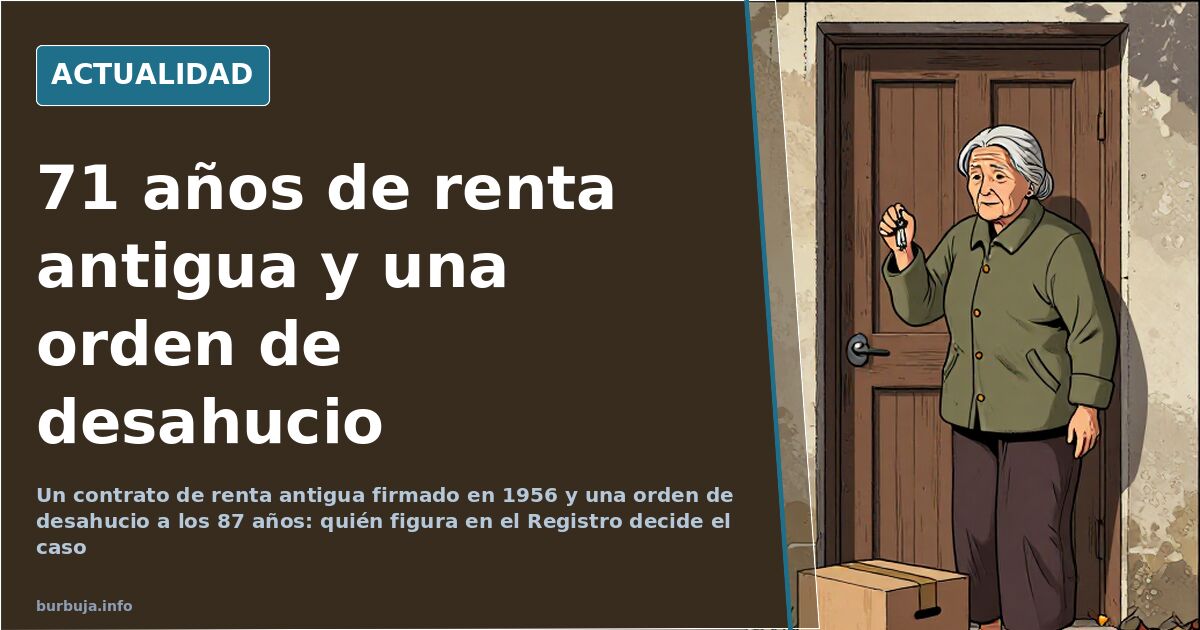
Eviction of Maricarmen, 87, Who Lived Renting for 71 Years
Maricarmen is 87 years old and has lived in the same home since 1956. More than seven decades, three generations, and an old rent contract signed when renting wasn't yet a financial asset. In 2026, this legal anomaly has ended in a judicial eviction and a nationwide fight over where private property ends and the right not to be left on the street begins.
What Peine with Maricarmen's Eviction
The original contract was signed in 1956 in her father's name. After his death in 1960, the title was transferred to her mother. When she died—in 2005 according to some accounts, 2007 according to others—the contract passed to Maricarmen, who continued to pay a regulated rent of around 500 euros. Before the eviction, she was offered to buy the property, and she declined; a move to another address was also proposed, according to circulating information.
The detail that entangles everything: the protagonist is not a typical squatter. She is a tenant with a contract, with paid receipts, and with legislation behind her. And the property owner is not necessarily the villain some portray.
The Urban Leases Law of 1964 and Subrogations
Here lies the technical root of the matter. Under the legal framework consolidated in the Urban Leases Law of 1964 (Ley de Arrendamientos Urbanos de 1964), mandatory renewal and subrogation upon the tenant's death were, in practice, unlimited: the contract could pass from one generation to another. This made these rents almost perpetual and the owner a mere bystander. The subrogation rules were later reformed in 1994, but old contracts remained anchored to the previous framework.
Hence the clash. Whoever bought that apartment also inherited an expiration date they couldn't control. Whoever signed it in 1956 knew what they were signing: standard conditions of the time, not a trap.
Who Really Owns the House? Private Property vs. Ironclad Contract
Two opposing currents collide. One argues that a contract is a contract and that reforming the law mid-game to alter its effects is what truly undermines legal certainty. The other responds that no one bought blindly: whoever acquired a property with a tenant already in place paid a discounted price and knew the hassle.
There is a case cited as a precedent: that of a content creator who bought a downstairs apartment occupied by an elderly woman. He paid, stayed silent, and moved on. It cost him less than a lawsuit and a smear campaign.
The media storm did the rest. This issue has moved from the courts section to the political forefront, serving as a platform for each side to plant their banner. Meanwhile, the house still has a registered titleholder and an 87-year-old lady who no longer lives there. At that exact point—between the registry paper and the person—is where the analysis gets stuck, and no one wants to look.
Maricarmen is 87 years old and has lived in the same home since 1956. More than seven decades, three generations, and an old rent contract signed when renting wasn't yet a financial asset. In 2026, this legal anomaly has ended in a judicial eviction and a nationwide fight over where private property ends and the right not to be left on the street begins.
What Peine with Maricarmen's Eviction
The original contract was signed in 1956 in her father's name. After his death in 1960, the title was transferred to her mother. When she died—in 2005 according to some accounts, 2007 according to others—the contract passed to Maricarmen, who continued to pay a regulated rent of around 500 euros. Before the eviction, she was offered to buy the property, and she declined; a move to another address was also proposed, according to circulating information.
The detail that entangles everything: the protagonist is not a typical squatter. She is a tenant with a contract, with paid receipts, and with legislation behind her. And the property owner is not necessarily the villain some portray.
The Urban Leases Law of 1964 and Subrogations
Here lies the technical root of the matter. Under the legal framework consolidated in the Urban Leases Law of 1964 (Ley de Arrendamientos Urbanos de 1964), mandatory renewal and subrogation upon the tenant's death were, in practice, unlimited: the contract could pass from one generation to another. This made these rents almost perpetual and the owner a mere bystander. The subrogation rules were later reformed in 1994, but old contracts remained anchored to the previous framework.
Hence the clash. Whoever bought that apartment also inherited an expiration date they couldn't control. Whoever signed it in 1956 knew what they were signing: standard conditions of the time, not a trap.
Who Really Owns the House? Private Property vs. Ironclad Contract
Two opposing currents collide. One argues that a contract is a contract and that reforming the law mid-game to alter its effects is what truly undermines legal certainty. The other responds that no one bought blindly: whoever acquired a property with a tenant already in place paid a discounted price and knew the hassle.
There is a case cited as a precedent: that of a content creator who bought a downstairs apartment occupied by an elderly woman. He paid, stayed silent, and moved on. It cost him less than a lawsuit and a smear campaign.
The media storm did the rest. This issue has moved from the courts section to the political forefront, serving as a platform for each side to plant their banner. Meanwhile, the house still has a registered titleholder and an 87-year-old lady who no longer lives there. At that exact point—between the registry paper and the person—is where the analysis gets stuck, and no one wants to look.
Summary of a discussion on Burbuja.info - Foro de economía, actualidad y política., translated from Spanish and reviewed before publication. Read the full discussion (83 replies).
More summaries
-
Keynes, Sánchez's Father-in-Law, and the Web of Blackmail
Keynes's private life, Ferguson's criticism, and the alleged link between Sánchez’s in-law and a Madrid sauna: the mechanics of political blackmail.
-
Pedro Sánchez meets NYC Mayor Zohran Mamdani amid Ceuta migrant crisis
Spanish PM Pedro Sánchez met with NYC Mayor Zohran Mamdani as the Ceuta migrant situation remains critical with thousands of arrivals.
-
Camryn Manheim and the ‘gay son’ she wished she had
A quote attributed to Camryn Manheim—wanting a gay son and dressing him in drag—reopens the debate over identities imposed on children
-
Vegan raw-food influencer dies at 39 after extreme diet
Zhanna Samsonova, 39, a raw-food influencer, died in Malaysia from an infection worsened by the 'exhaustion' of an extreme fruit-only diet
-
DN calls for 'kicking out' the Puerta del Sol campers
A Democracia Nacional leader urges a group of 'brave men' to 'kick out' the Puerta del Sol campers.
-
Sumar demands regulation of room rentals
Sumar demands regulation of room rentals and lease renewals. An investor warns that property maths no longer add up.