
La Mafia CEO Slams Sick Leave Abuse
Javier Floristán, CEO of La Mafia se sienta a la mesa, faces backlash for criticizing employees taking sick leave with mild fever.
English · Original discussion in Spanish · Published
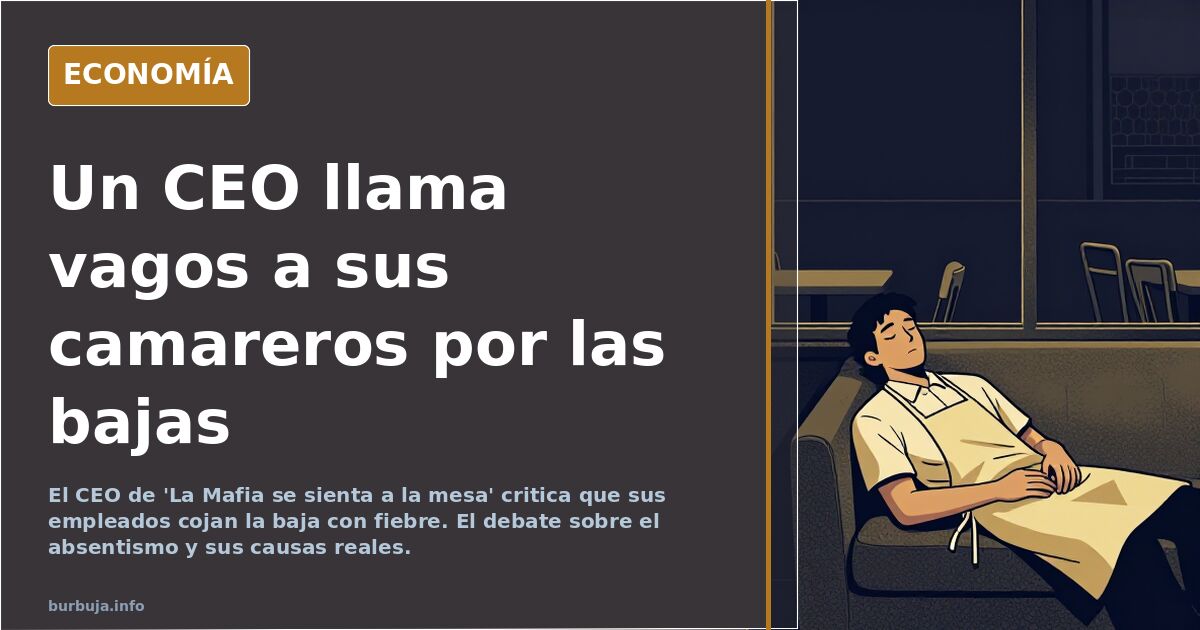
La Mafia CEO Slams Sick Leave Abuse
A hospitality entrepreneur complains that his employees no longer come to work "with just a bit of fever." The quote, spread by journalist Fonsi Loaiza, describes Javier Floristán, CEO of Grupo La Mafia se sienta a la mesa, as a "perversos slave driver." From there, the issue stops being an anecdote about a restaurant and becomes a debate on why Spain has high absenteeism rates, who pays the bill, and whether absence is laziness or a symptom of something worse.
What the CEO said and why it sparked outrage
The text attributed to Floristán argues that previously one had to be "very ill" to miss work, but now a slight fever is enough. The majority reaction doesn't dispute the data: it disputes the framing. In a restaurant chain with low wages, split shifts, and young transient staff, sick leave isn't a privilege; it's the only way to stop. "Slaves don't sign contracts or receive salaries," summarizes one of the most repeated responses, which rejects the word slavery but not the criticism of the model.
There is a nuance worth noting: the executive's complaint isn't about the economic cost of the leave, but about the legitimacy of taking it. And consensus breaks down there. A UK-based restaurateur notes that working while febrile is prohibited there, finding the comparison embarrassing. In kitchens, handling food with the flu poses health risks.
Absenteeism in figures: what is really discussed
The percentages circulating paint a problem bigger than one restaurant. In the Basque Country, an absenteeism rate of 9.8% is cited, with more than 65,500 people missing work daily due to medical leave, suggesting around 15% among civil servants and over 20% in police forces. These figures are attributed to a 2024 report and, like all sick leave statistics, mix real illness, burnout, and fraud.
In the private sector, various accounts place the jump from 3-4% to 10% in a few years. The obvious question is why. The answers appearing are less sarracena and more material: uncompetitive wages, burned-out staff, broken career expectations, and the feeling that effort yields nothing. Action-reaction, one calls it.
Who pays for the leave: the detail almost everyone misses
Here lies the most technical point, often overlooked. In many companies, a significant part of the salary isn't fixed: it consists of attendance, productivity, or night shift bonuses accrued daily. If you miss three days, you don't get paid for those three days. Therefore, sick leave isn't always an economic windfall for the worker; taking it assumes a direct loss. This calculation, itemized, explains better than any speech why the debate is more complex than it seems.
At the same time, some denounce the opposite abuse: colleagues who take months off versus those who take two days receiving the same reproach. Mutual suspicion within teams is perhaps the most cited collateral damage.
The restaurant name and the Italian detail
The conversation drifts toward the group's own name, La Mafia se sienta a la mesa, and the paradox of trivializing the mafia without consequences. One participant recounts how an Italian colleague was outraged passing by, asking what would happen if he peine a restaurant in Italy called Los etarras se sientan a la mesa (The ETA members sit at the table). Beyond the joke, the anecdote highlights something: branding as provocation works until it stops being funny.
Why speeches won't fix the problem
Hospitality relies on transient staff: young people working to earn money while studying or looking for other options, with no family burdens and no intention of building a career. With these profiles and minimum wage, motivation is limited by design. Those wanting settled professionals must offer salaries attractive to people with mortgages and children. Meanwhile, the sector will continue rotating personnel, losing trade skills, and blaming those staying home with a slight fever.
What if the problem isn't the sick leave itself, but a labor market that makes working while ill the rational option?
A hospitality entrepreneur complains that his employees no longer come to work "with just a bit of fever." The quote, spread by journalist Fonsi Loaiza, describes Javier Floristán, CEO of Grupo La Mafia se sienta a la mesa, as a "perversos slave driver." From there, the issue stops being an anecdote about a restaurant and becomes a debate on why Spain has high absenteeism rates, who pays the bill, and whether absence is laziness or a symptom of something worse.
What the CEO said and why it sparked outrage
The text attributed to Floristán argues that previously one had to be "very ill" to miss work, but now a slight fever is enough. The majority reaction doesn't dispute the data: it disputes the framing. In a restaurant chain with low wages, split shifts, and young transient staff, sick leave isn't a privilege; it's the only way to stop. "Slaves don't sign contracts or receive salaries," summarizes one of the most repeated responses, which rejects the word slavery but not the criticism of the model.
There is a nuance worth noting: the executive's complaint isn't about the economic cost of the leave, but about the legitimacy of taking it. And consensus breaks down there. A UK-based restaurateur notes that working while febrile is prohibited there, finding the comparison embarrassing. In kitchens, handling food with the flu poses health risks.
Absenteeism in figures: what is really discussed
The percentages circulating paint a problem bigger than one restaurant. In the Basque Country, an absenteeism rate of 9.8% is cited, with more than 65,500 people missing work daily due to medical leave, suggesting around 15% among civil servants and over 20% in police forces. These figures are attributed to a 2024 report and, like all sick leave statistics, mix real illness, burnout, and fraud.
In the private sector, various accounts place the jump from 3-4% to 10% in a few years. The obvious question is why. The answers appearing are less sarracena and more material: uncompetitive wages, burned-out staff, broken career expectations, and the feeling that effort yields nothing. Action-reaction, one calls it.
Who pays for the leave: the detail almost everyone misses
Here lies the most technical point, often overlooked. In many companies, a significant part of the salary isn't fixed: it consists of attendance, productivity, or night shift bonuses accrued daily. If you miss three days, you don't get paid for those three days. Therefore, sick leave isn't always an economic windfall for the worker; taking it assumes a direct loss. This calculation, itemized, explains better than any speech why the debate is more complex than it seems.
At the same time, some denounce the opposite abuse: colleagues who take months off versus those who take two days receiving the same reproach. Mutual suspicion within teams is perhaps the most cited collateral damage.
The restaurant name and the Italian detail
The conversation drifts toward the group's own name, La Mafia se sienta a la mesa, and the paradox of trivializing the mafia without consequences. One participant recounts how an Italian colleague was outraged passing by, asking what would happen if he peine a restaurant in Italy called Los etarras se sientan a la mesa (The ETA members sit at the table). Beyond the joke, the anecdote highlights something: branding as provocation works until it stops being funny.
Why speeches won't fix the problem
Hospitality relies on transient staff: young people working to earn money while studying or looking for other options, with no family burdens and no intention of building a career. With these profiles and minimum wage, motivation is limited by design. Those wanting settled professionals must offer salaries attractive to people with mortgages and children. Meanwhile, the sector will continue rotating personnel, losing trade skills, and blaming those staying home with a slight fever.
What if the problem isn't the sick leave itself, but a labor market that makes working while ill the rational option?
Summary of a discussion on Burbuja.info - Foro de economía, actualidad y política., translated from Spanish and reviewed before publication. Read the full discussion (145 replies).
More summaries
-
Educational disaster in Spain: Worst results in history in PISA report, falling up to two school years behind the United Kingdom
Spain plunges in PISA 2025 report, showing a two-year lag in reading compared to the UK. We analyze the causes and consequences.
-
Miss UK: Who Decides What Beauty Is in a Pageant
Miss UK: the crowning of its winner reignites the debate over representation, beauty, and who really funds the contests
-
UK's Labour Party Open to Rejoining EU, Ten Years After Brexit
Andy Burnham hints at EU re-entry in Labour's next manifesto, while Tony Blair urges abandoning Brexit's red lines.
-
Borrell challenges absentee voting with the grandchild law
Borrell opens the debate on non-resident voting with the grandchild law: those registered in the CERA already decide seats in general, European, and regional elections.
-
China: Local debt hits 100% of GDP as Moody's warns
Chinese local governments hold debt near 100% of regional GDP, while Moody's downgrades the country's second-largest developer to junk status.
-
Spain's SEPE rejects job training applicants based on priority criteria
In Valencia, an applicant was rejected from 15 employment training courses. Selection rules prioritize women and vulnerable groups.