
Evicted from Ibiza, family finds social housing in rural Zaragoza
After eviction in Ibiza in June 2024, Abraham and his family live in social housing in Villanueva de Jiloca. The father admits he would return to Ibiza immediately.
English · Original discussion in Spanish · Published
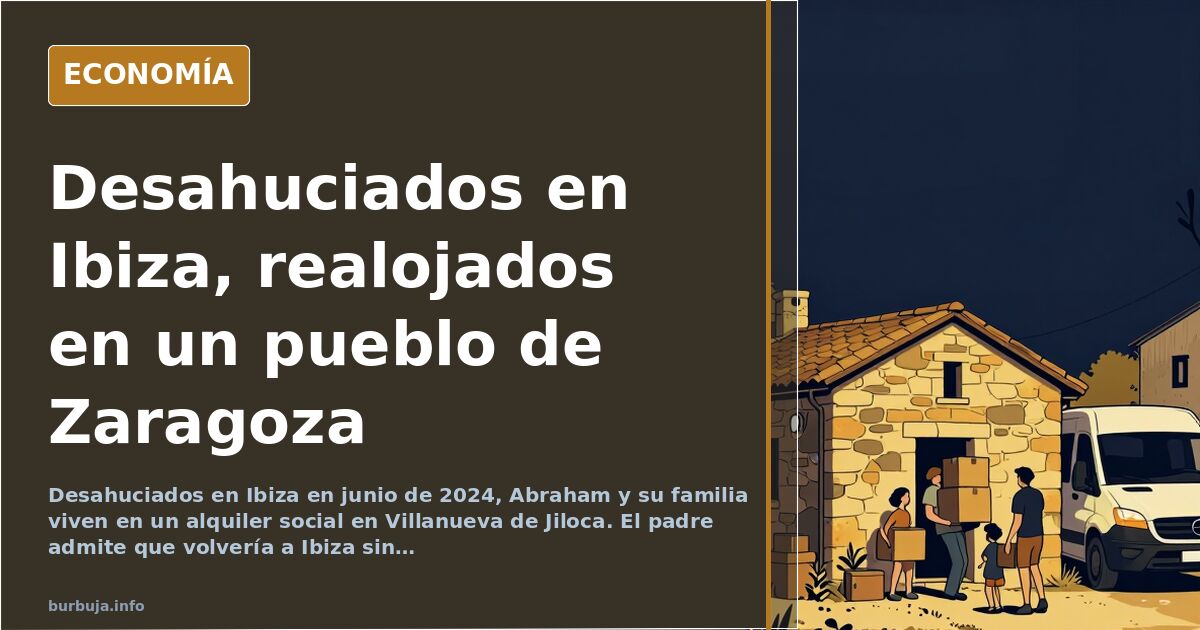
Evicted from Ibiza, rehoused in a Zaragoza village with social rent
In June 2024, an Ibiza family —Abraham, Alejandra, and their three children— was evicted and ended up in Villanueva de Jiloca, a municipality in the province of Zaragoza. The official narrative speaks of welcome, social housing, and enchanting landscapes. The father, however, is blunt: "If there were housing in Ibiza, I'd go back without thinking twice." The family first stayed in a municipal shelter in Santa Eulària des Riu that they had to leave when the tourist season arrived. The contrast between the 'empty Spain' receiving them and the island that expelled them is at the heart of an issue mixing housing, social services, and depopulation.
From Ibiza to Zaragoza: chronology of an exile
On June 22, 2024, Abraham, Alejandra, and their three children left their roots in Eivissa behind. Lack of affordable housing, administrative refusal, and eviction pushed them into a shelter funded by the Santa Eulària des Riu City Council. Months later, the council told them they had to leave: the tourist season was approaching and those spots were for visitors. "We had to leave the hostel because, as they told us, the tourist season was coming and they needed those places for visitors," recounts Alejandra. The final destination was Villanueva de Jiloca, where the town hall provided them with social housing. The family demonstrated before leaving, supported by the Tenants' Union, relatives, and friends, outside the social services offices of Villa del Río.
Social housing that doesn't stop nostalgia
In the village, the reception has been good. Neighbors support them, walks with the dog, and foxes crossing behind the house have become routine. "The welcome has been so good we don't think about moving from here," the family admits. But Abraham keeps looking at real estate portals on the island: "Well, I'm not searching, but I look; ads from when I was searching in Eivissa still pop up." The contradiction is evident: they appreciate the social housing, but their life remains anchored in Ibiza. They want to visit family and friends next winter. The journalistic account emphasizes that social services listen to them, unlike what happens with other groups. That asymmetry, noted in the article itself, fuels discomfort.
'Empty Spain' as an emergency solution
Moving families with no prior connection to villages at risk of disappearance does not solve the underlying problem. Villanueva de Jiloca gains inhabitants, but the family continues looking toward Ibiza. The debate on social housing in rural areas is recurrent: some argue homes are handed over at symbolic prices —cases of 12 euros a month are mentioned— and that some end up deteriorated. Others point out that social workers in these regions, far from urban stereotypes, are overwhelmed by municipal caseloads. Livestock farming and agriculture require early rising and deferred returns, a model that doesn't fit the immediacy of aid. The dog, a husky, seems the only one adapted to the cold.
The data that disorients
Social housing in Villanueva de Jiloca has not been enough for Abraham to stop looking for an apartment in Ibiza. The family appreciates the roof, but their horizon remains on the island. Meanwhile, the village adds neighbors and 'Empty Spain' becomes an emergency parking lot for housing crises originating hundreds of kilometers away.
Also available in: Deutsch
Summary of a discussion on Burbuja.info - Foro de economía, actualidad y política., translated from Spanish and reviewed before publication. Read the full discussion (113 replies).
More summaries
-
Tenant Union Spokesperson Linked to Former Minister and Nobility
A spokesperson for the Tenant Union is highlighted for their family background, being the grandson of a minister under Adolfo Suárez and possessing noble lineage. We analyze the context.
-
Tenants' union poster sparks debate over Madrid rent caps
Nearly 40 groups are calling for rent controls in Madrid, while landlords warn that such measures will reduce supply and drive prices higher.
-
Jon Echeverría, PP's lead candidate in Gipuzkoa, and the pensions row
Jon Echeverría, the PP's number one in Gipuzkoa, Spain, said people live well on a €1,000 pension with a paid-off home. The PP has dropped four tenths in…
-
Spain's housing 'miracle' defies the ECB: prolonged stagflation or a black swan ahead?
Euribor hikes are making mortgages more expensive and home sales are falling, yet housing prices in Spain keep rising. Keys to a market that refuses to obey theory.
-
Mike Bird: Spain's land crash is the most extreme in the West
Mike Bird puts land at 35% of global wealth and calls Spain's collapse the most extreme in the Western world. Credit, supply and young people.
-
El Español runs an unverified hoax and blames the government for its mistake
El Español publishes a hoax about a nepotism hire at Indra, partially retracts it and blames the government for its own error. With no evidence of any plot, the outlet's credibility is at stake.