
Everyone in 'The Odyssey' speaks English!
Is cinema faithful to The Odyssey? We break down the debate over the use of English, anachronisms and the reinterpretation of the classics in film adaptations.
English · Original discussion in Spanish · Published
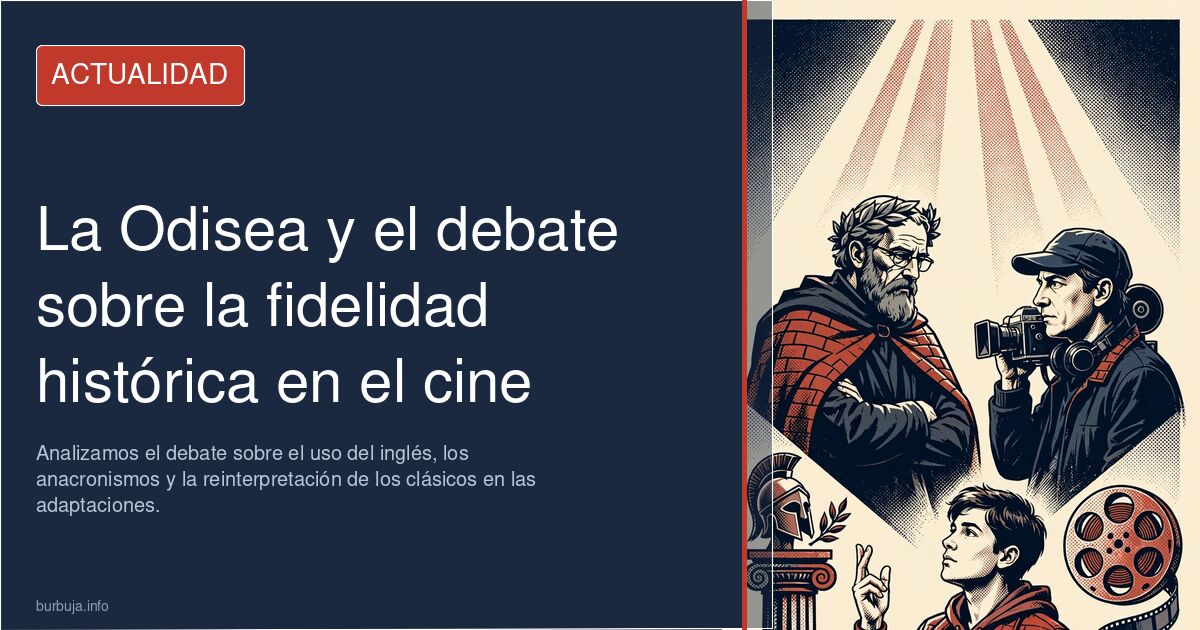
The Odyssey and the debate over historical accuracy in film
A recent forum debate examines whether the use of English in film adaptations of "The Odyssey" and the alteration of canonical elements undermine the essence of Homer's work. Users discuss whether these creative liberties are necessary narrative tools or a form of cultural revisionism that distorts the classical legacy.
Key points of the debate
What forum members say about historical accuracy
Why this thread is getting people talking
The thread stands out for the polarization between those who defend creative freedom in modern adaptations and those who denounce an ideological bias — what some call "proge" — in the portrayal of classical characters. The discussion swings between serious cultural analysis and the sharp humor typical of the community.
This is a summary of the thread. The full discussion includes 53 replies with data, sources and analysis available only to registered users. Create your account in 30 seconds to access the full debate and take part.
*Disclaimer: The opinions expressed in this thread belong solely to the users and do not necessarily reflect the forum's editorial line. The debate over historical adaptations is a matter of cultural interpretation and does not constitute historical or academic advice.*
Related threads on the forum
A recent forum debate examines whether the use of English in film adaptations of "The Odyssey" and the alteration of canonical elements undermine the essence of Homer's work. Users discuss whether these creative liberties are necessary narrative tools or a form of cultural revisionism that distorts the classical legacy.
Key points of the debate
- The language dilemma: Part of the forum argues that the use of English is a standard convention in cinema, similar to other historical blockbusters, and that criticism of the language is secondary compared to issues of historical rigor.
- The breakdown of immersion: Other users maintain that, beyond language, what really "ejects" the viewer from the narrative is the alteration of the original Mediterranean aesthetic and the introduction of anachronistic or ideologically driven elements.
- Reinterpreting the classics: Much of the controversy centers on how new translations and adaptations, with feminist or contemporary nuances, modify the perception of the myth, generating mixed reactions about the preservation of the original text.
What forum members say about historical accuracy
Position A (Pragmatic): Some forum members argue that complaining about the language is irrelevant, pointing out that any dubbed or subtitled version already breaks linguistic authenticity. They believe cinema should prioritize storytelling over exact archaeological reconstruction.
Position B (Critical): Other users argue that the problem is not the language per se, but the deliberate "subversion" of the characters and the setting. They claim that replacing fundamental elements of the Greek epic with modern agendas erodes respect for the classical legacy and undermines the work's coherence.
Why this thread is getting people talking
The thread stands out for the polarization between those who defend creative freedom in modern adaptations and those who denounce an ideological bias — what some call "proge" — in the portrayal of classical characters. The discussion swings between serious cultural analysis and the sharp humor typical of the community.
This is a summary of the thread. The full discussion includes 53 replies with data, sources and analysis available only to registered users. Create your account in 30 seconds to access the full debate and take part.
*Disclaimer: The opinions expressed in this thread belong solely to the users and do not necessarily reflect the forum's editorial line. The debate over historical adaptations is a matter of cultural interpretation and does not constitute historical or academic advice.*
Related threads on the forum
- The Shakira and tax agency affair is different from how the press tells it. · 173 replies
- Segarro immigrant: "I've been here 30 years. If something happens in Segarro tomorrow, I'll side with Segarro. Even though I have Spanish nationality, I'm a Mo · 59 replies
- fat British influencer run over by another · 45 replies
- Doesn't the day just fly by once work is done? · 18 replies
Also available in: Deutsch
Summary of a discussion on Burbuja.info - Foro de economía, actualidad y política., translated from Spanish and reviewed before publication. Read the full discussion (53 replies).
More summaries
-
Small English Village of 300 Votes Secession Over Proposed Arrival of 1,000 Muslims
**Piddington**, a village in **Oxfordshire** with **350 residents**, symbolically voted to separate from the UK. The protest stems from plans involving **1,000 migrants**.
-
Why older Spaniards say their DNI in millions
The old Spanish ID card had dots and no letter, leading many to recite it as a large number. The key lies in the 1985 format change.
-
El Corte Inglés pulls children's shirt with ambiguous message
Controversy erupts at El Corte Inglés over a girls' shirt with an ambiguous English slogan. The retailer cut its price by 70% before withdrawing it.
-
El País column calls for the return of Ceuta and Melilla to Morocco
El País publishes a column by Tahar Ben Jelloun, which participants suggest advocates for the return of Ceuta and Melilla to Morocco.
-
Why the Spanish sportswear brand Joma is named after a son
How Fructuoso López founded Joma in 1965 and why the Spanish sportswear brand carries the name of his first son, José Manuel. A story of entrepreneurship and legacy.
-
Broncano drops below double digits: 1,149,000 viewers and 9.4% share vs Horizonte
La Revuelta draws 1,149,000 viewers and a 9.4% share, falling below double digits, while Horizonte beats it by nearly 250,000 viewers in the same slot.