
European Scrutiny: Lost Ballot Papers and Banned Cameras
Scrutiny challenges over Spain's June 9 European elections reach the European Court of Human Rights, while Cáceres admits to losing official records.
English · Original discussion in Spanish · Published
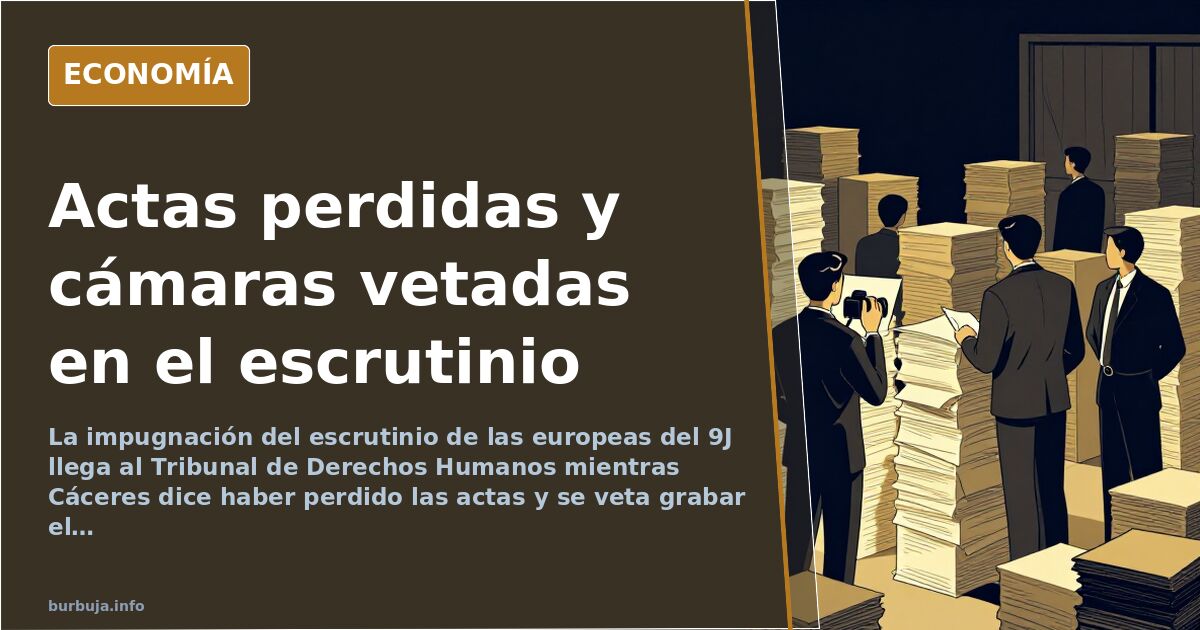
European elections: lost records, banned cameras, and Strasbourg appeal
The general scrutiny of the June 9 European elections has turned into a series of incidents that neither the Electoral Commission nor the Supreme Court has resolved. At the center of the controversy are clashes between representatives of Iustitia Europa, SALF, and Falange, and electoral officials over the recording of the count. These clashes, according to accounts from those involved, even led to police being called to seize mobile phones. The episode highlights the underlying tension: the suspicion that ballot paper records are not being counted and that data is accepted via IT systems.
Why is recording the scrutiny banned?
The official answer is data protection. The one given by complainants is different. Several provincial electoral boards have banned cameras during the general scrutiny, citing data protection rules, a decision that de facto prevents documenting any irregularities in the count with images. The president of the Electoral Commission himself reportedly expressed doubts about allowing recording, in exchanges shared by those affected, leaving the impression that the rule is applied at convenience.
There is a legal detail to remember: Article 98 of the LOREG (Organic Law of the General Electoral Regime) states that the general scrutiny is a public act. Party representatives may attend, but ordinary citizens—those not representing any party—have encountered closed doors or contradictory instructions depending on the province. The Electoral Commission has urged the ministry to adopt measures so that polling station documentation can be easily consulted, which in practice acknowledges that it currently cannot be.
The Indra figures that do not add up
Another focus of discontent is the results attributed to Indra's IT system. Screenshots circulate from wealthy districts in Madrid where the final allocation awards victory to Junts, with results where neither PP nor PSOE receive any votes. These figures, described by the complainants themselves as impossible, have not been officially explained. The suspicion of manipulation of the count—dubbed pucherazo (electoral fraud) online—currently lacks any judicial resolution supporting it.
It is important to be precise about what is known and what is not. There is no final judgment declaring fraud in the European election scrutiny. What exists is an accumulation of anomalies documented by independent observers: records that are not cross-checked, figures accepted without manual verification, and a total absence of public traceability for the vote. In this context, silence weighs more than any proof.
The judicial front: from the Supreme Court to Strasbourg
The legal route has been closing. The Supreme Court dismissed the appeal challenging the June 9 European elections, a procedure in which, according to the claimants, only SUMAR and CEUS formally opposed. The People's Party did not oppose, and VOX reportedly limited itself to arguing for strict compliance with the LOREG without requesting dismissal. This asymmetry—almost no one willing to defend the manual count—is, for the promoters, proof that the system protects only itself.
The next stop is Strasbourg. Activist Luis María Pardo filed a case with the European Court of Human Rights challenging Spain's electoral system, which has been admitted for processing. The thesis they support is that citizens were denied access to a second instance that administrative law generally recognizes. If the court opens a hearing, it would be the first time the Spanish scrutiny mechanism faces an international bench.
Cáceres loses the European election records
Amidst all this, the Electoral Commission of Cáceres announced it does not retain the election records from the June 9 polls. The provincial historical archive only contains records up to 1996, the year when scrutinies began to be computerized. Complainants see a pattern here, not a neglect: since IT entered the count, records have stopped being archived, along with the possibility of verifying them years later. Some summarize it with a phrase: in Venezuela, you would have to forge them; here, it is enough not to keep them.
The Observatory for Electoral Transparency has been denouncing this opacity for years, with the particularity that only political parties are authorized to challenge. Citizens who want the electoral law to be respected face a procedural wall: they are witnesses, not actors. And parties, with few exceptions, have little interest in disturbing a mechanism that guarantees their seats.
The detail of VOX's 500 euros
One detail highlighted by those challenging the results: Iustitia Europa reports that VOX claimed the costs of some procedure a year later, out of time, for a symbolic amount of 500 euros. Their reading is that the party had detected the same irregularities but preferred not to take the matter further. The dispute over who truly defends public scrutiny remains unresolved, and with the count judicialized, the admission for processing in Strasbourg is today the only open door.
The general scrutiny of the June 9 European elections has turned into a series of incidents that neither the Electoral Commission nor the Supreme Court has resolved. At the center of the controversy are clashes between representatives of Iustitia Europa, SALF, and Falange, and electoral officials over the recording of the count. These clashes, according to accounts from those involved, even led to police being called to seize mobile phones. The episode highlights the underlying tension: the suspicion that ballot paper records are not being counted and that data is accepted via IT systems.
Why is recording the scrutiny banned?
The official answer is data protection. The one given by complainants is different. Several provincial electoral boards have banned cameras during the general scrutiny, citing data protection rules, a decision that de facto prevents documenting any irregularities in the count with images. The president of the Electoral Commission himself reportedly expressed doubts about allowing recording, in exchanges shared by those affected, leaving the impression that the rule is applied at convenience.
There is a legal detail to remember: Article 98 of the LOREG (Organic Law of the General Electoral Regime) states that the general scrutiny is a public act. Party representatives may attend, but ordinary citizens—those not representing any party—have encountered closed doors or contradictory instructions depending on the province. The Electoral Commission has urged the ministry to adopt measures so that polling station documentation can be easily consulted, which in practice acknowledges that it currently cannot be.
The Indra figures that do not add up
Another focus of discontent is the results attributed to Indra's IT system. Screenshots circulate from wealthy districts in Madrid where the final allocation awards victory to Junts, with results where neither PP nor PSOE receive any votes. These figures, described by the complainants themselves as impossible, have not been officially explained. The suspicion of manipulation of the count—dubbed pucherazo (electoral fraud) online—currently lacks any judicial resolution supporting it.
It is important to be precise about what is known and what is not. There is no final judgment declaring fraud in the European election scrutiny. What exists is an accumulation of anomalies documented by independent observers: records that are not cross-checked, figures accepted without manual verification, and a total absence of public traceability for the vote. In this context, silence weighs more than any proof.
The judicial front: from the Supreme Court to Strasbourg
The legal route has been closing. The Supreme Court dismissed the appeal challenging the June 9 European elections, a procedure in which, according to the claimants, only SUMAR and CEUS formally opposed. The People's Party did not oppose, and VOX reportedly limited itself to arguing for strict compliance with the LOREG without requesting dismissal. This asymmetry—almost no one willing to defend the manual count—is, for the promoters, proof that the system protects only itself.
The next stop is Strasbourg. Activist Luis María Pardo filed a case with the European Court of Human Rights challenging Spain's electoral system, which has been admitted for processing. The thesis they support is that citizens were denied access to a second instance that administrative law generally recognizes. If the court opens a hearing, it would be the first time the Spanish scrutiny mechanism faces an international bench.
Cáceres loses the European election records
Amidst all this, the Electoral Commission of Cáceres announced it does not retain the election records from the June 9 polls. The provincial historical archive only contains records up to 1996, the year when scrutinies began to be computerized. Complainants see a pattern here, not a neglect: since IT entered the count, records have stopped being archived, along with the possibility of verifying them years later. Some summarize it with a phrase: in Venezuela, you would have to forge them; here, it is enough not to keep them.
The Observatory for Electoral Transparency has been denouncing this opacity for years, with the particularity that only political parties are authorized to challenge. Citizens who want the electoral law to be respected face a procedural wall: they are witnesses, not actors. And parties, with few exceptions, have little interest in disturbing a mechanism that guarantees their seats.
The detail of VOX's 500 euros
One detail highlighted by those challenging the results: Iustitia Europa reports that VOX claimed the costs of some procedure a year later, out of time, for a symbolic amount of 500 euros. Their reading is that the party had detected the same irregularities but preferred not to take the matter further. The dispute over who truly defends public scrutiny remains unresolved, and with the count judicialized, the admission for processing in Strasbourg is today the only open door.
Also available in: Deutsch
Summary of a discussion on Burbuja.info - Foro de economía, actualidad y política., translated from Spanish and reviewed before publication. Read the full discussion (376 replies).
More summaries
-
Spain's Supreme Court suspends electoral roll for grandchildren law
The Supreme Court halts electoral registration for new citizens under Spain's grandchildren law after Vox and Iustitia Europa win an injunction.
-
Supreme Court provisionally suspends 'grandchildren law' and conditions electoral registry entries
The Supreme Court suspends the 'grandchildren law' and conditions entries in the CERA. Review the judicial decision details.
-
Alvise Pérez: A Year On, No Salary Raffle, No Revelations
A year after joining the European Parliament, Alvise Pérez admits he has not raffled his salary or exposed the frauds he promised. His voters remain silent.
-
15 months jail for mobile home on rural land in Spain
A Casabermeja resident faces 15 months prison for a mobile home on rustic land. Defense claims it was used as a tool shed.
-
Trump supporters: Are you truly complicit?
Cheap US gas at €0.70 vs $2,800 hospital bills: analyzing why some Spaniards back Trump's Venezuela intervention.
-
Spain rental listings drop 8.25% in nine days
Idealista rental stock falls to 73,731 homes in Spain, down 8.25%. Barcelona leads the shift as 70% of supply becomes short-term.