
European Parliament calls for assessing the Muslim Brotherhood as a terrorist group
The European Parliament has approved, with 381 votes in favour and 167 against, a call for the Council to assess listing the Muslim Brotherhood as a terrorist group.
English · Original discussion in Spanish · Published
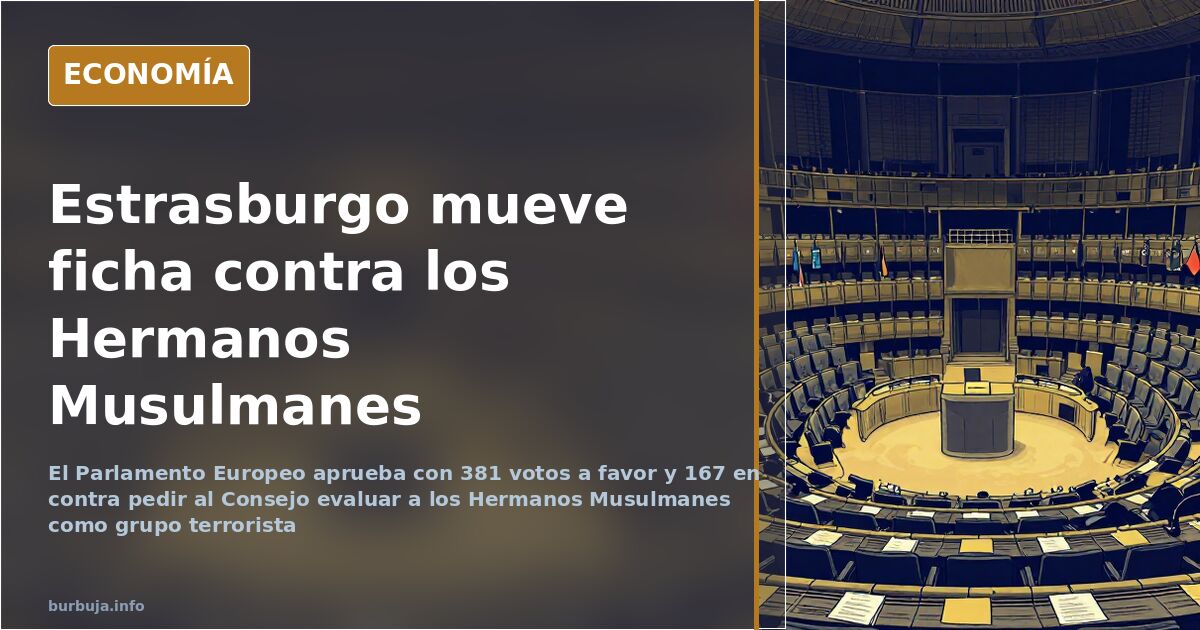
European Parliament calls for assessing the Muslim Brotherhood as a terrorist group
What exactly did the European Parliament vote on? It is not a ban: it is a non-binding resolution calling on the Council to assess and add entities and individuals linked to the Muslim Brotherhood to the EU's list of terrorist organisations. The text passed with 381 votes in favour and 167 against, according to the breakdown circulating. The difference between "calling for" and "deciding" is the whole story, and hardly anyone is telling it.
What it means when the European Parliament passes a non-binding resolution
The European Parliament has no power to place anyone on the EU's terrorist list. That authority belongs to the Council, which decides by unanimity or qualified majority depending on the applicable regime. What the Parliament has done is make a political declaration: it urges the Council to act. Anyone reading "the EU declares the Muslim Brotherhood terrorists" is getting the wrong institution and the wrong instrument.
The figure, though, is striking. 381 MEPs in favour versus 167 against is neither a technical tie nor a narrow majority. It is a sign that consensus in the chamber has shifted. The interesting question is not who won, but who lost and with what arguments.
Who voted against and why
Spain's left is in the spotlight. Some claim that the European socialists and the left to the left of the PSOE (Spain's Socialist Party) voted against, although the nominal breakdown is not settled in the available material. What is documented are the subsequent statements: Jaume Asens (Sumar) compared the Muslim Brotherhood with Opus Dei, and Juan Fernando López Aguilar (PSOE) warned that anyone wanting to stigmatise people for their faith "will find us in front of them, as we were when the Nancy went after the Jews".
The comparison with Opus Dei has an elementary problem: Opus Dei is not a political party, has never led insurrections and is not linked to the genealogy of international terrorism. One of the founders of the Muslim Brotherhood influenced Zawahiri, according to the historical reconstruction cited. Comparing a religious order with an organisation that has a political wing and an armed wing is not a nuance, it is a different category altogether.
The Sortu precedent and the suspicion of double standards
The comparison with the Basque case comes up quickly. Herri Batasuna was banned, then came Sortu, and later EH Bildu. The suspicion that the bar is applied unevenly depending on who is on the other side runs through much of the discontent. It is not a settled legal argument, but it is a political intuition that explains why the resolution has gone down well across a broad spectrum.
In parallel, some recall that when more than 400 MEPs voted in favour of the deportation centres, the left blamed the far right. Now, with an even larger majority, the label being thrown around is Sarracinophobia. The narrative changes depending on the outcome.
What the text does not say
The resolution bans nothing, closes no mosques, expels no one and does not change the legal status of any specific entity. It opens an assessment process. The Council may take months, may add no one, or may add only part of the list. Anyone claiming that "the EU has already banned the Muslim Brotherhood" is jumping ahead to a result that does not exist.
And there lies the subtle irony: a vote that changes nothing legally has changed the political map quite a bit. Majorities shift in resolutions before they do in regulations. When the regulation arrives, if it arrives, the debate will already have been settled.
Also available in: Deutsch
Summary of a discussion on Burbuja.info - Foro de economía, actualidad y política., translated from Spanish and reviewed before publication. Read the full discussion (21 replies).
More summaries
-
EU Parliament Query Claims AEMET Staff Admitted Weather Manipulation
An EU parliamentary question alleges four Spanish meteorologists admitted to manipulating DANA storms, but the Commission finds no evidence.
-
Sánchez Halts EU Summit for Energy Break to Force Pause
Sánchez leaves the European Council in Brussels after Germany and the Netherlands blocked Spain's energy proposal, pausing the summit.
-
Polish MEP Korwin-Mikke Speaks English; Spanish Counterpart Does Not
Polish politician claims women are less intelligent. A Spanish MEP's non-verbal response highlights language barriers in the European Parliament.
-
Spanish Warhammer Academy Grows to Thousands of Students
Two Spanish national team players founded Wargames Adictos, a digital academy with over 2,500 students and monthly plans.
-
PHPocalypse: chained PHP flaws leave 70% of the web exposed
Two chained PHP vulnerabilities, rated CVSS 9.2, allow remote code execution on WordPress and Drupal. The flawed code had been in the repository for a decade.
-
Porsche cuts 500 jobs and pulls back from electric vehicles
Porsche is cutting 500 jobs in its battery and software units and stepping back from the electric car: demand for luxury EVs is not taking off. Data analysis and industry views.