
Polish MEP Korwin-Mikke Speaks English; Spanish Counterpart Does Not
Polish politician claims women are less intelligent. A Spanish MEP's non-verbal response highlights language barriers in the European Parliament.
English · Original discussion in Spanish · Published
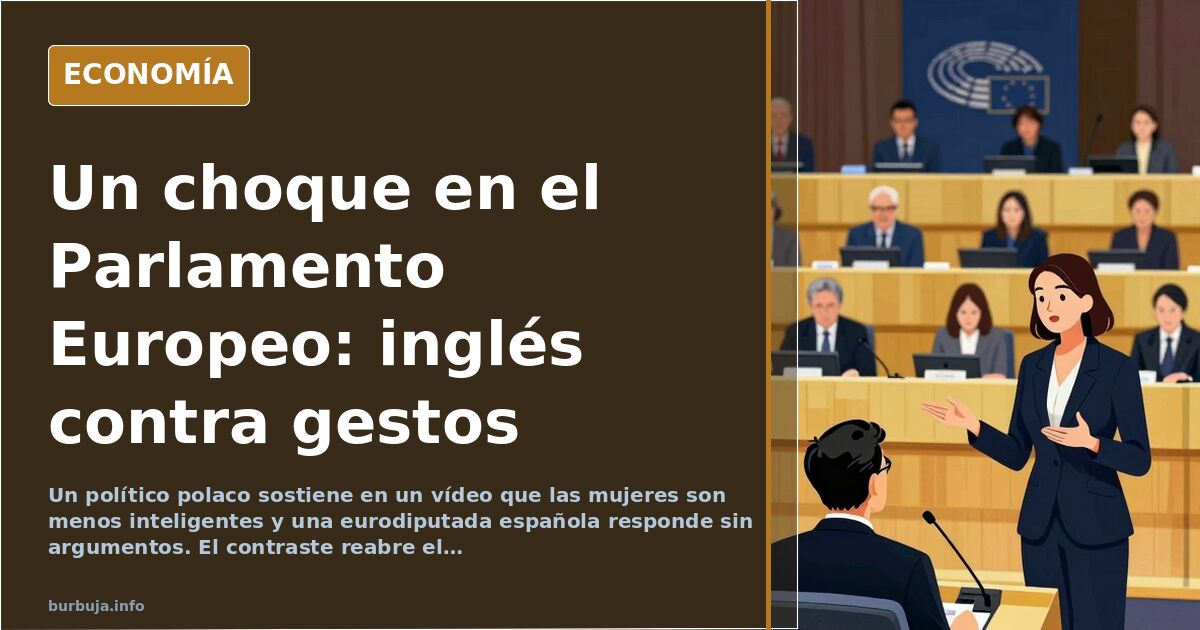
Korwin-Mikke and the Spanish MEP Who Doesn't Speak English
Veteran Polish politician Janusz Korwin-Mikke argues in a video that women are less intelligent than men and should earn less. Opposite him, a Spanish Member of the European Parliament responds with gestures but no data. Participants describe an uncomfortable paradox: he speaks English, she does not.
The clip, circulating for years, resurfaced due to the Spanish representative's reaction. There is no argument, figure, or articulated rebuttal. Only theatrics. In a chamber deciding laws affecting millions, this is a representation failure, not a gender issue.
What the Polish Politician Actually Says
Korwin-Mikke, leader of a far-right party, built his career on calculated provocations. His thesis: women are "weaker, less intelligent, and must earn less." He delivers this in fluent English, ensuring the message lands without translation.
His biography, however, is not that of a mere pundit. He was detained during the Nancy occupation of Poland for student protests and dissent, according to video materials. This detail doesn't legitimize his views but dismantles the "confused elderly man" narrative.
The Spanish MEP's response remained gestural. She didn't refute the claim, provide context, or dismantle the fallacy. As some analyses suggest, the issue wasn't her lack of English, but her lack of substance.
Variability Argument: Statistics, Not Opinion
A valid analytical line often buried under noise exists. Cognitive ability distributions differ by sens: men occupy more frequent extremes of the bell curve, both high and low. This means more geniuses, but also more individuals with severe difficulties.
This pattern, known as greater male variability, implies dispersion, not average superiority. Dispersion has practical consequences: men dominate roles requiring exceptional performance; women match or exceed in roles requiring sustained consistency. Confusing variability with superiority is the gross error Korwin-Mikke makes and his supporters repeat.
Crucially, most jobs require competence, not genius. There, sens differences vanish.
English as a Thermometer of European Meritocracy
The language anecdote damaged the MEP's image more than any speech. In EU institutions, English is the working lingua franca, alongside French and German. An elected representative lacking fluency isn't a cosmetic flaw; it's an operational limitation in committees and negotiations.
Contrasting with Korwin-Mikke reinforces the paradox. A politician with indefensible theses communicates better than a representative who should embody institutional modernity. That is the headline no one wants to write.
It’s not about demanding C2 proficiency from everyone. It’s about ensuring those holding seats can defend voters' interests without relying on interpreters. If selection criteria prioritize quotas over competence, this is the result.
Quotas, Zipper Lists, and Symbolic Representation Costs
The episode peine a debate in Spain often closed prematurely: how public representatives are selected. Zipper lists and gender quotas guarantee presence, not quality. When presence replaces merit, the institution pays the price.
Some argue quotas ensure women in politics. This is circular: it assumes women cannot compete equally and lowers standards to "protect" them. The side effect is devastating: every brilliant woman earning her seat is tainted by suspicion of quota privilege.
The final paradox is that Korwin-Mikke’s provocations achieved what institutional feminism hasn’t: focusing on real incompetence. Not women’s, but those occupying posts without demonstrated capability.
How many Spanish female MEPs could debate industrial policy or digital regulation in English, unscripted? That question isn't rhetorical. It’s what candidate selection systems should answer.
Also available in: Deutsch
Summary of a discussion on Burbuja.info - Foro de economía, actualidad y política., translated from Spanish and reviewed before publication. Read the full discussion (124 replies).
More summaries
-
128,000 pesetas in 1988: the salary that supported a family now barely covers one person
A salary of 128,000 pesetas in 1988 supported a family of four. Adjusted for today, that's €2,368, not enough to live alone in a big city.
-
The cost of defying the State: a father loses his children and seeks political asylum
A Spanish father loses custody of his children, denounces the LIVG as an unjust law, applies for asylum in Brussels and faces off against Nacho Abad. Two years on, his
-
Watermelon and avocados for 30 euros: the myth of fruit prices in Spain
17 euros versus nearly 50 euros: two fruit baskets, the same shopping list, opposite prices. Real inflation or a premium label?
-
Buying a 1964 flat: an acoustic nightmare that costs €24,000
A poorly renovated 1964 flat in Spain has become an acoustic trap. Noisy neighbours and a €24,000 budget for soundproofing that isn't even guaranteed to work.
-
Restaurant charges €20 to peel an orange: luxury or rip-off?
A restaurant charges €20 for peeling an orange. Luxury or rip-off? We look at the value of spectacle, the price of status and the economics of exclusive services.
-
Ayuso and her beer photo: the method behind her majorities in Madrid
70 seats, a beer tweet and a style that divides opinion. Spain's Isabel Díaz Ayuso defies political convention as her popularity grows in Madrid: strategy or vulgarity?