
Europe and savings control: the 1933 precedent
The EU is studying ways to channel savings into investments. Confiscation or mere management? The 1933 precedent and the alternatives savers are considering.
English · Original discussion in Spanish · Published
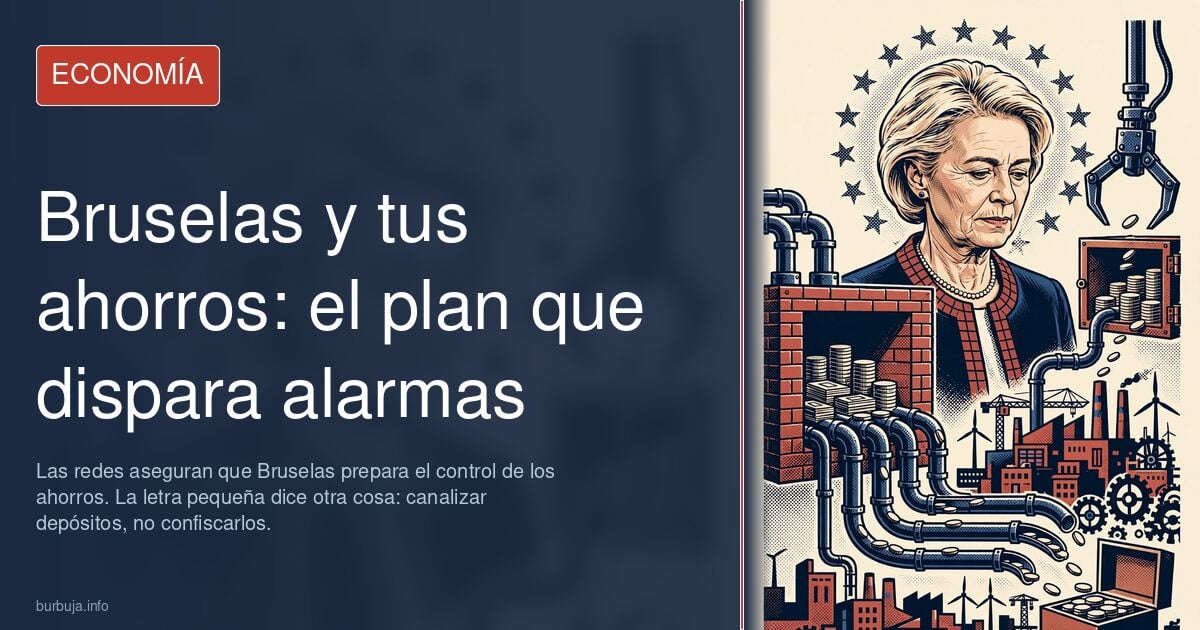
Brussels' plan for your savings: control or mere management?
Will Brussels dare to touch your savings? The question is echoing after Ursula von der Leyen's statements about the need to invest more and the alleged control of European savings. A tweet from Podemos in Europe has lit the fuse: the Commission President earns more than €31,000 a month and has lived off politics for 27 years, while asking citizens to put their money to work. But how much truth is there in the threat of confiscation?
The 1933 precedent: when the US confiscated gold
Recent history offers an uncomfortable parallel. In 1933, President Franklin D. Roosevelt signed Executive Order 6102, which required US citizens to hand over all gold coins and certificates to the Federal Reserve, with an exception of $100 (about five ounces). The deadline was May 1 and the penalty was severe: a $10,000 fine or ten years in prison, or both. The Treasury paid for that gold at $20.67 an ounce, a price it later devalued. It was not a total confiscation, but it was an iron grip on a safe-haven asset. Those who remember this episode see a disturbing echo in Von der Leyen's words.
Two readings: confiscation or channeling?
Interpretations are divided. One camp argues that the EU has no intention of touching individual deposits, but rather of channeling the money banks already manage into productive investments. Under this view, a saver with €10,000 in their account would not see their balance reduced; the bank would simply allocate those funds to European projects. A more alarmist reading points to forced investment: citizens would have to place their savings in financial products chosen by Brussels, such as debt funds or European stocks, with tax incentives that would later be withdrawn. At the extreme, there is talk of capital controls and financial repression, with restrictions on opening accounts outside Europe.
Alternatives: gold, silver, property or blockchain
Faced with the uncertainty, savers are looking for shelter. Gold and silver are once again being mentioned as safe assets, although some point out that owning them could also be regulated. Housing, the classic Spanish safe haven, is presented as an illiquid but tangible asset. Others are betting on bitcoin and blockchain, arguing that they escape state control. There is no shortage of those who, ironically, suggest going into debt so as not to have savings to confiscate. The underlying question is whether individual savings will remain a right or become a tool of economic policy.
Meanwhile, the average saver keeps looking at their account and wondering whether the next move will be theirs or Brussels'. History, as always, offers no free lessons.
Also available in: Deutsch
Summary of a discussion on Burbuja.info - Foro de economía, actualidad y política., translated from Spanish and reviewed before publication. Read the full discussion (74 replies).
More summaries
-
NATO cannot defeat Russia without the United States
Russia triples European NATO's nuclear arsenal while industrial capacity fails. Without the US, the Alliance is hollow.
-
Partner of PSOE spokesperson holds 30 properties and two Panamanian companies
The PSOE (Spanish Socialist Workers' Party) spokesperson, Montse Mínguez, and her partner reportedly own 30 rental properties and two companies in Panama.
-
Watermelon and avocados for 30 euros: the myth of fruit prices in Spain
17 euros versus nearly 50 euros: two fruit baskets, the same shopping list, opposite prices. Real inflation or a premium label?
-
Buying a 1964 flat: an acoustic nightmare that costs €24,000
A poorly renovated 1964 flat in Spain has become an acoustic trap. Noisy neighbours and a €24,000 budget for soundproofing that isn't even guaranteed to work.
-
Milei's Argentina: fewer medicines in the shopping basket
A video shows an Argentine woman buying two medicines instead of four. Is it propaganda or a reflection of Milei's austerity? Data and analysis.
-
The penalty fueling conspiracy theories: who really wins from a World Cup?
The controversial Spain vs France penalty at the World Cup has sparked conspiracy theories pointing to economic interests and globalist smokescreens.