
Europa, the Phoenician princess who gave the continent its name
The name Europe comes from a Phoenician princess abducted by Zeus in the form of a bull. The paradox of a continent named by a Semitic woman and symbolized by a...
English · Original discussion in Spanish · Published
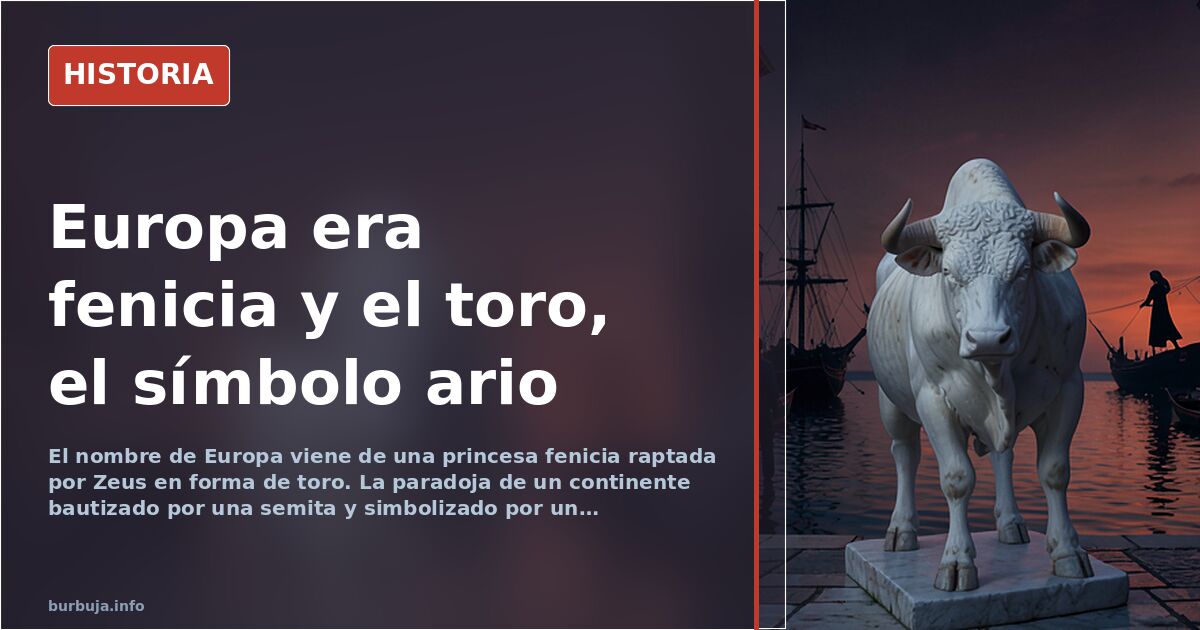
Europa was a Phoenician princess and the bull, the Aryan animal par excellence
The name of the richest continent on the planet comes from a woman who, according to the mythological account recorded by Apollodorus, was the daughter of a Phoenician king and was abducted by Zeus transformed into a white bull. The paradox is no small one: the Europe that today claims to be the cradle of Western civilization owes its baptism to a princess of Semitic origin who swam on the back of an ox to Crete, where she gave birth to Minos, Sarpedon and Rhadamanthus.
Etymology does not solve the mystery either. The name has been translated as "wide-eyed", a lunar epithet, or "far-voiced", a correlate of the ancient Zeus Euríopes. The philologist A. F. Losev places her cult in the pre-Greek strata of northern Greece and Asia Minor, and links her to the chthonic deities: in Sidon she was indistinguishable from Selene and Astarte. A deity of the earth and fertility, not an ordinary matriarch.
The bull as a symbol of the Iberian Peninsula
The animal that kidnaps the princess is the same one that structures the iconography of half a continent. The bull represented strength, the fertility of the land and the domestication of livestock, and milk and its derivatives —cheeses, yogurts, ferments— became the daily sustenance that allowed entire populations to survive in times of poor harvests. The leap from hunters to herders allowed the ancient Europeans to settle and prosper.
Hence the myth leaps to the sky: after the abduction, the white bull is raised by Zeus to become a constellation. And hence also the discomfort of certain contemporary readings that want to see bullfighting as a custom foreign to Europe. The symmetry is exactly the reverse: the princess who gives the continent its name is Semitic and the bull is the totemic animal of ancient Europe, present since the Bronze Age and earlier throughout the continent, from the frescoes of Crete to the primordial cow that freed the first Norse god from the ice.
The sacrifice of the bull and the Mithraic heritage
There is a second reading, less kind to the animal. In the heroic tradition the bull is defeated: Theseus defeats the minotaur of Crete and bullfighting reproduces that scheme, with the bullfighter in the role of the hero who subdues the beast. The tradition has its roots in the Mithraic religion, widespread among the military of late Rome, where the sacrifice of the bull was the center of the rite. The bull must die so that we may all live, the formula sums up.
The myth, therefore, is not univocal. Fertility and sacrifice, abduction and constellation, chthonic goddess and subdued beast. The Phoenician princess who named the continent carries all those layers and a question that remains open: which part of that heritage is claimed and which part is preferred to be forgotten?
Also available in: Deutsch
Summary of a discussion on Burbuja.info - Foro de economía, actualidad y política., translated from Spanish and reviewed before publication. Read the full discussion (19 replies).
More summaries
-
Is Your Desire for Justice Sinful? (Father Spyridon)
Father Spyridon argues that human justice demands punishment while divine justice calls for forgiveness. A look at the parable of the ungrateful servant and at meekness.
-
The European Cup nostalgia that the Champions League can't buy
The pure knockout European Cup has been replaced by a format that rewards teams that don't win their league. The debate over football as a business.
-
Iberian genetics aren't a color-coded map: R1b and the 10% non-European share
Haplogroup R1b is the most common in Spain, but it only describes a paternal line. Iberian genetics are a mosaic of migrations, not a certificate of purity.
-
ETA and GAL: two arms of the same Gladio network in Spain
Investigation linking ETA and GAL as arms of the same NATO Gladio network, with drug trafficking funding and CIA control.
-
Lenin embalmed: the body as a symbol of victory over death
The essay The Immortalization Commission documents how the Bolsheviks embalmed Lenin to prove that science could conquer death and to replace traditional religion with…
-
Roman soldier stabbed to death in a well was 1.90 m tall
A 1.90 m Roman soldier was found stabbed in a well at Velsen in 1977; isotope analysis places his childhood in southern Europe